When You Become a Different Person

Who were you 10 years ago? Have you changed in the last 5 years? How about the past year?

Each year—each day!—we’re a little different person than we used to be.

Think about how many experiences you’ve had just this past month. How many conversations. How many steps and rests and breaths.

Life changes us.

With big life changes, we change even quicker.

But even in ordinary, everyday moments, we are stirred and transformed, with every thought and activity.

Growing pains are uncomfortable, if not downright painful and unwanted. 

But be thankful for expansion, maturation, and progress.

Even when it hurts.

Image: When you become a different person

Have you noticed changes in yourself? Share your thoughts in the comments.


Wait, What? Should We Add “Thoughts and Prayers” to the 2022 Banished Words List?

Lists are compiled every year of worn-out words. Would you add “thoughts and prayers” to the list?

Is It Cliché to Say Cliché?

Why say something worn out when you can say something fresh?

I’m ASKING FOR A FRIEND. (Phrases in ALL CAPS are words from the list of misused and overused Banished Words for 2022.)

I can tell you one reason why we stick with clichés:

Because clichés are easy.

It’s hard to think of new ways to say things.
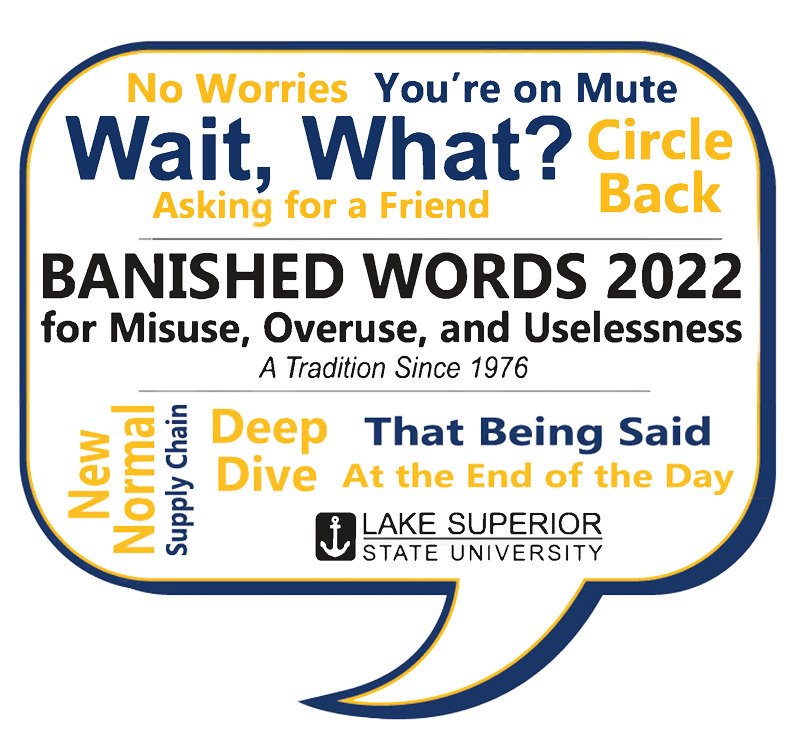
Image: 2022 Banished Words List

What About “Thoughts and Prayers”?

Let’s take a DEEP DIVE into the current controversy over the phrase “thoughts and prayers.”

Should “thoughts and prayers” be on the banished words list, too?

For many people, sending “thoughts and prayers” is sending a gift of attention and faith so God will work wonders.

It’s their gift of NO WORRIES to the recipient.

THAT BEING SAID, to many other people, hearing “thoughts and prayers” means the person praying is done, with no plans to actually help in person themself.

To the receiver, “thoughts and prayers” sounds like a shortcut, a cop-out, a sidestepping of responsibility. They want to scream, “YOU’RE ON MUTE.”

WAIT, WHAT? So am I suggesting we should stop sending “thoughts and prayers“?

A Deeper Dive

Let’s look at it from both sides.

One Side:

As a believer myself, I trust God listens to my prayers.

God wants me to share my heart’s desires and needs. I ask God for help. My prayers naturally include my concern for others. I want my friends to receive help, too.

The Other Side:

But also as a Christian, even I tire of hearing myself say and hearing others tell me “I’m praying for you.”

Especially if what someone (and myself) really needs is an answer to prayer: a human being in the flesh sent by God to offer a helping hand or a listening ear or a shared meal.

In other words, we often need for someone to be the embodied answer to the prayer.

But does it have to be either/or? Either pray or else do something?

Can it be both/and? Both pray and do something?

Maybe we can keep the SUPPLY CHAIN from breaking if we combine “thoughts and prayers” with words and deeds.

If possible, can we allow our actions to speak louder than our clichés?

Our New Normal

Maybe our NEW NORMAL might be to not only say, “I’m sending thoughts and prayers,” but also do this: back up those thoughts and prayers, when possible, with something tangible.

  • Maybe that’s a hug.
  • Or a word of encouragement.
  • Or an offer to babysit.
  • Or a call to a legislator.
  • Or a closer listen.
  • Or a donation to the cause.

When I commit to pray for someone, optimally I also commit myself to be the embodied answer to that prayer, in whatever way God shows me.

“God, show me what I can do to help you help my friend.”

I don’t want to toss all the work on God when God intends us to work together.

Partnering with God is invaluable.

Circle Back

Maybe we can’t cure our neighbor’s cancer or stop the war in Ukraine with our thoughts and prayers, but we can ask God to move us—to use us—to check in on our neighbor’s family or be kinder to an immigrant struggling with English in our line at the grocery store.

So to CIRCLE BACK, instead of only sending thoughts and prayers, let’s think of new phrases to say and actions to do alongside “I’ll be praying for you,” such as:

  • I’ll check on you again tomorrow to see what you need.
  • This is hard, so I won’t leave you alone in this.
  • Let’s talk together to sort things out.
  • I’ll watch with you for God to show us the next step.
  • Tell me again so I can better understand how you feel.

And here are some more:

Image: New Ways to Reframe I'll Pray for You

AT THE END OF THE DAY, thoughts and prayers themselves can’t be used too often.

But saying only “I’m sending thoughts and prayers” can be overdone.

I’m not ready to add “thoughts and prayers” to the banished words list.

Maybe we can use more thoughts and prayers to hear fresh ideas from God.

Then use more words and deeds to spread God’s love to others.


See all 10 words here from the Banished Words List for 2022.

What word or phrase do you think is overused? Share your thoughts in the comments.

More to Think About: 

You Can Keep It Short – And It Still Matters

I can’t get this out of my mind.

Ever since I read about the challenge allegedly put forth by Ernest Hemingway in the early 1900s—“I bet I can write a short story using only 6 words”—I’ve been impressed with his response.

Here it is:

“For sale: baby shoes, never worn.”

Hemingway won the $10 bet.

Image: You Can Keep It Short

It is a complete story.

We might each fill in the missing blanks with different details. But we all have either known of (or personally lived) this story.

A story, a life, a single act of kindness, need not be long to be memorable, powerful, or important. 

Each still matters.

What story are you living today?


Share in the comments.


On the Blog—July 2022

Here are brief summaries and links to posts on the blog, Lisa notes, in July 2022.

blank

See previous months’ archives here


Too Much to Do? Here’s My Strategy for Time Management

How’s Your Calendar?

During 2020 and 2021, many of us let go of some of our activities, either by choice or by necessity.

As an introvert who loves being at home, a leaner schedule felt freeing to me.

But as covid numbers declined in 2022, we began adding more back into our schedule.

And now? Has your calendar filled up again?

Mine is filling up. I’ve begun taking on new projects.

I admit, it feels a bit uncomfortable. Do I have time for more new things? Will I still have time for the old things? Do I need to give up something else to make room for it all?

Image: Too much to do? My strategy for time management

A Strategy for Time Management

In general, I use top-level questions to help guide me:

  • Which activities mostly closely match my values?
  • Which things are most meaningful to me?
  • Which things can only I do?

But after that, I need to more specifically organize the smaller details.

Here’s a strategy that helps me on a daily basis when I feel I have too much to do and not enough time to do it in.

1. Make a list

I list all the things I’d like to do today on a spreadsheet. It can be a little or a lot, unrealistic or probable. 

2. Rank each item

Then in a separate column beside each item, I rank each item with a number from 1-4. Quickly. I don’t want to waste more time by overthinking it.

1—I really must do this today
2—It would be best if I did this today
3—If there’s time leftover
4—Highly unlikely today

3. Sort by ranking

Then I let Excel sort the items, with all the 1s together, all the 2s underneath, the 3s under those, etc.

4. Plug into calendar

Next, I plug in all the #1 items into a time-appropriate slot on my computer calendar.

If there are still empty spots left, I add in the #2 items.

The #3 items don’t often make the calendar, but if there’s plenty of time, I’ll add them in, too.

The #4 items? Nah. I forget about them for today.

5. Work the calendar

Admittedly, actually doing the items is the hardest thing. 

A Meaningful Day

It’s not a perfect strategy.

But it usually works well enough to create a meaningful day. And it’s quick and easy (it took longer to type up this explanation than it does to actually do it).

Typically, if I work the list in the right order, I’ll at least get the top three items accomplished on my list. And I’ll know those were the most important ones.

Because distractions will come up. Distractions ALWAYS come up.

And that’s okay.

Every day is full of uncertainty. The more we can accept uncertainty, the more mentally healthy we are (I spent a whole year with UNCERTAINTY as my One Word in 2021, and I still struggle with it).

I want to manage my time with people ranked first (including my own needs), and projects second, but sometimes the lines get blurred because most of my projects also involve people on some level.

None of us manage our time perfectly.

But if we get to the end of a day and know this—we have loved someone and have been loved by someone—we can call it a good day.


Do you like schedules or do you prefer spontaneity? Share your thoughts in the comments.


10 Books I Recommend—July 2022

“Readers know…in their bones something we forget at our peril: that without books—indeed without literacy—the good society vanishes and barbarism triumphs.”
– Steve Wasserman

Here are 10 books I recommend from what I finished reading in July.

[See previously recommended books here]

Image: 10 Books I Recommend

NONFICTION

1. MWF Seeking BFF
My Yearlong Search For A New Best Friend
by Rachel Bertsche

Image: WMF Seeking BFF

This was a fun book recommended to me by my friend Ashley. The author set out to meet 52 new friends in one year in her new city of Chicago. She chronicles the different methods, different personalities, different struggles—and successes!—that she has over the year.

Making new friends as adults might take work, but it’s possible.

2. Reader, Come Home
The Reading Brain in a Digital World
by Maryanne Wolf

Image: Reader, Come Home

While not everyone reads books, they say the average person in the U.S. reads the equivalent of a novel everyday—much of it is just through screens. It’s changing our brains.

Bottom line: don’t do all your reading on screens. Don’t let your children do all their reading on screens.

3. Whole Brain Living
The Anatomy of Choice and the Four Characters That Drive Our Life
by Jill Bolte Taylor

Image: Whole Brain Living

Know your brain. After she recovered from a stroke, Dr. Taylor researched the Four Characters of our brain, including the “justice-demanding judgment of the dominating left brain (Characters 1 and 2) and the merciful characters of our compassionate right brain (Characters 3 and 4).”

This is an interesting book with practical takeaways.

4. Do the Work!
An Antiracist Activity Book
by W. Kamau Bell, Kate Schatz

Image: Do the Work!

This is a very interactive, thought-provoking book designed to get us moving to dismantle white supremacy. 

[Read my full review here, Is This Your Work to Do?]

5. Finding God in the Waves
How I Lost My Faith and Found It Again Through Science
by Mike McHargue

Image: Finding God in the Waves

This is Science Mike’s story from six years ago. He chronicles his journey from Christianity to atheism and back to Christianity through science and an experience with God. He writes very personally (and sometimes very scientifically). I enjoyed it all.

6. Cringeworthy
A Theory of Awkwardness
by Melissa Dahl

Image: Cringeworthy

Do you ever feel awkward? This book is a fascinating look behind the psychology of awkwardness. It’s funny. It’s relatable.

“The best way to be comfortable with that part of yourself again is to share the awkwardness with someone else. It’s the choice between contemptuous cringing and compassionate cringing, but directed toward yourself. You bring back the pushed-away piece of you.”

7. Write for Your Life
by Anna Quindlen

Image: Write for Your Life

You likely already know if you like to write or not. If you do, you’ll enjoy this soothing book about reasons to keep writing. If you don’t like writing, you’d still benefit by Anna Quindlen’s advice on learning more about yourself through your written words. 

“We are all made of nouns, live by verbs, enlarge and entertain ourselves with adjectives and adverbs.”

8. Jesus Unbound
Liberating the Word of God from the Bible

by Keith Giles

Image: Jesus Unbound

I often wonder if some Christians worship the Bible more than they worship Christ. This book addresses that.

“Why does any of this matter? Here’s why: because the apostles wanted us to understand that it was important to have a relationship with a person named Jesus, not with a book that they were still in the process of writing down.
Jesus even warns us not to fall in love with a book, not even with the Scriptures (John 5:39-40).”

FICTION

9. All That Fills Us
by Autumn Lytle

Image: All That Fills Us

I don’t know much about eating disorders. But I learned a little more by reading this novel.

Written by a recovering anorexic and exercise addict, I heard through the main character Mel Ellis how devastating anorexia can feel, both physically and mentally. The plot is a little thin for me (Mel decides on a whim to hike from Michigan to Mt. Rainier in Washington, all alone with no preparations), but the action moves forward at a rapid enough pace to keep me interested. (I received this book from NetGalley for review.)

10. Run, Rose, Run
by Dolly Parton, James Patterson

Image: Run, Rose, Run

Dolly Parton co-wrote this novel about an aspiring young singer/songwriter in Nashville who is being mentored by a famous older female star (in the audiobook, Dolly reads this part). It was a fun book to read and to listen to. 

READING NOW

  • Apples Never Fall
    by Liane Moriarty
  • Necessary Losses
    The Loves Illusions Dependencies and Impossible Expectations That All of Us Have
    by Judith Viorst
  • I Guess I Haven’t Learned That Yet
    Discovering New Ways of Living When the Old Ways Stop Working
    by Shauna Niequist
  • Sins of the Tribe
    by Mark. A. Salter
  • WayMaker
    Finding the Way to the Life You’ve Always Dreamed Of
    by Ann Voskamp

What good book are YOU reading this month? Please share in the comments.

More books I recommend