God unplugged

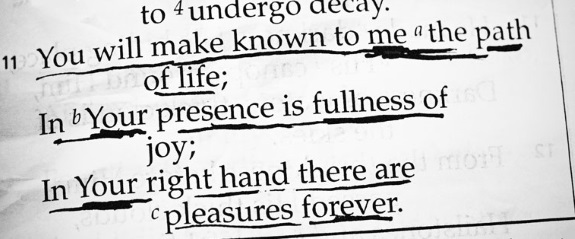
Psalm_16_11

I looked at the clock. 3:35 a.m.

It was too early to be awake.

But the clock didn’t shine long. Suddenly everything went black. All electricity had shut down.

My mind raced to the morning’s agenda. It was Sunday. That meant getting up early to shower, eat pancakes, then head to choir practice before worship services began.

But with no electricity, I’d take a cold shower and keep wet hair. And forget the pancakes. And would we even have church? Their power supply was the same as ours.

I drifted in and out of sleep, weighing pros and cons of possible plans.

In the end, it didn’t matter. The electricity came back on, just in time for me to get up and start the day (with pancakes).

At church that morning, Pastor Mark admitted similar turmoil over contingency plans if the electricity hadn’t returned.

But he’d concluded it wouldn’t matter.

Because the presence of the Lord isn’t dependent upon our creature comforts. Jesus always shows up wherever and whenever his believers do.

And to prove the point, during the middle of morning worship, he had all the lights turned off. The musical instruments shut down. The place was silent.

And God was present. His Spirit was thick. As always.

Lesson learned.

Until yesterday.

Another Sunday. I woke up, got ready (but no pancakes since Jeff the pancake man was sick), and left for choir practice.

But walking into the church building, I noticed it was dark. No electricity. Two Sundays in a row, we’d lost power. Jeff texted me, confirming the same just happened at our house.

This time the electricity did not come back on before services began. Instead, we lit 50 candles, rallied the acoustic guitarists, and welcomed Holy Spirit among us.

It was a beautiful service. With or without electricity . . .

  • We had Power.
  • We had Light.
  • We had Heat.

At the end of the service, with eyes closed and heads bowed, Pastor Mark invited those who didn’t know Jesus, to get to know him.

And the power clicked. The lights came on. At just that moment. (I know that sounds corny or made up, but maybe God really wanted to drive home his point? I just know it’s what happened.)

New Power. Fresh Light. Restored Heat.

It’s the climate I want to stay in. This now of God’s presence that permeates our atmosphere.

Because plugged or unplugged, the Lord stays on.

God-unplugged

* * *

Have you had a cool experience with God lately? Please share in the comments.


Light on dark

They were desperate.

Their drugs were all that mattered.
They didn’t want to waste a single rock.

So the contrast had to be sharp. They ripped all the carpets out of the room. And painted the floor black.

When they dropped the white, it’d show up best on black.

Bobby Hayden was telling his story in the chapel at the Rescue Mission.

. . . to men and women who understood—the homeless, the hopeless, the drug addicts—the ones trying to break free.

. . . and to men and women who wanted to understand more—the sheltered, the filled, the employed—the ones wanting to live even more free.

bobby-hayden-jr

I felt the outward contrast. Even though I was in blue jeans like many others, I knew I still stood out. My clothes weren’t dirty. My hair was washed. I drove up in a car; I would leave in one.

I didn’t know all that Bobby was talking about.

  • I’ve never been a rock star in L.A.
  • I’ve never looked for fresh veins to shoot heroine in. (Sugar is my self-medicating drug of choice, through the mouth.)
  • I’ve never spent even one night in a cardboard box, and certainly not ten years.

There’s a depth of darkness I’ve never seen.

But I do know the light Bobby talked about.

I wondered if the man on the third pew knew.  I watched him as Bobby spoke. He was a stone statue. His head was shrouded in a black hoodie. His heart was covered in a dingy flannel shirt.

He didn’t sing “I’ll Fly Away” when the others did. He didn’t lift a hand in praise. He didn’t sit close to friends.

He seemed dead.

Yet he’s the one. One that Jesus died for, still lives for. Jesus wants this man to see the contrast between dark and light.

As we say, Jesus didn’t come to make bad people good. He came to make dead people live.

He came to turn corpses of stone into breathers of life.

I don’t want to be another suit and tie on a Sunday morning pew, sitting quietly by another suit and tie.

I don’t want to settle comfortably between good and better.

I want to rip out the carpets so I’ll be a bright light to a dark world.

Alive. Not dead. That’s the biggest contrast. That’s the one Bobby discovered in Jesus. That’s the one he was testifying about.

That’s the one he was preaching to the man in the black hoodie. And to the woman in the silver necklace.

Jesus is light on dark. Rip out the carpets and see.

* * *

revised from the archives


What I’m into – March 2015

AROUND THE WEB

THINGS I LOVE

  • Reading through the gospels
    A 40-day plan on YouVersion leading to Easter
  • Before and After pics
    My extended family gathered one last time at my parents’ old house before we put it on the market. We recreated lots of before and after pics. Bittersweet moments! This one is of my two sisters Sandy and Elisabeth, me, my sister-in-law Bonnie, and her daughter Amanda—then and now.
    30-years-later
  • SNOW
    I wouldn’t love it all the time, but getting a foot of snow in Alabama is very rare and very beautiful! Jeff and our golden retriever had a great play day.
    alabama-snow-2015
  • Stop comparing yourself to others. Stay in your lane. I love this sermon by Robert Madu at my church last Sunday. Watch the video here. 

    Robert-Madu-but-me

  • Prepping for the next Bible memory challenge with Do Not Depart.
    Details coming soon. (Sneak preview: watch for a practical and inspiring chapter from the New Testament!) I loved memorizing Psalm 27 this winter with the lovelies at Do Not Depart.

WHAT I’M READING

  • Being Mortal: Medicine and What Matters in the End by Atul Gawande
    What a thought-provoking book! About aging and dying and how we can do better with both. Same author as The Checklist Manifesto, another wonderful book.
  • Middlemarch by George Eliot
    I hit the halfway mark. These slow-paced British classics are great leisure reading. It helps ease the pain of Downton Abbey being over again (but I SO enjoyed the finale!)
  • My 2-yr daily Bible reading plan has me in 1 Kings and 2 Chronicles this week in the Old Testament, and the end of Matthew and the middle of John in the New Testamentbible-reading-plan

ON THE BLOG

WHAT I’M LOOKING FORWARD TO

  • Reading to a Kindergarten class
    Jenna is letting me go to school with her! She’s interning in a Kindergarten class for her final semester at Auburn before graduating in May. She’s invited me to read a book to her class this week.
  • Outdoor Church this Saturday at Manna House
    They don’t have it in January and February because of the weather, so I’ll be happy to see some of my friends I haven’t seen in awhile.
  • Seeing these 2 new oaks
    They were planted at Toomer’s Corner in Auburn last month to replace the ones poisoned by an Alabama fan in 2010
    Auburn-oaks-at-toomers-corner

* * *

What are you looking forward to in March? Please share in the comments.

Linking at Leigh Kramer’s


Plant your seed of freedom

“Sometimes all it takes is for one person to start something good in your community. In your community, that person could be you.”
– Hester Bass, Seeds of Freedom

I slid into the folding chair only minutes before the speaker stood up to introduce the author of the day. An elderly white man already seated motioned me in; he was alone and didn’t mind sharing his row with me.

I looked around the room at the public library. Quite a mix of people had gathered on this Sunday afternoon.

  • In front of me was a mom with three young girls, each holding a copy of the book Seeds of Freedom.
  • To the right of me was an older black woman, once a school librarian, and now wanting to write her own book, tell her own stories.
  • Ahead and behind were more white people, black people, old people, young people.

We wanted to hear children’s author Hester Bass. Her latest book, Seeds of Freedom (a multi-award winner), centers on integration in the 1960s in Huntsville, Alabama, next door to my home town.

hester-bass

I didn’t even know the stories she told, sitting today in a public library that blacks wouldn’t have been allowed to use back then.

They were quiet stories overall. But they were sad stories.

They told of little girls not being able to try on Easter dresses in stores. Not allowed to try on shoes. They’d trace their feet at home, bring the tracing to the store, and purchase a shoe that roughly matched.

The stories were also of little 6-year-old Sonnie Hereford IV, walking to the all-white Fifth Avenue School with his daddy, the physician Dr. Sonnie Hereford, on a September morning in 1963, only to discover the Huntsville schools had been closed by then-Governor George Wallace rather than mix black and white children in the same schools.

sonnie-hereford-1963

I saw an older black gentleman in front of me wipe an eye.

And so did the white man beside me.

But the stories told were also of another day, a few days later on September 9, 1963, the day when Sonnie was allowed in school, becoming the first black child enrolled in a white public school in Alabama. Stories of how he made friends with other boys and girls. Stories of peaceful Civil Rights demonstrations around town. Stories of sit-ins at a lunch counter nearby that did not erupt into violence.

The stories didn’t match the ones that happened 50 years ago this week in Selma, Alabama, 3 hours further south. On March 7, 1965—otherwise known as Bloody Sunday—600 peaceful marchers were attacked by state troopers and officials as they were marching across the Edmund Pettus Bridge. (If you haven’t yet seen the movie Selma, go see it.)

People will gather in Selma again this weekend to remember that day and the days that followed. Including President Barack Obama and former President George W. Bush.

Listening to Hester Bass in the library now, I was thankful that Huntsville didn’t share a similar history of violence, even though discrimination occurred then and now in other ways, ways still painful and just as wrong.

At the end of Mrs. Bass’s speech and the reading of her book, she introduced two special guests: Sonny Hereford IV (now in his 50s) and his father Dr. Sonnie Hereford (in his 80s).

They stood and waved, the rest of us snapping our cameras and not knowing whether to laugh or cry from the weight of the moment.

sonnie-hereford_hester-bass

In the end, I saw more smiles than tears that day, from those old enough to remember the injustices first-hand, from those too young to understand at all, and from those like me, understanding more now about a time we didn’t understand at all as it happened.

Now I want us all to understand.
To keep moving forward against injustice.
To each plant a seed of freedom, wherever it—wherever we—may grow.

Lord, have mercy.

* * *

Do you have memories of integration? Discrimination? Let’s talk in the comments.

Related:


On the blog – February 2015


Simply open to God

We can’t often go away with God for a quiet spiritual retreat in a cabin.

But we can still experience the presence of God in our everyday lives. Simply Open walks us through it.

Simply-Open-by-Greg-Paul

Author Greg Paul gives these four steps to open up to God, to ourselves, and to others:

  • Releasing
  • Receiving
  • Becoming
  • Doing

He doesn’t lay out an elaborate, detailed plan to follow, but rather an intention:

“Here’s the truly wonderful thing: we don’t have to worry about making any of this happen. We need only the desire to become more open and enough intention to express this desire in the simplest of prayers—Open my eyes!—throughout the course of any normal day. The rest we can entrust to God.”

He suggests we use seven practical avenues for this journey: our five senses plus mind and heart. And this is the outline prayer we can offer for each avenue.

A Prayer for Openness
Lord, open me to release (what I have seen, what I have heard, …), that I may receive (so see you, so hear you, …), become (see myself through your eyes, become a listener, …), and do (truly see others, truly hear others, …).

Each chapter gives us examples and suggestions for being more open to God, using this prayer as a guideline for releasing, receiving, becoming, and doing. It’s simple, yet effective.

Some snippets from each section . . .

1. SEEING (Open my eyes)

“Here is a way that I may actively choose to see God: by gazing unflinchingly at—by beholding—those in my world from whom others hide their faces.”

2. HEARING (Open my ears)

The author notes that the Bible is, of course, the most reliable source for hearing the voice of God. But because there are thousands of books already written on that, he focuses here on the contemplative practice of hearing God.

“Truly hearing the voice of God is never an exclusively individual matter. Our Western culture has elevated individualism almost to the status of a religion, often asserting the rights of the individual over the welfare of the community. But God, the Triune God, is the original community; he never acts only for the individual. Listening to God always leads to listening to others.”

3. INHALING (Open my nostrils)

Surely we’ve all had these kinds of encounters that Greg Paul shares about a casual (but holy) encounter he had with his friend Sue.

“We had only a few moments to speak, and neither of us said anything even remotely profound. And yet, I walked away feeling that the Holy Spirit had breathed on me. Sue would laugh and shake her head at that. I would dearly love to be that kind of presence in the lives of others.”

4. TASTING (Open my mouth)

“Perhaps instead we should be worshipping by sharing our food with people who are hungry. Perhaps we should be using our mouths to speak up for those who are oppressed and finding ways of helping them speak for themselves. Perhaps we should be speaking words of blessing and affirmation to people whose lives are messed up—we won’t have to look far to find them! We could open our mouths to welcome in the ones who are always left out, calling them brothers and sisters. This would be a generous openness!”

5. TOUCHING (Open my hands)

“Consider four general aspects of our lives where we need to open our hands and release our grip: our certainties, agendas, accomplishments, and possessions. . . .

When we cling to our certainties, we are closed to the gifts others may hand us—new perspectives, approaches, abilities, modes of doing or being. . . .

We are driven by our addiction to more and have lost our capacity to be joyfully content with enough. As long as those of us who already have more than we need continue to demand still more, those who do not have enough will never have what they need.”

6. UNDERSTANDING (Open my mind)

“Here’s the curious thing: the more I have come to know God experientially—the way Paul spoke of knowing the power of resurrection—the less I’m sure I really understand about God factually. To put it another way, the more I loosen my grip on my restrictive understanding about God, the bigger, fuller, wilder, more loving and gracious he seems to become. There is tremendous freedom in this. The more we open our minds, the more he fills them up. It’s like cleaning the junk out of a disused room so that it can become a space for living.”

7. LOVING (Open my heart)

“More than any other thing we do, loving defines us as being human. The act of loving deepens and strengthens our humanity; it does so because it deepens and strengthens our likeness to God. The capacity to love is the seed of the Divine within us.”

It’s not a straight line, this movement along these seven paths to open to God. As we cycle through releasing, receiving, becoming, and doing, we may meander a bit.

But if we remain open to the Lord’s leading, we can trust that God will “provide a path deeper into the great mystery” of who he is and who we are in him.

“We cannot contain; we can only be open.”

* * *

Thanks to Thomas Nelson for my review copy of this book.