On the Blog—January 2021

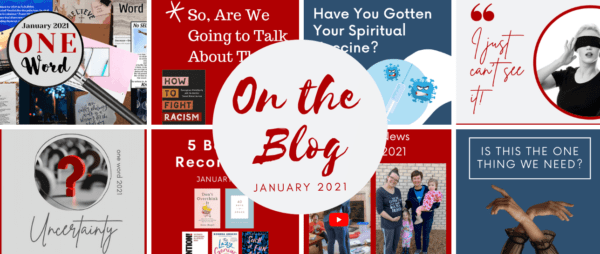
Here are brief summaries and links to blog posts from January 2021.


When You Think You Can’t Say No
—Grace & Truth Linkup

I can’t say no to that. To her. To him. 

I have to say yes. Isn’t that what good Christians do?

We often chain ourselves to “yes” because we want to make everyone happy. We think we can’t refuse an opportunity.

But Leslie Newman reminds us in our featured post this week that it’s okay to flip our “I can’t say no” to “Actually, I can.” I can say no. 

And once we say “I can,” we are freed to do the more specific things God has called us to do. We can release our need to please people because we want to please God.

When we learn to stop saying, “I can’t say no” to people, we can say, “Actually, I can” more often to God.

Read all of Leslie’s post here at her blog, then link up your own blog posts below.

“How to Release the Need to Please“

blank

Thanks for sharing, Leslie! Here’s a button for your blog.

blank


Grace and Truth_Rules

1. Share 1 or 2 of your most recent CHRISTIAN LIVING posts. (No DIY, crafts, recipes, or inappropriate articles.) All links are randomly sorted.

2. Comment on 1 or 2 other links. Grace & Truth linkup encourages community.   

3. Every host features one entry from the previous week. To be featured, include this button or link back here on your post (mandatory to be featured, but not to participate).

Grace Truth_Button

4. If you need help, watch these videos: “What is a link-up?” and “How to link up.” 

blank blank

Grace and Truth_Meet Hosts

We encourage you to follow our hosts on their blogs or social media.

MAREE DEE – Embracing the Unexpected
Blog | Facebook | Twitter | Instagram | Pinterest

HEATHER HART & VALERIE RIESE – Candidly Christian
Blog | Facebook | Twitter | Instagram | Pinterest

LAUREN SPARKS
Blog | Facebook | Twitter | Instagram | Pinterest

LISA BURGESS – Lisa notes
Blog | Facebook | Twitter | Instagram | Pinterest

Now Let’s Link Up!

You are invited to the Inlinkz link party!

Click here to enter

Do you struggle with people-pleasing? Share your thoughts in the comments.


Share Four Somethings—January 2021

I’m jumping on the “Share Four Somethings” bandwagon this month hosted by Heather.

SOMETHING LOVED

  • Wireless Sleep Headphones

Wireless Sleep Headphones

I often listen to podcasts in bed when I have trouble sleeping. But that means I can get tangled up in earbud cords the rest of the night if I don’t put them back on the nightstand before I fall asleep again.

So for Christmas my daughter Jenna gave me this new invention (to me) to try out. It’s wireless sleep headphones. And they work! Plus, they also double as an eye mask. I don’t use them every night, but when I do use them, they work wonderfully.

SOMETHING READ 

  • Invisible Women

“Is women’s unpaid work under valued because we don’t see it – or is it invisible because we don’t value it?”
– Caroline Criado Perez

Hmm. . . .

I’ve been reading a most fascinating book this month, Invisible Women: Data Bias in a World Designed for Men by Caroline Criado Perez. Each chapter shows a different way in which we default to “male” as normal and “female” as atypical in health care, politics, the workplace, etc.

The above quote is about work from Chapter 3, The Long Friday. It also includes this: “Husbands create an extra seven hours of housework a week for women.” True or not? I’d rather not comment. lol.

SOMETHING TREASURED

  • One Line a Day Journal

one line a day journal

I started keeping a five-year memory book, “One-Line-a-Day,” on January 1, 2011. I filled it up. Five years later, I started writing in “A Thought a Day” from January 1, 2016-December 31, 2020. So this January 1, 2021, I started my third one-line journal (and I keep buying larger ones as my eyesight gets worse).

Sometimes it’s a hassle to write something down, but I absolutely love being able to flip back through the years and see what we were doing on any given day. It’s also come in handy when I’m trying to remember the name of a restaurant we went to or when we last went to the beach, etc. (Both of those memories are getting more and more distant.)

Previous memories on this day, January 28:

  • 2011: Jenna drove herself to Friday classes today for the first time! And the check engine light came on. Morgan coming in tonight from Auburn.
  • 2016: 1 week since gall bladder surgery. All well. Doc said do what I feel like.
  • 2020: School for math games then library duty. Jeff cooked chicken & dumplings for supper.

Rarely is it anything earth-shattering (and rarely only one sentence), but they are still treasured memories of ordinary life.

I also continue to keep track with my one-second video each day.


SOMETHING AHEAD

  • 3-Year-Old Birthday Party

I won’t have to wait long for this. Saturday afternoon is our oldest granddaughter’s 3rd birthday party! The most memorable thing opened at her 2-year-old party was a birthday card that played music; the gift is forgotten. The party will be quite different this year because of the pandemic, but I doubt she will notice the difference. Gifts and cake and full attention from a few of us is party enough.


previous Favorite 5’s


Are You Lazy or Genius?
—Review of "The Lazy Genius Way"

Do you ever think you are lazy? When there are certain tasks that I continually put off, I can accuse myself of laziness.

But maybe it’s just that those things don’t really matter to me?

In The Lazy Genius Way, Kendra Adachi shows us it’s okay to be “lazy” about the things that don’t matter.

And for the things that do matter? Find a way to be a genius.

“Telling yourself you’re better than someone is just as harmful as telling yourself you’re worse. . . .
Remember, it’s not all lazy or all genius. You get to choose.”

I love the simplicity and organization of this book. Kendra gives us 13 Lazy Genius Principles (along with a healthy dose of humor). She explains each principle and gives examples, then ends each chapter with a recap, plus “One Small Step.” (She knows how we are.)

blank

For example, the Lazy Genius Principle #3 is “Ask the magic question.”

“The Magic Question, put simply, is this: What can I do now to make life easier later?“

Kendra suggests we tend to the necessary before it becomes urgent. For her, the after-school schedule was chaotic. So to make life easier later, BEFORE she picks up her kids from school, she throws whatever food she has on a big plate and sets it on the kitchen table. When she arrives home later with her kids, there are no arguments about what to eat.

Another example is what to cook for supper. Even putting a pot of water on the stove in the early afternoon can make cooking spaghetti easier later in the day when you have a toddler on your hip and everyone is getting cranky.

Kendra uses the magic question for lots of areas.

  • What can I do now to make vacuuming the floor easier later?
    Have a 60-second family floor pickup and pull the vacuum out of the closet.
  • What can I do now to make writing my blog post easier later?
    Collect ideas in a voice memo and put the computer on the kitchen counter for when I’m ready to write.
  • What can I do now to make paying bills easier later?
    Have a basket specifically for time-sensitive mail, and set an alarm on my phone to remind me to go through it every two weeks.

The “One Small Step” for this principle is:

“What’s up next in your day? Ask yourself the Magic Question and see what happens.”

Here are all 13 of the principles.

  • DECIDE ONCE Lazy Genius Principle #1
  • START SMALL Lazy Genius Principle #2
  • ASK THE MAGIC QUESTION Lazy Genius Principle #3
  • LIVE IN THE SEASON Lazy Genius Principle #4
  • BUILD THE RIGHT ROUTINES Lazy Genius Principle #5
  • SET HOUSE RULES Lazy Genius Principle #6
  • PUT EVERYTHING IN ITS PLACE Lazy Genius Principle #7
  • LET PEOPLE IN Lazy Genius Principle #8
  • BATCH IT Lazy Genius Principle #9
  • ESSENTIALIZE Lazy Genius Principle #10
  • GO IN THE RIGHT ORDER Lazy Genius Principle #11
  • SCHEDULE REST Lazy Genius Principle #12
  • BE KIND TO YOURSELF Lazy Genius Principle #13

I’ve read several books in this genre lately, but The Lazy Genius Way may be my favorite.

“Never ever feel guilty about what matters to you. Name what matters to you. If it matters, it counts. . . .
Stop trying so hard, friend. Stop trying to build it big. You’re tired because you’re trying to overcome the world, but we can take heart because the God of the universe has already done that. . . .
The indwelling Christ is with you, and now you can just be.”

Isn’t that refreshing?

Let go of the “shoulds” and live your life how God designed you to live it.


Do you see yourself more as lazy or genius? Which of the 13 principles do you need the most? The least? Share your thoughts in the comments.

My thanks to Net Galley, WaterBrook &
Multnomah for the review copy of this book


I Just Can’t See It! How to Uncover Hidden Biases (series coming February 1)
—#Write28Days

Have you ever said to someone: “Why can’t you see this?!?”

It’s often a struggle to understand another person, especially when we disagree. We think the other person is the problem. . . .

  • They’re so naive.
  • They’re being selfish.
  • They’re not even trying.
  • They’ve gone crazy.
  • They’re not listening to me.

Meanwhile, they are thinking the same about us, that indeed we are the problem. 

But the truth? We all have blind spots.

Our brains work hard to protect the status quo. To keep us from using too much mental energy to think things through.

We all operate with a suitcase of mental biases. We unconsciously pull one out as needed and wear it proudly, without even realizing it. 

Biases prevent us from seeing things as they are. The word bias itself comes from an Old French word biais meaning “sideways, askance, a slant.”

Who wants to see life sideways? Maybe for an amusing side show, but for regular living, we need to see life straight forward.

Uncover Hidden Biases

To see more clearly—and to reduce unnecessary arguments with people we love—we need to uncover common biases that blind us, such as Confirmation Bias, Loss Aversion Bias, Conspiracy Bias, Complexity Bias, etc.

Understanding these hidden roadblocks can open our paths to be less prejudiced, less closed-minded. And it can help us have healthier relationships and more peace.

For the next 28 days in February 2021, we’ll create a cheat sheet together of mental strategies that bias our thinking.

And more importantly, we’ll discover ways we can break these biases to see life, God, and each other more clearly.

The Table of Contents page is here. I’ll add accompanying links as we go.


Is there a particular bias that gets in your way? Share your thoughts in the comments.

If you want to follow the series, subscribe to the blog here to receive the posts as email.

If you want to write your own series (on ANY topic!) for Anita Ojeda’s #Write28Days blogging and/or Instagram challenge, get the details here. We start February 1. 


I Just Can’t See It! How to Uncover Hidden Biases—Table of Contents

To see clearly, we need to uncover the biases that cloud our thinking. Join me in this 28-part series to reduce our blindspots.

blank

Introduction to the Series(opens in a new tab)

Day 1: Confirmation Bias 
“How Can You Avoid Your Confirmation Bias?”
What is confirmation bias? How can we avoid it to keep from getting trapped in our own thoughts?

Day 2: Comfort Bias 
“I Don’t Want to Leave My Comfort Zone” 
Staying in your comfort zone may feel safe, but it stunts your growth. Take baby steps to step out of your comfort zone. Rewards await you on the other side.

Day 3: Competency Bias (Dunning-Kruger Effect) 
“Why We Fail to Recognize Our Own Incompetence”
“A little knowledge can be a dangerous thing.” Why do we think we know more than we do? And how does our incompetence harm us?

Day 4: Negativity Bias
“How to Stop Being So Negative”
Drifting toward the negative is easy. How can we fight against our negativity bias?

Day 5: Bias and Politics
“Blinded by Politics? Uncover Your Biases”
Our biases can easily blind us and divide us when it comes to politics. Uncover these 4 biases to see more clearly.

Day 6: Bias Quotes
“5 Quotes to Awaken Our Hidden Biases” 
5 quotes to awaken our hidden biases.

Day 7: Scripture Wisdom 
“If You Don’t Know What You’re Doing” 
If you don’t know what you’re doing, James 1:5 reminds us that God loves to help. And you won’t be condescended to when you ask him for help.

Day 8: Loss Aversion
“But It’s Mine! Why We Can’t Let Go” 
Why do we cling so tightly to things once we own them? Learn about the bias of loss aversion. We all have it. But we don’t have to live with it.

Day 9: Halo Effect
“Are Taller People More Successful Than Shorter People?” 
The halo effect causes us to make an overall judgment based one trait, such as taller people are also smarter, more skilled, and more successful. But is it true?

Day 10: Community Bias 
“If You See Differently Than Your Group” 
Community bias is seeing only what our group wants us to see. But what if we start seeing differently?

Day 11: Hindsight Bias
“I Knew It All Along! Really?”
Looking back we say, “I knew it all along.” But did we? Hindsight bias tricks us into thinking life is more predictable than it really is.

Day 12: Bias and Religion
“Is Questioning Your Religion Bad? Or Is It Healthy?”
Is it bad to question our religion? Or is it a necessary and healthy way to grow our faith? Look at 4 ways to overcome our biases in religion.

Day 13: Bias Quotes
“Don’t Be Afraid of the Light—5 Quotes” 
“We can easily forgive a child who is afraid of the dark; the real tragedy of life is when men are afraid of the light.” – Plato. See 5 quotes on bias.

Day 14: Scripture Wisdom
“Wisdom’s Starting Point” 
Wisdom’s starting point? Respect for the Lord. Understanding follows. Get to know the Lord.

Day 15: Fundamental Attribution Error
“You’re Bad But I’m Just Stressed—Fundamental Attribution Error”
When other people act bad, we assume it’s a character flaw. But when it’s us? It’s just the circumstance. This is fundamental attribution error. How can we fight against it?

Day 16: Declinism Bias 
“Are Things Really Worse Now?”
Is the world in decline? See how we can avoid declinism to see reality as it is, for better or for worse.

Day 17: Framing Effect Bias
“How the Frame Influences the Painting”
The frame influences how we see the painting. This is how the framing effect biases us toward making decisions.

Day 18: Contact Bias
“When You Don’t Know the Other”
It’s hard to relate to people you’ve had no contact with. Your prejudices go unchallenged. Get to know someone different than you. See what happens.

Day 19: Bias and Race 
“Are You Aware of Your Racial Bias?”
Look at these four biases. Can you use them to become more aware of any racial bias you might unknowingly have?

Day 20: 5 More Quotes About Bias 
“Cast Off One’s Chains”
Here are 5 more quotes relating to our biases, including Nelson Mandela’s. Which one resonates most with you?

Day 21: Scripture Image
“What Are You Looking At?”
God doesn’t judge people by their weight, their age, their skin color. Do we? The Lord looks at the heart.

Day 22: Conspiracy Bias
“6 Things You Need to Know About Conspiracy Theories” 
Here are 6 things you need to know about conspiracy theories. Why are we susceptible? How can we reduce them?

Day 23: Confidence Bias 
“They’re So Confident, They Must Be Right”
Our tendency is to believe the most confident one. They’re certain they’re right; shouldn’t we be certain too? Not necessarily. Learn about confidence bias.

Day 24: Normalcy Bias 
“Think It’ll Never Happen? Is Your Head in the Sand?”
“It’ll never happen to me.” That’s normalcy bias, burying your head in the sand. Why do we do it and what can we do about it?

Day 25: Anchoring Bias 
“Beware Your Starting Point”
The first number you hear often drops an anchor in a negotiation. Why are you prone to sticking with the information you hear first? Blame it on anchoring bias. 

Day 26: Bias and the Pandemic
“Living (and Dying) with Our Biases During a Pandemic”
During the pandemic, our biases have been working overtime to fill in the gaps of uncertainty. Can we uncover our blindness to these four biases before they do even more damage to us and others?

Day 27: Bias Quotes
“Think First—5 Quotes About Bias”
“Think first. Talk less. Start today.” -Charles Swindoll. See all 5 quotes about bias.

Day 28: Scripture Image
“When You Don’t Know Where to Begin, Start Here. You Can End Here Too.” 
Our many biases can feel overwhelming. Where do we start? The first step always begins with this. And ends with it, too.