5 Quotes to Awaken Our Hidden Biases {Bias Day 6}

“An unexamined life is not worth living.”
—Socrates

~ * ~ * ~

“The fool doth think he is wise, but the wise man knows himself to be a fool.”
—William Shakespeare

~ * ~ * ~

quotes about bias

~ * ~ * ~

“It ain’t what you don’t know that gets you into trouble. It’s what you know for sure that just ain’t so.”
—Josh Billings

~ * ~ * ~

“Search me, O God, and know my heart! Try me and know my thoughts!”
Psalm 139:23
—King David


You are on Day #6 of the series: “How to Uncover Hidden Biases.”

Previous: Our Biases and Politics {Bias Day 5}
“Blinded by Politics? Uncover Your Biases”

Next: Wisdom Scripture {Bias Day 7}
“If You Don’t Know What You’re Doing”


Blinded by Politics? Uncover Your Biases {Bias Day 5}

Everybody Has an Opinion on Politics

One of the greatest dividers in our nation lately has been politics.

But not just politics itself. Our opinions on politics, too.

I’ve personally felt the divide among family, among friends, among neighbors.

And I don’t like it. I’m sure you don’t either.

How can we bridge the divide? No magic solutions here.

But there is something we each can do: Attempt to uncover our own biases regarding politics. We all have them. No one is immune.
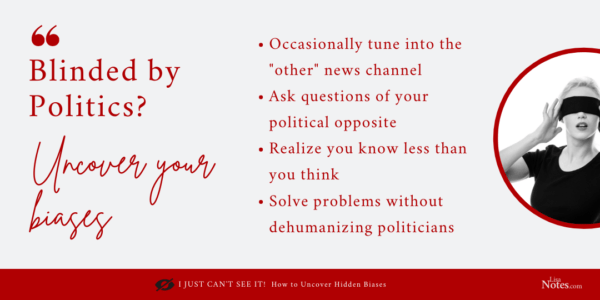
Biases and politics

Overcoming Our Biases in Politics

How can we apply the four biases from this week specifically to politics?

(1) How Can You Avoid Your Confirmation Bias? {Bias 1}

CONFIRMATION BIAS is listening only to what we already agree with. Listening only to our political party or leaning. It keeps us trapped in our own echo chambers.

My friend is a good example of how to break out of confirmation bias in politics. She and her dad are on opposite sides of many political issues. She has her sources; he has his.

But occasionally, she watches his news channel. She reads articles he suggests (and suggests some for him). She goes out of her way to listen to views that might oppose her own.

It doesn’t mean she changes her mind. That’s not necessarily the goal.  

But it educates her on how her father is thinking. And it gives them a better chance at communicating with each other. It’s still difficult. But it’s better than it would be.

(2) But I Don’t Want to Leave My Comfort Zone {Bias 2}

COMFORT BIAS causes us to avoid uncomfortable political conversations before they even happen.

No one is suggesting we pick political fights on Facebook. Or leave snarky comments on Twitter. Those are never helpful. 

But in person, when the right opportunity arises, it’s okay to push ourselves a little, to engage in safe and healthy conversations about our political stands. To ask questions. To listen. To grow. To step outside our comfort zone for a few minutes. 

(3) Why We Think We Already Know the Answers {Bias 3}

COMPETENCY BIAS (also known as the Dunning-Kruger Effect) is a tricky one. We each unconsciously overestimate what we know, without knowing we’re doing it.

When it comes to politics, we all know people (and likely ourselves too) who think they are “experts” on several issues. Maybe we read a news article or saw something online, and voila!—we now know the simple solution to untangle complex issues.

But as our mamas told us, “A little knowledge can be a dangerous thing.”

With politics, as with all other topics, we need to remember there is always more iceberg under the surface than what we see on top. Let’s practice a humble “I don’t know” more often so we can keep learning more.

(4) How to Stop Being So Negative {Bias 4}

NEGATIVITY BIAS also affects us all. It’s easier to see the bad things in politics rather than the good things, to point out what’s wrong with everyone else. 

Recruit a friend or partner to gently remind you when you’re getting too negative.

While we don’t have to find good in every issue (some issues have nothing good in them), we also don’t have to assume the worst about every politician (especially those on the opposite side). Name-calling and gaslighting and generalizing are not helpful; they are negative and harmful.

We need to keep our eyes open to problems that need solving. And work to solve them. But we also need to seek out positive things happening in politics, too (and yes, there are many!).

Seeing Past Our Biases

No one is immune from having biases. But likewise, none of us are beyond hope from seeing past our biases if we’ll keep an open mind.

No one has to live in the dark basement of politics, locked down in their own opinions. We all have a choice to walk into the light, and to live and love in brighter spaces.


How do you overcome your political bias? I’m trying, but it’s hard. Share your thoughts in the comments.

You are on Day #5 of the series: “How to Uncover Hidden Biases.”

Uncover Hidden Biases

Previous: Negativity Bias {Bias Day 4}
“How to Stop Being So Negative”

Next: Bias Quotes {Bias Day 6}
“5 Quotes to Awaken Our Hidden Biases”


How to Stop Being So Negative {Bias Day 4}

What is the negativity bias?

The negativity bias is our tendency to focus more on our negative experiences than on our positive or neutral experiences.

Here’s an example of the negativity bias.

You’re at your favorite restaurant. The appetizer is wonderful, the main dish is fantastic, but the dessert tastes strange. What do tell your friends the most about the meal? The lousy dessert.

Or say your spouse cleans the kitchen after dinner, sweeps the floor, and loads the dishwasher. But they put the silverware in the dishwasher upside down. That’s the thing that will stick in your mind.

Or you’ve been close with a co-worker for years. Until they say one negative thing about you. You’re willing to forfeit the friendship over it. 

Why are we so negative anyway?

It starts as a brain thing. We’re hardwired to stay safe by focusing on things that go wrong rather than on things that go right. Our minds give more weight naturally to negative experiences than positive experiences.

One study suggests that one angry face will stand out in a crowd of happy faces, but one happy face won’t stand out in a crowd of angry faces. Our brains detect threat quicker than comfort. 

(Interestingly though, men and women often respond differently. For example, when we hear a negative comment about us, men are more apt to externalize it with anger, whereas women tend to internalize it as sadness or depression. Maybe that’s a cultural thing?)

Why is the negativity bias a bad thing?

Here’s an obvious reason: Nobody enjoys being around a totally negative person. We avoid them if possible.

But if it’s me that is the negative person, I’m sacrificing my quality of life if I focus on the negative all the time. Negativity causes us to spiral down into pessimism and fail to notice the good things happening all around us. We can lose perspective on what’s truly a problem and what’s just an inconvenience.

How do we stop being negative?

Here are some ways to counter the negativity bias in ourselves.

  1. Catch your self-talk.
    How do you talk about your experiences? Put more effort into valuing the positive aspects of your life to break the pattern of negativity.
  2. Challenge your negative filter. 
    Are things really that bad? Could your judgment be clouded by other things? 
  3. Give yourself hope.
    Talk to yourself like you would talk to your best friend, with compassion and care and hope.
  4. Keep a gratitude list.
    It sounds cliché, but find things to be grateful for. Keep a gratitude journal or start a habit of thanking God for your blessings when you wake up and before you go to sleep.
  5. Use the 5:1 rule.
    If you’re being negative toward others, remember John Gottman’s 5:1 rule:

For every negative encounter, balance it with five positive ones.

This doesn’t mean you ignore problems. Do address negative things. Don’t gloss over them. But don’t notice ONLY the negative. Give your life balance.

How to stop being so negative

How did Jesus handle negative people?

Jesus had negative voices constantly yelling at him when he was here. His own people, the Pharisees and scribes, were the loudest critics.

He never seemed surprised by the negativity though. He knew his enemies would push back against his new commandment of love. Yet he still listened to them, prayed for them, ate with them, talked with them.

He didn’t let others’ negativity affect his positive mission. He kept moving forward with his plan to love all people in words and deeds, and to tell us to do the same.

As we strive to love all people—even the negative ones—may we remember to not take their negativity personal. And when WE are the negative ones? Let’s remember to pray for ourselves too, to follow in Jesus’s footsteps, and to be hopeful, joyful, bringers of light, even when it’s dark.


Have you caught yourself being negative lately? How do you combat it? Please share in the comments.

You are on Day #4 of the series: “How to Uncover Hidden Biases.”

Uncover Hidden Biases

Previous: Competency Bias {Bias Day 3}
“Why We Fail to Recognize Our Our Incompetence”

Next: Our Biases and Politics {Bias Day 5}
“Blinded by Politics? Uncover Your Biases”


Why We Fail to Recognize Our Own Incompetence {Bias Day 3}
Dunning-Kruger Effect

What is the Competency Bias (also known as the Dunning-Kruger Effect)?

This cognitive bias is when we unconsciously overestimate our abilities or knowledge (we’re all above average drivers, right?).

Basically, we don’t know enough to realize how little we know.

At the same time, people who ARE an expert in an area might still think others know more than they do, when they don’t. (These people might have the Impostor Syndrome, the bias of doubting your legitimate accomplishments, thus feeling like an impostor.)

Bottom line: we’re not very competent at determining our own competence.

Competency Bias

Here’s an example of the Dunning-Kruger Effect (Competency Bias).

They say the first rule of the Dunning-Kruger club is you don’t know you’re in the Dunning-Kruger club.

We’re all familiar with someone who brags at the dinner table about their knowledge on a topic, but they are unaware of how little they know.

For example, if you’re white, and you claim to understand exactly how it feels to be Black in America, you’re probably a member of the Dunning-Kruger club.

Another example: When surveyed about their knowledge of social policies, people in both political parties were confident in their expertise of a complex issue even though they held only a simple understanding.

And here’s a humorous example.

Coronavirus expert

Why do we think we know more than we do?

We naturally need confidence. It allows us us to take action. It’s the overconfidence that hurts us.

But it’s hard to know we’re not performing well if we don’t know the correct measure of “well.” Ironically, those mostly likely to overestimate their abilities are often the ones with the least skills.

Also, once we know something in one area, we often assume incorrectly that the knowledge transfers equally to other areas. Or if we’ve learned a little, we assume we know a lot.

As our parents told us, “A little knowledge can be a dangerous thing.”

Culture also plays a factor (certain nationalities are more prone to this competency bias than others). We’re uncomfortable saying, “I don’t know” so our brain tells us actually we DO know. It creates a shortcut that doesn’t exist so we can make sense of the matter.

Why does incompetence carry a “double curse”?

1. Incompetence causes us to reach bad conclusions, make mistakes, take unnecessary risks, and undervalue the genuine experts.

2. But secondly, we’re also cursed by not realizing it’s our own incompetence that’s causing our problems. We don’t learn from our mistakes.

Dunning-Kruger Effect dev.to

How can I prevent having this Competency Bias?

  • Work on your meta-cognition skills.
    Think about your own thinking. Realize your ignorance is invisible to you until you seek to become aware of it.
  • Keep learning more.
    The more you learn, the more you’ll realize there is to learn.
  • Get honest feedback.
    Listen to other people about your abilities. Don’t rely on your own opinions about yourself.
  • Be intellectually humble.
    Let down your defenses. Can you take constructive criticism? Do you listen to others? What are you basing your confidence on?

(And maybe read this article about contradictions about our understanding of the Dunning Kruger effect.)

How did Jesus handle the competency bias in others?

Here’s how Brian McLaren describes it in his book, Why Don’t They Get It?

“Jesus praised child-likeness and helped people learn that they have a lot to learn . . . building their confidence that they can enjoy life beyond their current biases.

He praised people for wise answers and ‘caught them doing good,’ and boldly confronted ‘blind guides’ and ‘hypocrites’ who were unaware of their ignorance.”

In one of Jesus’s last conversations with his disciples before the crucifixion, he told them they would do greater works than he had done (don’t underestimate your power) (John 14:12).

Yet he also said they didn’t know everything (don’t overestimate your knowledge); wait on the Holy Spirit to teach them (John 14:26).

Jesus’s advice is good for us today, too: 

  • Don’t underestimate God’s ability to work through you.
  • And don’t overestimate how much you think you know.

As with the other biases, we’re all prone to the competency bias. How do you become aware you don’t know as much as you think you do? Share in the comments.

You are on Day 3 of the series, of “How to Uncover Hidden Biases.”

Uncover Hidden Biases

Previous: Comfort Bias {Bias Day 2}
“I Don’t Want to Leave My Comfort Zone”

Next: Negativity Bias {Bias Day 4}
“How to Stop Being So Negative”


I Don’t Want to Leave My Comfort Zone {Bias Day 2}

What is it?

Also known as Complacency Bias, the Comfort Bias is when we don’t want our comfort disturbed. We favor the familiar and resist the different.

Here’s an example of Comfort Bias.

When an uncomfortable subject comes up in conversation, we quickly change the subject or leave the room to preserve our emotional stability.

Why does this happen?

Our brains don’t want to deal with confrontation or discomfort. It’s easier to maintain the status quo without having our emotions disrupted.

I like my comfort zone

Why is this dangerous?

Staying in our comfort zones prevents us from moving forward when we need to. Our growth is stunted when we refuse to try anything new or different or challenging. We fail to live out our purpose when we refuse to take leaps of faith.

How can we counter it?

Know that it’s natural to want to stay where we’re comfortable. Just start where you are. Move forward a little at a time.

Remember that even baby steps, however short, will still move us in the right direction. We don’t have to do it all at once. Rewards await us on the outside boundaries of our comfort zones.

What did Jesus do?

Jesus was constantly calling people out of their comfort zones. But never to do it alone. He walked through it with them. Through his example and words, he encouraged others to take up their cross daily and to follow him. To step out of the boat.

He promises the same for us: we don’t have to leave our comfort zones by ourselves. When we step out of the boat, his hand is there to hold us up.


How glued are you to your comfort zone? What prompts you to step outside of it? Please share in the comments.

You are on Day 2 of the series, “How to Uncover Hidden Biases.”

Uncover Hidden Biases

Previous: Confirmation Bias {Bias Day1}
“How Can You Avoid Your Confirmation Bias?”

Next: Competency Bias—Dunning-Kruger Effect {Bias Day 3}
“Why We Fail to Recognize Our Own Incompetence”


How Can You Avoid Your Confirmation Bias? {Bias Day 1}

What is Confirmation Bias?

Confirmation bias is listening only to what we already believe, what we agree with. It is seeking out information that confirms what we think already.

If we come across information that is different from our pre-existing ideas, we say it’s false and automatically ignore it.

Confirmation Bias

Here’s an example.

If I already believe masks won’t help against contracting COVID-19, I won’t read or consider the most current CDC guidelines that advise me to wear a mask.

Or vice versa. (I do believe masks work, btw.)

Why does this happen?

Our brains naturally want to take the easiest path. It conserves energy.

And the easiest path? Stick with what we already know. It’s a lot of work to think things through. Why waste mental energy trying to change our mind when we already *know* the answers anyway?

Why is confirmation bias bad?

Confirmation bias prevents us from unlearning wrong things and relearning correct things. It keeps us from updating our knowledge when more correct data comes along.

Ultimately, it keeps us stuck. It reduces our ability to accept new evidence. It prevents us from understanding reasonable arguments and changing our minds when we need to.

How can we avoid confirmation bias?

1. Be aware that confirmation bias exists.

Understand that we are inherently biased against new information. It doesn’t mean we’re bad; it means we’re human.

2. Seek out new information.

Look for ways to challenge what you already think. Proactively investigate and engage new information, experiences, and viewpoints. Give them a fair hearing. 

3. Talk to people outside your circle.

Gather information from a wide range of sources, not just those you normally peruse. Listen to what others are saying. Hear their stories. 

4. Play devil’s advocate

Get someone to play devil’s advocate with you to test what you currently believe. Are there holes in your thinking? If not, great. Maybe you’ve been right all along.

But stay open to truth so you can see it when it presents itself. Don’t fight against something just because it’s different from what you once believed. 

How did Jesus handle it?

Jesus faced a huge challenge with the Jewish people when he arrived on earth. They were already steeped in centuries of believing that they only were “right.” When Jesus introduced new wineskins, a new command, a new way of living, many of his listeners automatically tuned out.

So Jesus often used stories to wake people out of their confirmation biases. He taught by engaging their imaginations. He helped them see from a different vantage point so they could open their minds to accept the truths he was bringing instead of refusing to let go of their old thoughts. 

And he brought them new experiences to rattle the old ways of thinking. His miracles were mind-blowing, creating space for new ways of thinking. Even still, many refused to accept his new ideas.  

As we live in the new opportunities he brings us and see his miracles of grace around us, may we open our minds to new ways of experiencing him and discovering truth. 


It’s hard to see something different than what we already believe. How do you keep an open mind? Share in the comments.

You are on Day 1 of the series: “How to Uncover Hidden Biases.”

    Uncover Hidden Biases

    Previous: Introduction to the series

    Next: Comfort Bias {Bias Day 2}
    “I Don’t Want to Leave My Comfort Zone”