“As a general rule, people, even the wicked, are much more naïve and simple-hearted than we suppose. And we ourselves are, too.”
– The Brothers Karamazov, Fyodor Dostoyevsky
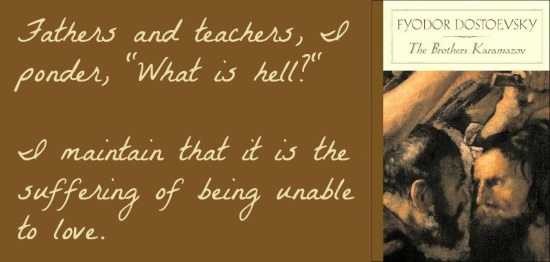
In case you weren’t assigned this in high school (I wasn’t) or been industrious enough to read this on your own (it took me 50 years), The Brothers Karamazov is a philosophical novel written by Fyodor Dostoyevsky in 1880. Dostoevsky’s father was murdered when he was a young boy, in adulthood he spent time in prison and in a Siberian labor camp for his political beliefs, and he suffered from epileptic seizures, situations that pop up in this novel in various forms.
The book is set in 19th century Russia, and it tells the story of Fyodor Pavlovich Karamazov and his three (and likely fourth) sons.
What I didn’t like about The Brothers Karamazov:
- Dostoyevsky tells stories within the story that have little to no bearing to the larger story (my opinion)
- It is very, very long
- It’s hard to follow on audio because you need to flip back too often
- Several characters have multiple names used interchangeably (and Russian names at that)
- The speeches by the characters go on and on and on
- Details are abundant and often totally irrelevant to the plot
- It is very, very long
But despite it being very, very long (did I mention that?), and other idiosyncrasies, I’m glad I finally read this classic.
What I did like about The Brothers Karamazov:
- I end up caring about even the worst characters
- The good characters (like Alyosha, also known as Alexei, Alyoshka, Alyoshenka, Alyoshechka, etc., and Father Zosima) inspire me
- Hearing the names pronounced correctly on the audiobook makes it more fun
- Redemption is throughout it
- It doesn’t gloss over ugly motives or doubts
- Grace ultimately wins over judgment (in weird ways, but still)
- It continues to grow in me even though I’m finished reading it
- It’s insightful and spiritual and thought-provoking on matters of faith and morality and reason
But still, it’s long, just so you know. (Could it have been shortened and retained the same effect? According to my 2014 internet-altered mindset, yes.)
Is it worth reading anyway?
Definitely. Take a few months and plunge in, even if only a little at a time. You’ll be glad you did.
A sampling from the book (without giving away the story):
“He suddenly recalled how he had once in the past been asked, ‘Why do you hate so and so, so much?’ And he had answered them, with his shameless impudence, ‘I’ll tell you. He has done me no harm. But I played him a dirty trick, and ever since I have hated him.’”
“Alyosha was delighted that he had brought him such happiness and that the poor fellow had consented to be made happy.”
“‘And so I hasten to give back my entrance ticket, and if I am an honest man I am bound to give it back as soon as possible. And that I am doing. It’s not God that I don’t accept, Alyosha, only I most respectfully return Him the ticket.’”
‘That’s rebellion,’ murmured Alyosha, looking down.”
“At some thoughts one stands perplexed, especially at the sight of men’s sin, and wonders whether one should use force or humble love. Always decide to use humble love. If you resolve on that once for all, you may subdue the whole world. Loving humility is marvelously strong, the strongest of all things, and there is nothing else like it.”
“But after all, what is goodness? Answer me that, Alexey. Goodness is one thing with me and another with a Chinaman, so it’s a relative thing. Or isn’t it? Is it not relative? A treacherous question!”
“Ah, children, ah, dear friends, don’t be afraid of life! How good life is when one does something good and just!”
* * *