On the Blog – May 2019

Here are brief summaries and links to blog posts from May 2019.


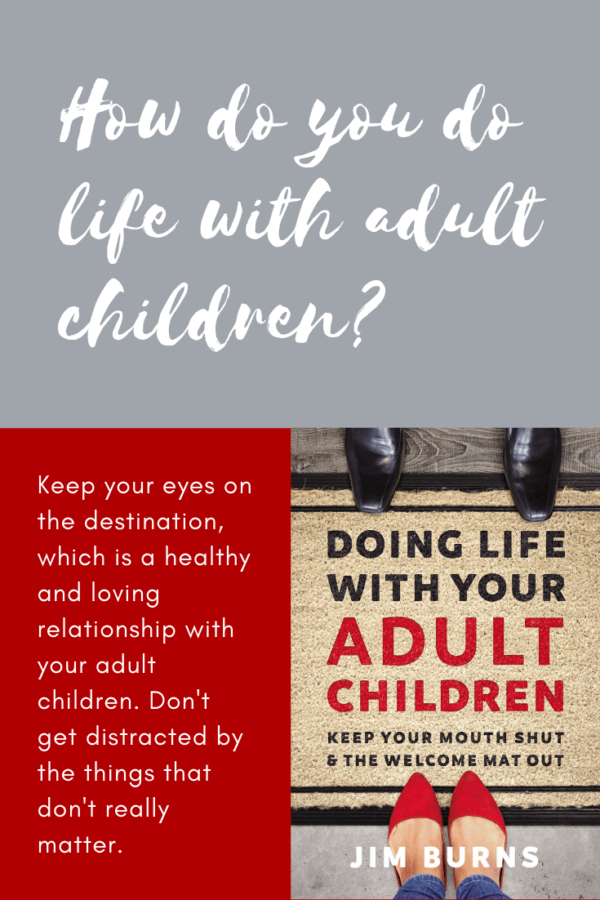
Do Big Kids Need Their Mother, Too? Review of “Doing Life with Your Adult Children”

Parenting Books

My kids do grownup things. They have jobs. They have husbands. One already has a child.

Why would they need their mama now?

My parents have been gone for nine years. I still wish they were here. We would always like to have good parents with us, yes?

Yet as adults, we don’t need our parents in the same way that we needed them when we were children. That’s where it gets sticky.

I read lots of books on child-rearing when my girls were small. I wanted to do things the best way, the right way, God’s way.

As they grew older, the books I read changed. No longer about parenting babies, but about parenting elementary kids. Then about teenagers.

But now that the last one has graduated from high school and college and married, do I still need a parenting book?

Parenting Adult Children

Actually, the years of parenting adult children will likely surpass the number of years we parented small children. It’s just very different. It has to be from a distance. And loose. And non-judgmental.

Jim Burns new book, Doing Life with Your Adult Children, is a helpful resource for these years. (His subtitle is profound: Keep Your Mouth Shut and the Welcome Mat Out.)

Doing Life with Adult Children

Here are the nine principles Burns shares in the book. Is there one you need the most?

  1. Your role as the parent must change.
  2. Unsolicited advice is usually taken as criticism.
  3. You can’t ignore your child’s culture.
  4. They will never know how far the town is if you carry them on your back.
  5. Your job is to move them from dependence to independence.
  6. You can’t want it more than they want it.
  7. Financial independence and responsibility is the goal.
  8. Wear beige and keep your mouth shut.
  9. Being a grandparent may be your greatest legacy.

This book is full of wisdom, some of which I’ve already learned (often the hard way, such as, don’t argue about holidays), and some of which I’ve yet to experience.

My daughters don’t need me like they did when they were younger, but I can still play an important role in their lives, and they in mine.

I want to do this stage of parenting well, too.

Quotes from Doing Life with Your Adult Children

“Most parents I’ve talked with have told me they lost sleep worrying about their kids when the kids were younger, but I’ve been surprised to discover how many parents of adult children tell me the same thing.”

“It’s important to acknowledge your old job description as a parent so that you can set it aside. That’s the only way to make room for your new job description.”

“This transition of moving from daily involvement and hands-on parenting to a more intermittent involvement will likely be an easier move for your kids than it is for you.”

“There is absolutely nothing more important in life than a right relationship with God and a right relationship with family. Ultimately, that’s what defines the legacy you leave your children.”

“Many parents of adult children tell me that the most difficult part of their new job description is abstaining from giving advice when they know they’re correct.”

“Trust that experience is a better teacher than advice….If we keep our mouths shut and keep the welcome mat out, we increase the odds that our children will come to us for guidance on their own.”

“Parents who continue to take care of their adult sons and daughters out of their own need to be needed do so at the expense of their adult children’s maturity.”

“Your child’s choices don’t have to break you. Your child’s regrettable decisions do not make you a bad parent. Even good parents have children who make poor choices.”

I highly recommend this book to parents of adult children. This line from it makes me laugh the most: “The first forty years of parenting are always the hardest.”

My adult children are worth it all.

* * *

Are you parenting an adult child? Has anything been difficult? Surprising? Do you have a favorite parenting book? Please share in the comments.

My thanks to BookLook Bloggers
for the review copy of this book
(and to Beth for the real thing!)


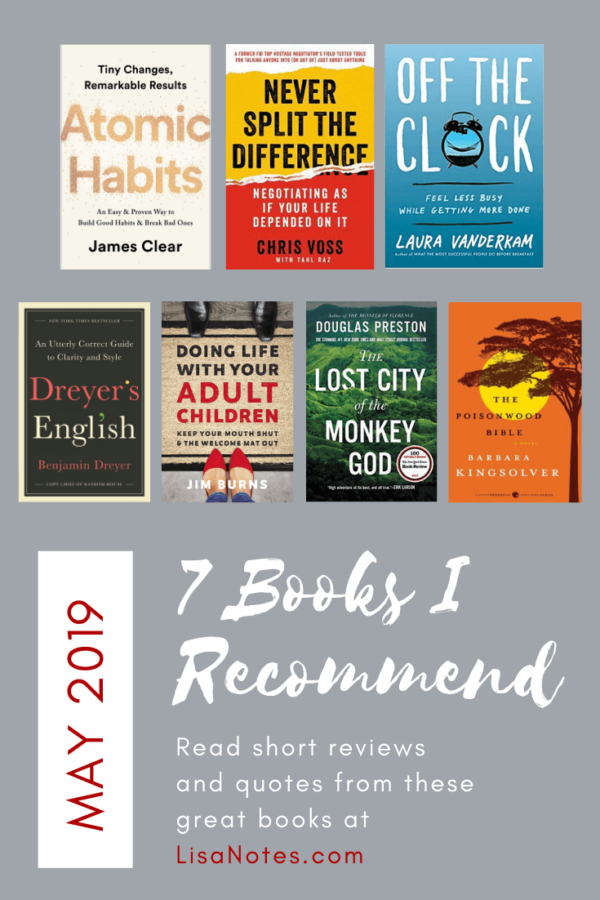
7 Books I Recommend – May 2019

I’m stingy with my personal list of 5-star ratings.

But for books #1-5 below, I easily give 5-stars. So, so good.

(#6 and 7 are also very good.)

7 Books I Recommend_LisaNotes

Books I Recommend

NONFICTION

1. Atomic Habits
An Easy & Proven Way to Build Good Habits & Break Bad Ones
by James Clear

Atomic Habits

If you care about making good habits in your life, this is a must-read. I’d been hearing it was good; it lives up to the hype. I’m already applying several little tricks to my own life to improve habits.

“Ultimately, it is your commitment to the process that will determine your progress.”

[click here if you can’t see 1-Minute Book Review]

James Clear has a great newsletter you can sign up for here. It is often excerpts from the book Atomic Habits.

2. Never Split the Difference
Negotiating as If Your Life Depended on It
by Chris Voss

Never Split the Difference

This book is also SO good. Author Chris Voss is a former hostage negotiator for the FBI. He uses his experience (such fascinating stories!) to explain nine strategies we can use to make our lives better (not just for negotiations, but for relationships).

“Your most powerful tool in any verbal communication is your voice. . . .You can be very direct and to the point as long as you create safety by a tone of voice that says I’m okay, you’re okay, let’s figure things out.”

Chris Voss also has an informative weekly newsletter with one tip each week at his blog, Black Swan. Even when it doesn’t apply directly to me, there’s something I can use each time.

3. Off the Clock
Feel Less Busy While Getting More Done
by Laura Vanderkam

Off the Clock

This is yet another game-changing book. Too often I catch myself saying, “I just don’t have enough time.” This book helped me realize mistakes I’m making with time and how to correct them.

Off the Clock is not just a time-management book though (although it is partially that), but also a philosophy of living.

Be warned: Laura Vanderkam strongly encourages you to track your time for two weeks to see where it’s actually going. It’s painful. But enlightening. (I’m using the free version of Toggl to track my time; if you want a digital tool to track your time, I highly recommend Toggl.)

“I repeat a two-part mantra: Plan it in. Do it anyway. If my anticipating self wanted to do something, my remembering self will be glad to have done it. Indeed, my experiencing self may even enjoy parts of it. I am tired now, but I will always be tired, and we draw energy from meaningful things.”

I also listen to Laura Vanderkam’s short podcast, Before Breakfast, each morning.

4. Dreyer’s English
An Utterly Correct Guide to Clarity and Style
by Benjamin Dreyer

Dreyer's English

If you write anything (blogs, books, emails, etc.), this book is a wonderful resource. But beyond that, it is very entertaining. Author Benjamin Dreyer (copy chief at Random House) is an expert at using words. Who knew a grammar book could be so funny? I had to read excerpts out loud again and again to Jeff because they were so witty.

Here’s some writing advice:

“Here’s your first challenge: Go a week without writing very, rather, really, quite, in fact. And you can toss in—or, that is, toss out—’just’ (not in the sense of ‘righteous’ but in the sense of ‘merely’) and ‘so’ (in the ‘extremely’ sense, though as conjunctions go it’s pretty disposable too).

   “Oh yes: ‘pretty.’..And ‘of course.’ That’s right out. And ‘surely.’ And ‘that said.’

   “And ‘actually’? Feel free to go the rest of your life without another ‘actually.'”

5. Doing Life with Your Adult Children
Keep Your Mouth Shut and the Welcome Mat Out
by Jim Burns

Doing Life with Your Adult Children

There are thousands of books on parenting young children. But parenting adult children? Not many. This book is excellent. Written from a Christian perspective, Jim Burns answers questions like:

  • When is it okay to give advice to our adult children?
  • What do we do if they’re about to make a big mistake?
  • How do we relate to our child’s spouse?
  • Where’s the line between enabling and helping?

“There is relatively little available about the challenges of parenting an adult child. Yet we will spend more time as a parent of an adult child than we will as the parent of a young child and adolescent.”

My daughters are both in their 20s, but I’m still their mother. They still need me, just in a different way. This book helps clarify the way. (Thanks, Beth, for tipping me off to this one and for the giveaway copy.)

[See review and more quotes here of Doing Life with Adult Children]

6. The Lost City of the Monkey God  
by Douglas Preston

Lost City of the Monkey God

This is a 4-star book for me, only because it had more historical detail than I needed. But if lots of background information is your thing, you might give it 5 stars. It’s the true story of discovering a lost city in the jungles of Honduras. It’s not for the squeamish. The journey was dangerous, snake-filled, and disease-ridden. But fascinating.

FICTION

7. The Poisonwood Bible
by Barbara Kingsolver

Poisonwood Bible

This novel is about a traditional, evangelical Baptist missionary, Nathan Price, who takes his wife and four daughters to the Belgian Congo in 1959. The female characters take turns narrating the chapters. Living in Africa turns out to be much more difficult than they had imagined or prepared for.

Barbara Kingsolver does an excellent job switching voices for each character and keeping the plot rolling along over three decades. It’s a long book (546 pages), but the length felt necessary to fully hear the story.

READING NOW

  • I’d Rather Be Reading
    The Delights and Dilemmas of the Reading Life
    by Anne Bogel
  • Glorious Weakness
    Discovering God in All We
    Lack
    by Alia Joy
  • Outliers
    The Story of Success
    by Malcolm Gladwell
  • Almost Everything
    Notes on Hope
    by Anne Lamott
  • In the Shadow of Statues
    A White Southerner Confronts History
    by Mitch Landrieu
  • The Highly Sensitive Person
    How to Thrive When the World Overwhelms You
    by Elaine N. Aron
  • Born to Run
    (audiobook)
    by Bruce Springsteen
  • Nine Perfect Strangers
    by Liane Moriarty

* * *

What good book are you reading this month? Please share in the comments.

My books on Goodreads
More books I recommend


Only God, Only Good

What Is Synecdoche?

Driving through Birmingham, I saw this billboard for a church. It said, “God is ONLY good.”

But when something bad happens, we can think God is mean. Or indifferent. Or at the very least, concerned but powerless to act.

I learned a new word last month: synecdoche (/səˈnekdəkē/). It is when we refer to a part of something as the whole.

For example:

  • Down south, we say we want a “Coke” when we mean ANY carbonated drink.
  • Or we say Atlanta won last night, meaning the Atlanta Braves’ baseball team won their game.
  • Or we might say the world is out to get us because one person cut us off in traffic this morning.

When we ascribe too much to the whole, when it’s just a part, it can ruin our day.

And our faith.

All Good

Synecdoche also happens in our spiritual lives. If we expect Christians to be perfect, we can lose faith when a pastor has an affair. Or we can quit praying altogether if a sick child dies. Or we can lose hope when a tornado hits another poor neighborhood.

Maybe that’s why the billboard caught my eye again yesterday on my drive home from Morgan’s house: “God is ONLY good.”

I think God may be an exception to synecdoche. It is safe to credit complete goodness to him.

God is the only being that is consistent, whole, all.

It’s impossible to ascribe TOO much goodness to God.

If I get poison ivy, God is still good. If the trip I’d planned gets cancelled, God is still good. If someone that I love disappoints me, God is still good.

Circumstances change. My emotions change. People change. I can’t trust these parts to be a whole.

But God doesn’t change.

God is good consistently, not just occasionally. Completely good, not partially.

Only God is always good, and never bad.

It's impossible to ascribe TOO much goodness to God

* * *

Seth Godin taught me the meaning of synecdoche on his podcast, Akimbo.

In this year of practicing Hope for 2019, I find great hope in trusting God to always be good. What gives you hope about God? Please share your own thoughts in the comments.


4 Ways to Enjoy Your Peace Again

Have you lost your peace?

If we start to feel anxious, we binge on distractions. We tune into Netflix. We chat up a friend. We busy ourselves with work.

Looking outside is easier then digging inside to uncover what God wants us to see.

So our peace goes unnoticed. Jesus isn’t consulted. And our anxiety, while it may hit pause for a minute, is still on.

Another reason we don’t find peace is we misunderstand it.

What is peace anyway? Is it the opposite of worry? Is it the absence of fighting? Is it total serenity with the world?

Isn’t peace something we’re supposed to “feel”?

Read it all here:

“Lost Your Peace? 4 Ways to Find and Enjoy Peace Again“

Peace is here- fruit of the Spirit

***

I’m writing today at Do Not Depart. Will you join me there?


When We Lose Another Author – Goodbye, Rachel Held Evans

“My story is about moving from certainty, through doubt, to faith. It’s not about the answers I found but about the questions I asked, questions I suspect you might be asking too. It’s not a pretty story, or even a finished story. It’s a survival story.”
– Rachel Held Evans

The Loss of RHE

I look at my keyboard. I see it’s happening again.

The letters are going away.

It’s a pattern I’ve noticed. On my old computer keyboards, I typed away the letters A, S, and N. The letters rubbed off the keys from overuse.

And now, the A, S, and N are starting to blur on my current keyboard, too.

(Factoid: The three most used keys are supposedly the space bar, the letter E, and the backspace.)

Mac Keyboard Letters

Last Saturday morning, we all lost RHE.

Maybe you saw the trending hashtag #BecauseofRHE and read story after story about her.

Here’s why.

RIP, Rachel Held Evans

Rachel Held Evans—a Christian author, blogger, speaker, mother, wife—died at 37 years old on May 4, 2019. (The doctors initially suspected complications from an allergic reaction to antibiotics for an infection. But symptoms also suggest encephalitis.)

The world mourns. I mourn.

Even though I never met Rachel in person, I knew her through her words. I read her books. Her blog. Her tweets. I listened to her on podcasts and interviews.

Her letters were used over and over.

Ask the Questions Rachel Held Evans_LisaNotes

We readers hate to lose another stellar spiritual writer, another inspiring faith friend.

I felt this same way after the death of Tim Hansel, December 13, 2009; Dallas Willard, May 8, 2013; Jerry Bridges, March 6, 2016; Eugene Peterson, October 22, 2018.

And now Rachel Held Evans, May 4, 2019. We’ll hear no more evolutionary new words from her. We won’t see what she would have done next.

We won’t have her clearing a path in front for us to follow.

Ask the Questions

Rachel led the way through her questions. She grew up in a conservative Christian tradition that sometimes skirted the hard questions or buried them in platitudes.

When Rachel began searching for answers on her own, she discovered a bigger God than she’d been taught to believe. God still didn’t provide all the answers she wanted. But he taught her to make peace with the questions.

Rachel was studious, insightful, and deeply in love with Jesus. Instead of losing her faith through the doubts, she grew her faith through them. Instead of loving God less, she loved him more.

And through her, we did, too.

“But the truth is, I’ve found people to be much more receptive to the gospel when they know becoming a Christian doesn’t require becoming a know-it-all. Most of the people I’ve encountered are looking not for a religion to answer all their questions but for a community of faith in which they can feel safe asking them.“

But because of her questions, Rachel was often hit from inside church walls. Her views weren’t welcomed among all. She took the shots.

“With Scripture, we’ve not been invited to an academic fraternity; we’ve been invited to a wrestling match. We’ve been invited to a dynamic, centuries-long conversation with God and God’s people that has been unfolding since creation, one story at a time. If we’re lucky, it will leave us with a limp.”

Like many of us, Rachel walked with a limp.

And Now?

Eventually every writer will use up the words they’ve been given to say in this life, either by disinterest, or disease, or death.

But the troubling thing about losing our artists is we lose another lens to see God. When writers scribble down their picture of God, we see a new side of God, too. I learned to broaden my perspective of God through word pictures from Rachel. And Tim, Dallas, Jerry, Eugene, and many, many others.

Where do we go from here, with more letters scrubbed off our keyboard? What will we do without RHE?

1. We keep reading her written words.

I’ll keep returning to Rachel’s books (see the list below), just like I do other authors (all the way back to Moses) who no longer write fresh words. With Rachel’s words, we continue to nurture our love for Jesus through church, through the Bible, through Holy Spirit.

And we nurture our love for God’s grace.

“Perhaps we’re afraid that if we get out of the way, this grace thing might get out of hand. Well, guess what? It already has.

“Grace got out of hand the moment the God of the universe hung on a Roman cross and with outstretched hands looked out upon those who had hung him there and declared ‘Father, forgive them for they know now what they do.’

“Grace has been out of hand for more than two thousand years now. We best get used to it.“

Rachel was a champion for grace.

2. We turn the old words into new experiences.

Christian authors don’t publish books simply for their own growth; they want us to live them out in our own ways. They inspire us to create fresh and original experiences with God ourselves.

“So perhaps a better question than, ‘Do I believe in miracles?’ is, ‘Am I acting like I do?’ Am I including the people who are typically excluded? Am I feeding the hungry and caring for the sick? Am I holding the hands of the homeless and offering help to addicts?”

Rachel encouraged us all to live the gospel, not just preach (or worse, argue) about it.

3. We seek God’s voice among new voices.

Fortunately, we live in an age where new voices are speaking up all around us. Through the guidance of Holy Spirit, we continue listening, weighing, learning from those still on the journey here, integrating them with voices from the past. Keep adding new authors to your reading list.

“Indeed it’s easier to remember things together than alone.”

A Resilient Faith

Ironically, since Rachel was known for her questions, she leaves us with a new question: Why did Rachel die young?

We ask God for an explanation; we don’t get adequate answers.

But even in this, as Rachel once said, the Christian faith won’t fall apart.

“Faith is more resilient than that. Like a living organism, it has a remarkable ability to adapt to change. At our best, Christians embrace this quality, leaving enough space for God to surprise us every now and then.”

Even if you’ve never read a book or article by Rachel Held Evans, you’ve likely still been influenced by her through someone else who did read her works. That’s the way community works. None of us are Christians on our own.

Rachel said,

“Like it or not, following Jesus is a group activity, something we’re supposed to do together.

“We might not always do it within the walls of church or even in an organized religion, but if we are to go about making disciples, confessing our sins, breaking bread, paying attention, and preaching the Word, we’re going to need one another. We’re going to need each other’s help.”

Rachel, you were one of our helps.

We’ll mourn your loss, our RHE. But we’ll continue to hear your voice.

“It’s about all the strange ways God brings dead things back to life again. It’s about giving up and starting over again.”

* * *

Do you have a favorite book by Rachel? What author do you wish you heard more from? Do you have a favorite new author?

Please share your thoughts in the comments.

Rachel’s Books:

  • Faith Unraveled
    How a Girl Who Knew All the Answers Learned to Ask Questions
    2010/2014
    (previous published as Evolving in Monkey Town: How a Girl Who Knew All the Answers Learned to Ask the Questions)
    Kindle version on sale $2.99
  • A Year of Biblical Womanhood
    How a Liberated Woman Found Herself Sitting on Her Roof, Covering Her Head, and Calling Her Husband Master
    2012
  • Searching for Sunday
    Loving, Leaving, and Finding the Church
    2015
    Kindle version on sale $0.99
  • Inspired
    Slaying Giants, Walking on Water, and Loving the Bible Again
    2018