My Newest Hobby: AI Detection
Do You Use AI?
I wonder if AI underestimated how quickly humans would figure out if something is written solely by AI.
I understand why people want to use AI to help them write. It’s so easy to use. Just throw a topic into ChatGPT and out comes a beautiful product in a second or two. And AI phrases things so clearly. No thinking required.
I use AI myself. It has become a useful editor to me. I get it to untangle some of my more confusing sentences. I sometimes ask it to reorganize my paragraphs to make better sense. I often let it do boring tasks like write SEO descriptions or choose social media titles.
Even while writing this (sort of) anti-AI rant, I want to use AI. Badly. I’m so tempted to put this very writing into AI for an automatic upgrade.
But this time I’m not. I want these thoughts and words to be strictly my thoughts and words. Not AI’s words. For better or for worse.
Because every day I notice how quickly the internet is swapping human voices for computer voices. And it’s making me sad.
Just like I don’t want to talk to a bot when I need help for a unique problem I’m having, I also don’t want to read AI’s words when I’m longing to hear a unique voice.
AI is flattening out unique voices.
We’re Rightfully Suspicious
I’ve been slowly reading a book about AI by Robert Wright called The God Test: Artificial Intelligence and Our Coming Cosmic Reckoning. His premise is that we’re currently faced with a technological tipping point: will we as a species rise to the moral challenge of using AI for good and not bad? Will we get “the God we deserve,” on either end of the spectrum?
TBD. Check back in a few years.
In the meantime, we’re already becoming suspicious of images we see online. And rightfully so. Is that cat really ringing someone’s doorbell pretending to deliver a pizza? Did that politician really become a superhero last night? Some things really are too crazy to be true, even for these times.
So I’ve picked up a new hobby myself. It’s not one I particularly enjoy. But it’s one that I can’t seem to put down.
I’m becoming an unofficial AI writing detective.
Do You Want to Know If It’s AI?
I’ve been suspecting some writers’ work for awhile now. Not the loyal blog writers that I follow. Their voices seem authentically their own. I’m more grateful than ever for them.
But I am noticing an uncomfortable blandness of writing in several Substack newsletters I follow. Especially among newsletters that pop up quickly and suddenly have tons of content every week.
Obviously it’s not just me noticing either.
One study I read says that AI-generated content now accounts for 41% of long-form content on LinkedIn, 13% on Reddit, and 10% on Substack. And on average, the AI-generated posts on LinkedIn receive 45% less engagement than human-written posts.
We can just tell.
Within the past few weeks, Substack has encouraged writers to develop their own “How I make this” statement for their newsletters. Not to discourage or shame people from using AI, but to advocate for transparency about it if you do. I for one would appreciate if writings would come with a label if they’re created 100% by AI.
And people are having opinions about it. Big ones.
Substack also recently suggested using Pangram as an AI detector. It’s not foolproof, of course. (And isn’t it ironic to use AI to detect AI?)
Of everything I’ve tested so far, it’s told me what I suspected, that the piece was likely written completely by AI.
My favorite tells of AI are overuse of the words “quietly” and “matters,” as in this article that landed in my inbox yesterday:
“The 3 Substack Updates That Quietly Turn Your Publication Into a Business Tool
…The reason that matters now comes down to who’s arriving on the platform.”
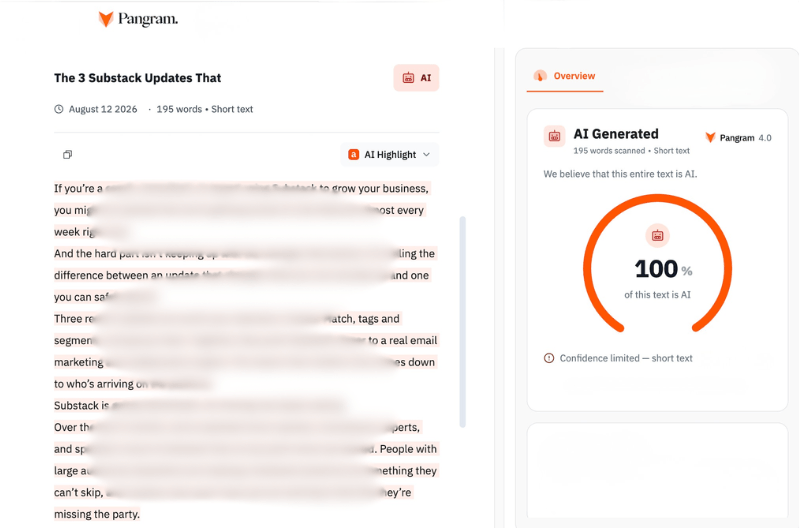
Yep, it’s AI. (Or so AI tells me, anyway.)
I’ve even put my own work in Pangram as a test. So far it says my writing is 100% human . . . even though I use em dashes—I refuse to let AI steal them from me.
Of course I’m not surprised it shows I’m human since I did write it myself. But still, I appreciate the verification. Even if it’s from AI. Whew.
Is It All Bad?
Some people think writers should not use AI at all. Others say it’s fine because people are busy or they are genuinely bad writers, so why not let AI write for them?
To be fair, AI writing isn’t necessarily bad. It is usually quite organized, grammatically correct, and informative, things that I appreciate in good writing. I’ve received lots of help and insights from AI-generated articles.
In my own writing, I appreciate AI’s advice when I ask it questions like, What doesn’t make sense here? How can I make this simpler? What points have I missed?
And if I’m looking for solid information, like 3 tips to unclog a bathtub drain, I don’t care if the data comes from AI or a human. Just give me the help, as long as it’s accurate.
However, if I’m looking to hear what actually worked for a fellow human being—and I would appreciate a good laugh along the way when they tell a funny story of what happened when they tried to unclog their own drain—I don’t want that to come from AI.
I want it to come from you.
What AI Can Never Give Me
AI can give me information, but it can’t give me a person. Maybe this is what it boils down to: Do we prefer knowing content or knowing a person?
I do love some good content, don’t get me wrong.
But it will never replace loving a good person.
I want to hear you and your stories. In your human words. From your own lived experiences. In your individual tones and rhythms and expressions.
So what you get here today is 100% from a human. Could AI have improved it? Yes, definitely. It would have been cleaner and clearer.
But this time I didn’t give AI the opportunity to make it better. Instead, you’re getting a version with my errors and blurry syntax and perhaps a slightly confusing structure.
It’s not perfect.
But it is personal.
I’d love to hear your beautifully human thoughts in the comments.
Read More:
- Do You Say Thank You to AI? The Bots Are Listening
Are we trusting AI too much? Stay aware of how computers are shaping us. - What CAPTCHA Got Wrong About My Humanity
Instead of identifying fragile objects, CAPTCHA reminded me of my grandson, risk, and what it truly means to be human. - That “Friend” Is Not Who You Think They Are
As AI becomes more helpful and polite, it’s easy to confuse it with friendship. - When to Ignore GPS (and Listen to Yourself Instead)
Here’s how one road trip reminded me that the best navigation system is sometimes your own intuition.
Yes, AI has added work to my reading experience, scanning for any tell-tale signs that AI had been used! Safety when it comes to AI is also my concern. I agree that AI can be tempting because it does seem to clean up my sentences nicely (yes, I did use it for that). But now I consciously stay away from adding any of my writing into AI. In work environments, I’ve noticed employers dictate what AI platforms are safe for their employees to use (& it is never OpenAI in my experience). I do write on Substack and was wondering if the Pangram tool was safe to use? But it looks like it is, so I will try it out today. BTW, I saw no confusing structure in your post! It is lovely and perfectly human.
Thanks for your kind words, Lynn. I appreciate that you brought up the safety issue too with AI. I started out being very cautious of what I put into AI, but have gotten more lax as time goes on. I probably need to put a check on that.
I can’t guarantee that Pangram is a safe tool, but I haven’t heard anything negative about it yet. It’s supposedly one of the more accurate AI detectors. But who can say for sure? AI? ha. It’s a crazy world.
Hear, hear! I feel absolutely no curiosity to try having AI write for me or clean up my sentences, but I suppose that’s because I enjoy doing it myself. It would be like having someone else eat my ice cream for me. And reading AI-written stuff is like eating plastic. No thanks!
Of course, I do use machine assistance to speed up certain tasks. How much information do I now have instant access to, for example, that would once have required endless and costly research? I’m thankful for that, and many other aids to creativity. Spell and grammar check – so long as I can review the changes and make decisions – is also handy. But I draw the line at having the computer write for me.
Maybe what is needed is to help people enjoy being human more — including the messy and complicated parts? And to value the humanity in each other? I ought to make sure to do that as much as I can, while I still can.
As I’ve said before – you’re an excellent writer. I definitely value every word that comes from you.
Your metaphor of having someone else eat ice cream for you is delightful, Lory! I’ll have to remember that one. 🙂 I’ve often said that editing is one of my favorite parts of the writing process…yet that’s what I’m mostly likely to invite AI to help me with. Hmm…I’ll have to reconsider if I’m feeding AI too much of my ice cream.
And also your imagery of reading AI-written stuff as eating plastic. That resonates with me, too. I agree with you that perhaps this era of AI-everything will help us appreciate our humanity more.
Unless I needed to submit a formal request and wanted to have all my ducks in a row regarding facts, I will not use AI in my writing whatsoever, Lisa. I want to be authentic, if messy, with my readers because that is who I am. I need to have personal relationships not perfect syntax nor vocabulary. By the way, just know that I’ve never thought that your writing was anything but clear and sensible. Steer clear of AI! Blessings!
Authentic and messy – those traits are becoming more and more valuable. I’ll take that any day over “perfect” inauthentic writing! I like knowing the people behind the words, not the machines they’re using. Thankful for you being you, Martha. ❤️
AI came along after I left the work force but honestly for the mundane stuff I could see it becoming a crutch. I could see using it where before I’d be guilty of cutting and pasting stuff I had to repeat constantly and independent thought was not really the point passing basic info was what was required.
I do find it annoying that it has become an income stream for “personal stories” that are no more personal than most junk mail I get. AI not only rights a horrible story but then repeats it on overload on a thousand different locations merely changing an few details.
AI definitely does have its place, I agree. I use it for several different things, including formatting book notes that I collect from books I read. It completes a very mundane and repetitive task for me about 100 times quicker than I used to do it myself. But yes, it is very annoying when it’s passed off as “personal” writing, when we know it’s not. It will be interesting to see what comes next from it.
I’d never entrust my personal writing to AI but seek out a knowledgeable person if I needed help. I’d not even experiment with it. However, I have used AI for explanations of various questions I had when I was publishing my last book via KDP and came up against some difficulties. KDP is not a ‘live person” nor is one able to contact anyone with that program when their directions (at least how I was understanding them) did not work. I appreciated the thoroughness of the understanding response/s that came through. The same is true for some computer glitches I was having and needed insight before I actually phoned a ‘real person’ for help.
Pope Leo XIV has written an encyclical (formal letter) not limited to Catholics to read. He addresses AI and it is an excellent overview of how it can be used in healthy ways…and what to avoid. YouTube has an hour conversation with a Catholic priest, Father Mike Schmitz and Harvard professor Dr. Arthur Brooks who is a social scientist. Each of them were involved in writing a forward and after-ward. I can’t recommend this enough. (look for Fr. Mike Schmitz & Dr. Arthur Brooks Discuss Magnifica Humanitas) It all comes down to having our own life and priorities in order! Real life!
I like your examples of using AI to help with certain things, Lynn. I use it for those type of things too, and it has been very useful. I do have to remind myself at times that it’s not a person, though. ha. It can be so “personable” in how it chats with us.
I haven’t read Pope Leo’s letter but it sounds like something that would be informative for all of us. I also admire Arthur Brooks’ work so I’ll look up that youtube video you mentioned.
I love this: “It all comes down to having our own life and priorities in order! Real life!” Beautiful, messy, real life!
I’m all with you Lisa, echoing your following statement;
“I want to hear you and your stories. In your human words. From your own lived experiences. In your individual tones and rhythms and expressions.”
I don’t use AI for my writing & don’t plan too, when I’m sharing my lived experience through my writing I believe it should be me, warts & all so to speak!
It may not be perfected grammar or syntax but it’s genuine. People aren’t perfect, none of us are & that’s what makes their lived experiences so interesting, unique & inspirational.
A timely post my friend.
Blessings, Jennifer
I love that your writing is genuine, Jennifer. I feel like I’m getting to know YOU when I read your words. That’s what makes it special. I sense such a flatness when I read things written by AI. The uniqueness is stripped away; who wants that? I prefer a lovely imperfect human any day. 🙂
I love this so, so much!! I don’t use AI ever. In part because I enjoy writing and want my content to sound like me, but in part because I’m too lazy to learn how to use something that can simplify things. LOL.
I am a teacher, and although my subject is American Sign Language so students can’t do actual signed assignments (video assignments) using AI, I do ask them to write Discussion Boards about what they think about various topics about Deaf Culture and the Deaf Experience that they learn about through the semester. In my AI policy, I have stated something like: I don’t care what AI thinks about this topic, or what AI thinks you should think about this topic. I care what YOU THINK.
Thanks for the great thoughts on this! Visiting from the Crazy Little Lovebirds linkup.
It’s wonderful that you have an AI policy for your students (who could have imagined even a decade ago that it would be necessary?). I love that you let them know that you care what THEY think, not what AI thinks. That’s how I feel too. Thank you for living this out, and for sharing it here, Jennifer.
I definitely agree that if you are going to use AI just let us know that you did. I can live with that. Great post! So glad you wrote it yourself 🙂
I’m in total agreement with you, Catherine. If someone wants to use AI for their writing, go for it – but just disclose that fact. We frown on anyone taking someone else’s words as their own when both parties are human; should it be any different for a computer? New technologies will force us to think deeper about our ethical choices.
I really haven’t used AI much and never with my writing. BUT it is sneaking into all of our lives in so many places. And often hard to detect. Great overview and discussion here, Lisa. Thanks
Yes, AI is everywhere now. It seems all the platforms want us to use AI too. It’s an interesting time to be in. I do appreciate the things it can do well; I just don’t want it to become a substitute for our humanity. Sigh.
I use AI in a few cases at work (as a library we have to deal with the subject) and in rare cases to translate blog posts if I don’t know a language at all, but that’s it.
All of my writing is mine. My thoughts, my experiences, my mistakes.
I think AI has its uses in science (although I would lie if I said I’d always trust it), but unfortunately humans never know when and where to stop. I’m tired of AI images, videos, and texts, and (from experience, private and at work) smart people who seem to forget critical thinking.
And I don’t want to see creativity disappear. We need people making art, writing literature, and thinking.
Yes to all those things, Cat. AI is good for a lot of things, but may it never replace people because we are good for a lot of things too! 🙂 I’ve seen reports that people prefer human-generated text over AI-generated text, even when they don’t realize who the writer was. For now anyway, we still naturally gravitate to the humans.
This was such an interesting read Lisa, I had no idea about programs to check if things are written by AI. I have used it for the odd idea or for things like SEO info for posts but generally my posts are my own words and I like it like that! Thank you for highlighting this issue and for information on detecting AI.
The next thing will be AI detectors to prove which AI detectors are accurate. ha. I’m not sure where all this is going to end. I like throwing off mundane tasks onto AI too (like for SEO info, which is a computer issue for algorithms anyway). It frees us up to do more of the creative human work. 🙂
Lisa, you really sparked a great conversation here. As usual, so well done, and no AI version could replace anything that you personally create. You are unique, just the beautiful way in which God made you, and that is just right! No AI could ever simulate you–your ideas, your expression.
As an author who has an artist daughter, I have really been pondering this phenomenon. It feels as if authors, artists, creatives of all manner, are becoming redundant (using the British meaning of the word). Why should we bother anymore?? Honestly, if I had to earn my living writing in the age of AI, I’d panic. Frankly, I didn’t make much income writing anyway. Without a big name, publishers never want to pay you much, and churches expect you to write and speak gratis (it is ministry, after all). Without digressing too much, there is a definite place for voluntarism, but that is juxtaposed with Christian leadership who are cheap and want something for nothing.
AI has helpful uses and harmful. I think “they” (meaning the government) really need to get a handle of protections wrapped around this. Plus, creatives need to take a public stand on just how, if at all, they will employ AI in their work.
In the meantime, I just did a personal experiment. I typed in “Write like Lynn D. Morrissey.” Instantly AI was telling me how to write like me! I will not give you the full scoop here, but I’ll say it gave me instructions of how to write in just the way *I* supposedly write, step by step! Then it gave me a sample writing of mine, and then it did a step by step summary for good measure.
For you, or anyone interested in reading this, here is AI’s sample of a piece of writing that *supposedly* sounds like me:
Example in style:
“Dear friend,
Have you ever felt the words inside you bubbling like water from an artesian well, rising until they can no longer be held back? That’s the gift God has placed in your heart. You are not just a writer—you are His ambassador, commissioned to shapechange the world with truth.
Imagine the crows that once perched in your mind, each one a worry, each one a burden. Now picture them as blackbirds, singing a gentle ‘Bye Bye Blackbird’ as you release them into the wind. Let your pen be the branch that holds them, and your heart the sky that welcomes them away.
Squelch the naysayers—whether they are voices in your head, whispers from others, or the quiet fear of failure. They cannot stop the well. You cannot stop the writing. Write to glorify, to clarify, to beautify, and to satisfy. Write to tell God’s truth and your own.
Your words are building in your bones, beating in your heart, pulsing in your brain. Let them overflow, for you are a passionate Jeremiah, and you cannot not write.”
Lisa, what I find exasperatingly troubling about this, is that this is crappy writing (no logical flow between paragraphs stealing from two distinctly different pieces of my writing, separated by at least twenty years!, that has literally been lifted from my own COPYRIGHTED words (by the way), and inserted them in a way that I would NOT write. That means if anyone wishes to copy (or worse, impersonate me), she can easily do that, and I would never know. Not only would I not be credited and remunerated, BUT I would not have granted permission!!!! And such a bastardization of my writing makes my writing sound awful, frankly. I’d be embarrassed to write like the newly minted AI me!!!
Here are my actual pieces, from which some of these words were lifted (stolen)!
On this piece, which I shared on Jennifer Dukes Lee’s old blog; do scroll down a ways, so you don’t think the screen is empty:
https://jenniferdukeslee.com/featured-tellhisstory-writer-lynn-d-morrissey-and-a-book-giveaway/
And this piece, which I shared with my friend Christin on her old blog, originates in my book, Love Letters to God: Deeper Intimacy through Written Prayer:
https://www.christinditchfield.com/bye-bye-blackbird-lynn-d-morrissey/
So I must tell you that I do not like this particular use of AI and I find it upsetting!
Lynn
What a great experiment to do, Lynn. I appreciate you sharing a sample of how AI tried to write like you–and completely failed in the attempt. The real Lynn’s writing has such a flow and such a depth. AI has neither of those because AI doesn’t have your experiences or gifts. I hope that we will see more guardrails around AI use in the future. We need them!
Nice blogpost.
I use AI too, especially for things like making collages and adding text to my photos. The first image on my latest blog is actually made from two of my own photos; I just gave AI instructions for the layout and text. But the more I use AI, the more I realize it is not human. It often gets my feelings slightly wrong, or turns them into something much neater than I actually feel.
AI can help me create, but it cannot be me.
I think you explain it well with this, Aritha: “AI can help me create, but it cannot be me.” Yes! AI can be a great helper, coming alongside us to create. I use it for those things too. But it can never replace us as creators.
How timely of you to bring this up. I have noticed recently, some well written (too well written) comments on my blog, composed so thoughtfully. As if the person commenting actually read the entire post and really thought about it. Then the URL that gives it all away, confirming my suspicions that the comment was entirely AI generated and meant to redirect the reader to another page. Ugh! My blog is and will remain 100% human!
How discouraging that AI is infiltrating comment sections too. It’s such a crazy world. Glad you’re a human commenting here, Leslie. 🙂 Thank you.
No, I never use AI like Chat GPT or other versions of AI to write my blog posts. I do use the free version of Grammerly to check spelling and some comma inclusion grammer, but they don’t do much more for free and I don’t want to pay for more, or see the need to.
I want my posts to be in my own words even when they are perhaps a bit muddled and perhaps east coast accented. It’s my voice, not something fake. If I quote directly from an article I always use quotation marks and give attribution, as it deserves to be given proper credit.
I look at blogging as a way to keep my brain functioning well, instead of doing crossword puzzles, or Wordle or puzzles, etc. Taking photos, choosing a subject, researching facts, and then putting it all together in a blog post is all mentally stimulating –why would I let computer AI take that away from me?
I appreciate your very human attitude, Pat. Using our brains is definitely the way to go! We can still take advantage of technology in so many helpful ways, like using Grammarly, and still keep our voice intact. Finding the right balance is key. In the end, I’d rather read a real person’s “muddled” thoughts any day rather than AI’s “perfect” ones. Thanks for keeping it real!
I’ve been avoiding AI primarily because I want to do my own thinking. But also, I’m afraid I’d also be tempted to use it a little more and a little more and then get too dependent on it.
I’ve heard the AI detectors aren’t always reliable. I read of people plugging in best-selling books or books of the Bible only to be told they were primarily AI. A blog friend’s son got a zero on a paper because the teacher said it was AI. It wasn’t, but he didn’t have a way to prove it. Hopefully these things will improve over time.
Your reluctance to use AI is valid, Barbara. I’ve noticed how much of a temptation it is to me already to just run something through AI as a double-check. Not that it’s wrong to do that. But I don’t want to *have* to do that. And if I do it every time, I think it will affect my ability (if not also my confidence) in doing it on my own.
Yes, I hope the AI checkers will improve over time. It’s all so strange…to want AI to get better at checking for AI. ha.
I have only used AI to create some images when I had nothing even remotely similar. My oldest granddaughter told me kids use it all the time to create essays. She does not. She also told me you can chat with AI, and it becomes quite addictive. It scares me quite a bit, if I’m honest. It sounds like something out of the old series, The Twilight Zone. I have gotten to the point I avoid Facebook (which I use to keep in touch with school friends). There is so much AI slop there. I’m pretty sure anyone who reads my blog can tell I don’t use it…hahaha!! Thanks so much for joining us on Weekend Traffic Jam Reboot.
https://marshainthemiddle.com/
I agree that AI does sound like an episode from The Twilight Zone. And it will only get more bizarre as time goes on. Good for your granddaughter in not giving in to AI to write her essays. She will have more skills in the long run. I imagine it’s even more tempting for the young people to use AI for everything. My heart goes out to them in the decisions they’ll have in years to come with it. At least those of us with some years on us can *maybe* distinguish between good and bad uses for it.
And yes, the “friendships” that are being created with AI are scary. Choosing an AI friend instead of a real person friend is getting in dangerous territory.
Lisa, great post! My kids are always talking about their school and the AI detection they have in place for the students. I do agree with Barbara, as she mentioned that the AI detection is not always reliable. I’ve actually typed up a post and used my text just to see what it would come back with, and it flagged it as AI, even though I typed it up entirely on my own. And I have heard students get in trouble because it was suspected that they used AI to write their papers, and they have had to prove otherwise. I’m seeing a lot of AI use in videos, and it’s becoming a bit annoying.
I am a little paranoid too that my writing will show up as AI when I know it’s not. So I will occasionally put it in the AI detectors too. So far it confirms that I’m 100% human. ha. But I imagine it would be very frustrating if someone did write their own material yet AI says otherwise. I’ve heard some schools require writing to be done in class so the teachers can see with their own eyes who is doing the work.
A conversation we each need to have with ourselves….one of my features for SSPS #425. Thanks for sharing with us!
I agree, Melynda – we all will have decisions to make about the healthiest ways to use AI now and in the years to come. Ready or not, it’s here and won’t likely be going away so we’ll have to figure out what to do with it.
Thanks for the feature at SSPS!
I use Gemini +. Sometimes if I’m stuck I know what I want to say but can’t get it out I type my thought in in all it’s messy ness. And type in my voice and how I use come join me for coffee voice. Ant it gives me options to choose from. Then I’m like that’s it, that’s what I was trying to say. I mainly use my Canva paid plan for blog images. But sometimes I describe to Gemini what image I want and sometimes it’s accurate and well, sometimes not. So I go back to Canva. I also have a Grammerly paid plan for checking my grammar.
I can usually tell if an image is AI, its seems something is “off” about it. I’ve also read articles where the “speech” is so bad it’s confusing or I’ll get to the end of an article and there will be a blurb about it being AI generated and only for entertainment purposes.
I hear you about wanting to connect with human friends. I love visiting with all of you. It brings me such joy.
Thanks bunches for sharing with Sweet Tea & Friends this month dear friend.
xo