
Conflict, Estrangement, and the Choices We Make About Belonging: Three Books About Struggling to Connect
As humans, we have a longing to connect. To family, to groups, and to a larger community.
But what do we do when these connections become sources of conflict? Do we stay if it means we lose a piece of ourselves? What do we do when we want to stay connected but the other person doesn’t?
Relationships are complicated.
I’ve recently finished reading three books that address these questions from different perspectives. One explores why women are leaving church. Another looks at family estrangement through a specific lens. The third offers practical ways to navigate conflict within groups.
The three books don’t agree on everything. And I don’t agree with everything in any one of them.
But together, I find an interesting thread among them about the hard choices we often have to make about belonging.
1. DAMNED IF SHE DOES
Why Women Quit Church and What It Means for the Future of Religion
by Sarah Stankorb

Why are more women leaving churches that once gave them identity, community, and spiritual meaning?
In Damned If She Does, journalist Sarah Stankorb shares what she learned about the reasons many Christian women are walking away from organized religion.
Combining her interviews with hundreds of women and her own lived experiences, Stankorb details stories and statistics about abuse by church leaders and institutional cover-ups, restrictions on women’s roles in the church and expectations in the family, exclusion of LGBTQ people, Christian nationalism, and other sources of disillusionment.
Stankorb doesn’t reduce their decisions to leave on single isolated incidents. She retains the complexity of the situations they faced in choosing to walk away.
For some women, leaving creates space needed to reconnect with themselves—to examine what they believe and what they value.
But even when leaving was their choice, it still came with great costs. Many of the women also lost friendships, family connections, spiritual frameworks, and a sense of their own identity.
Stankorb’s book allows space for the tension between a woman’s decision to stay or leave and a church’s decision to remain as it is or change. In this time when many people are deconstructing their faith, I find the tension presented here to be particularly thought-provoking.
2. NO CONTACT
How a Seductive Ideology Broke Families and Friendships and How We Can Repair Them
by Noelle Mering
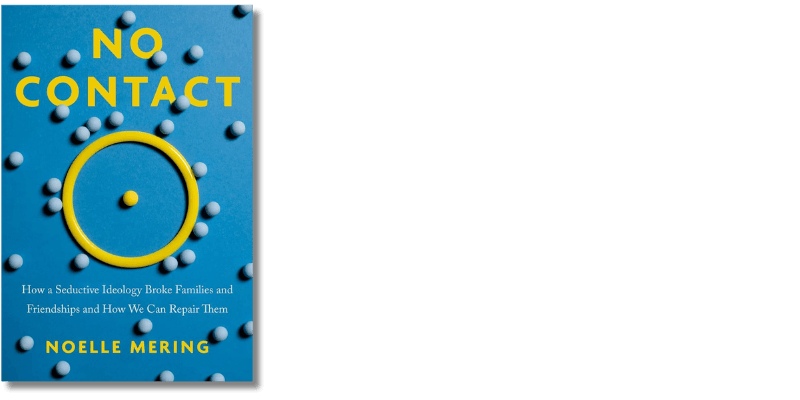
Family estrangement is another complicated phenomenon.
Mering, a fellow at a Washington, D.C.-based think tank, writes about modern estrangement between parents and adult children, specifically cases not based on abuse, but from:
“the ordinary parental failings that, in previous generations, would have been absorbed or forgiven rather than collected, catalogued, and marshaled retroactively to support a narrative of childhood harm.”
She argues that today’s ideological divisions are the source of many estrangements. She says the three most common ideological reasons fall into roughly three categories: disagreement over Covid policy, voting for Donald Trump, and gender ideology (no sources are cited for this list).
While she often provides interesting insights, such as “disagreeing well is civilizing,” her analysis frequently places the blame on liberalism. I found this approach to be polarizing itself.
She fails to give sufficient attention to other causes that may contribute to a child going no contact outside of abuse, such as the lack of desire or communication skills to navigate disagreement, the heavy influence of a partner or other third-party, or mental health struggles or addiction affecting either the adult child or the parent.
I also questioned her advice on negotiating a reconciliation based on the parents finding the right words. That assumption negates the premise of her title, No Contact. No contact typically means all communication has been severed. Even if a parent had the perfect words, it wouldn’t matter if the adult child has chosen not to hear them.
I wish Mering had spent less time defending her political perspective and more time exploring how people can have discussions even when they disagree. To me, her judgment of one side of the divide doesn’t seem helpful in guiding families toward making peace despite their differences.
3. THE ART OF FIGHTING
The Transformative Power of Conflict
by Priya Parker

What if conflict in a group isn’t necessarily a sign that the group is failing? Parker writes that learning to face conflict instead of avoiding it can forge meaningful human connections.
“If you want to be more connected to the people in your life, fight more. And learn the art of doing it well.”
In The Art of Fighting, Parker says we haven’t developed enough tools for working through conflict as a group. So she offers many real-life examples and lots of practical suggestions:
- ask “dumb questions” to better understand other people’s perspectives
- normalize saying “ouch” when something hurts
- make quick mini-repairs more often within the group
- talk things out face-to-face rather than relying on digital communication
Also, keep asking, “What is the group’s actual need?”
Sometimes it’s worth learning to fight well enough to stay together.
But Parker also says that not every conflict can be resolved. She points out that groups have life cycles, and sometimes they reach a natural end. Acknowledge it. Rather than slowly fading away or ghosting one another, she encourages groups to recognize and verbalize when it’s time to close a chapter.
Easier said than done, but healthy connections sometime mean letting go instead of trying to preserve a group when it no longer makes sense.
My Takeaway
I appreciate that each book helped me see from three different angles that the struggle to connect can be worth our effort. And that disconnection doesn’t automatically equal failure.
Whether we’re connecting with ourselves, with a group, or learning that connection isn’t possible, the books also shows that there is no easy formula for any of this. Relationships aren’t simple.
The harder work may be recognizing what is needed when: when to stay and work through the conflict and when to leave.
What helps you decide when a relationship or group is worth fighting for—and when it’s time to let go? Share your thoughts in the comments.
Thanks to NetGalley for the review copies of these books
Lisa, what a thoughtful and interesting post! ❤️ I really appreciate how you look at these three books critically, without trying to find one simple answer to such complicated questions.
I especially appreciated your thoughts on “No Contact”. You can have the best intentions and choose your words ever so carefully, but rebuilding a relationship takes more than one person’s willingness. You cannot have a conversation on your own. Thanks fot that.
And I love the idea that disagreement doesn’t necessarily have to mean disconnection. We don’t have to agree on everything to love and respect each other.
But sometimes, despite our best efforts, a conversation just isn’t possible. And I think that’s where wisdom comes in. Knowing when to keep trying and when to let go. It’s hard for me.
What struck me most is that you leave room for both. Not every relationship needs to end because things become difficult, but neither can every relationship be repaired simply because we want it to be. Thank you so much, Lisa. You’ve given me a lot to think about. ❤️