
The Book Begins . . .
I appreciate the beginning of this book:
“I challenge you to question every topic I discuss in this body of text. For without questioning and doubt, our faith is both stagnant and boring.”
And I do question things in this book. Some I agree with; some I don’t (as with any book).
Reborn Again is the story of Christopher VanHall’s faith journey from Christian conservatism, through deconstructionism, to where he is now.
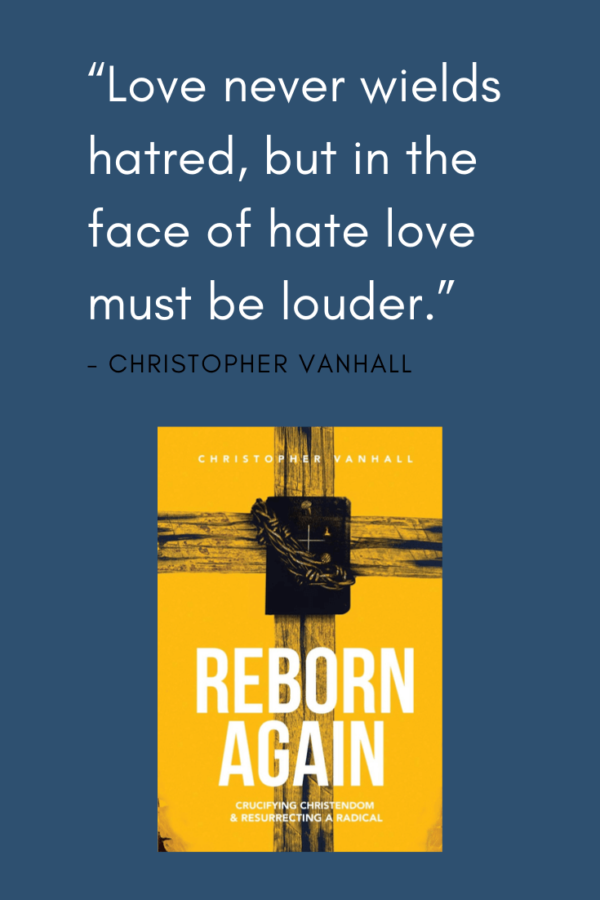
I’ll tell you up front: This book isn’t for everyone. VanHall uses language you don’t find in most Christian books (he warns you in the intro). But he also includes stories of radical obedience that you also don’t find in many books.
So while I won’t give it a hardy recommendation for everyone for various reasons, you can decide for yourself. If you like reading about nontraditional paths to Jesus, aren’t flustered by questioning of traditions, and can listen to alternate approaches to ministry in colorful language, you might enjoy it.
I give it three stars out of five.
The Book’s Meat
With that caveat, here are four lessons I appreciate in Reborn Again:
• Let go of Christian traditions that are directly opposed to Jesus’s teachings.
“If the Gospel of Jesus is going to have impact in modern application, then it is time to place irrelevant traditions and tarnished systems of belief in the grave so that the historically radical directive of a Jewish, nonviolent, subversive rabbi named Jesus can be resurrected. That directive is this: The God of scripture is opposed to any system of law and order that survives by utilizing hierarchical values to elevate the status of some by lowering the societal value of many.”
“The Church has forgotten its purpose and replaced its historical mandate with ridiculous customs and beliefs that are far from biblical.”
• Don’t be afraid of the “other.” Let love be louder than hate.
“The acute isolationism of many southern conservatives is a byproduct of fear-based propaganda. There is so much terror surrounding the concept of the ‘other’ and frightening ‘liberal ideals’ that many rural southerners often prefer seclusion.”
“Love never wields hatred, but in the face of hate love must be louder.”
• Honestly reevaluate the morality of America’s past.
“If we are honest about our nation’s origins of genocide, theft, slavery, neglect, and abuse, it is clear that we have never been great. We have been powerful. Between these two distinctions there is an ocean of difference.”
“The restorative work of the historical Jesus beckons Christ followers to the front lines of resistance and demands that systemic racism be yanked from America’s soil root and stem. A just future is possible, but not until the Church can confess the sins of our ancestors that fashioned the foundation of the many injustices that surround us. Dr. King said it best in these famous words, “The time is always right, to do what is right.”
“Contrary to popular belief, God is not an American.”
• Let prayer inspire you to act, not to just be passive.
“Prayer does not alter unfortunate circumstances for us. Prayer endows us with the courage and insight to change the world around us.”
“How often had my privilege blinded me to the suffering of the marginalized, when I possessed the capacity to do something about their suffering?”
And It Ends . . .
I appreciate the ending of this book because VanHall has a great “Further Reading” list of many books that I also would recommend, and many more that I want to read. In his own words, he prefaces the list with this: “If the thought, ‘Where the h*** did Christopher come up with this s***?’ entered your mind at any point in my book, then I invite you to check out these amazing literary works.”
He then gives a similar caveat for these books that I give you for his book: “I may not be totally on board with every theological position these authors have, but I have learned valuable information from each of these incredible works that inspired me at different points of my spiritual journey.”
We pass along to each other what we learn from God.
* * *
My thanks to Speakeasy
for the review copy of this book