Is Faster Better?
The last decade has been one of speed. Faster internet. Faster sprinters. In general, faster living.
But is faster always better?
Do we always need to move along quickly? Quicker? Quickest?
I’ve known for awhile that I personally value efficiency highly. I like maximum proficiency with minimal waste.
But perhaps too highly? Does our culture foster an idolatry of efficiency?
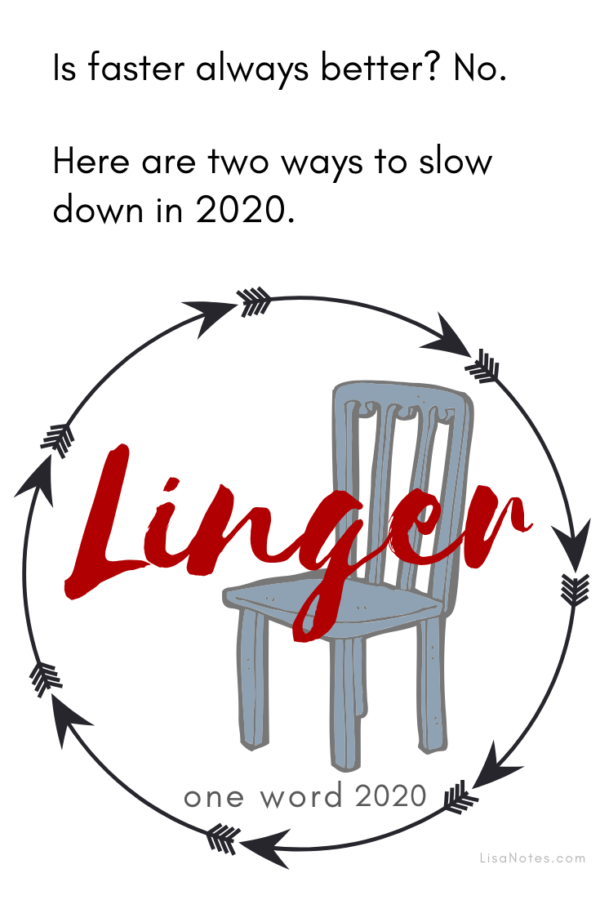
Here are two ways to slow down this decade, instead of speeding up.
Instead of feeding the idol, we can purposefully starve it.
1 – Redefine Waste
I don’t like waste. Of any kind.
I’ll squeeze a toothpaste tube dry. I balance my checkbook to the penny. I maximize a 22-minute workout routine from home (Justice Ruth Bader Ginsberg’s trainer affirmed it for me this week).
And time? Of all things I hate to waste, it’s my time. I want to account for my hours and invest them wisely. My to-do list is tightly tied to my calendar so there’s a proper slot to finish each thing.
I want to live efficiently by properly stewarding my resources. It was drilled into me by my father, and hard-wired into me by God.
But can it be wasteful to use something all the way up?
Yes. It can be wasteful when we try to be too productive. We damage our health, our work, our relationships.
It can be more valuable to leave some left over for later.
- Leave space for growth.
- Leave margin to breathe.
- Leave downtime for renewal.
Live life less efficiently and more extravagantly.
2 – Do Fewer Things
No one likes to be rushed. Ask any 2-year-old when you’re pushing them to get dressed.
“Hurry up! Hurry up!” (It makes me anxious even typing it.)
But as much as I dislike hurrying, I also hate being late. I’d rather start preparing too soon, leave too early, and plan too far ahead than feel time clamping down on me at the last minute.
We feel the speed of 2020 pushing us to hurry more and more.
Intentionally counter the need for speed by consciously choosing slowness instead. Do fewer things and take longer doing them.
And when we accomplish less by eliminating things and moving slower? We can still feel more accomplished.
Living at a human pace instead of automatically rushing is more satisfying.
My Antidote to Waste and Hurry
Of all words NOT for me in 2020, “linger” would be my anti-word. Linger feels costly, too slow, even . . . wasteful.
Until I came across this:
“‘Lingering is the opposite of rushing,’ [KJ Dell-Antonia] says. It feels more grownup and luxurious than dawdling and dillydallying. It doesn’t imply that you have nothing to do or that you are avoiding the important stuff.
“[Lingering] implies that you have important things to do and you are giving them the time they deserve.”
– Laura Vanderkam, Off the Clock
This made me pause. It made me set the book down. It made me pray.
One Word 2020: Linger
Linger is now my word for 2020. Whether I like it or not. God gave it to me.
And I don’t want to waste it. I don’t want to hurry through it.
- I need Linger to fight my idolism of efficiency.
- I need Linger to calm my pace.
- I need Linger to stop moving on before it is time.
If I linger more this year, does that mean I’ll be inefficient? Will I have to live hurriedly to catch up on things left undone?
I hope not. God, I’m trusting you. Guide me through moments of when to linger and when to pass on through. Reset my priorities to fit the container of time you hand me.
“We’re in no hurry, God. We’re content to linger in the path sign-posted with your decisions. Who you are and what you’ve done are all we’ll ever want.”
Isaiah 26:8 (Message)
How I’ll Linger
I have a stack of books that I’ll be lingering through all year, reading slowly, stretching them out. They include, but aren’t limited to, these:
I’ll also use six concrete themes to rotate through and linger on through the year, including:
- Lingering in Conversation
- Lingering in Body
- Lingering in Silence
- Lingering in Experience
- Lingering in Sharing Details
- Lingering in Now
I’ll share specific examples later of how it’s happening and what I’m learning.
I’m not sure where God wants to take me through Linger.
But I won’t know if I don’t linger with him a bit to find out.
* * *
Does life feel too fast to you? How do you slow down? Please share thoughts (and your One Word) in the comments.