Which Shape Should I Be? – Book for Toddlers

Which Shape Should I Be? is just the right size boardbook for toddler hands to hold and turn pages.

And it uses just the right size words and concepts to match.

Which Shape Should I Be

Each page explores a shape, clearly defined, then invites you to interact by finding the shape in the accompanying picture. The images are brightly colored in bold shapes of activities that children can relate to.

The ending is delightful as well:

God shapes every girl and boy
with love so wondrously
Because He knows the best shape
for each one of us to be!

“I will praise you because I have been remarkably and wondrously made.”
Psalm 139:14

* * *

My thanks to B&H/LifeWay Bloggers
for the review copy of this book


Keep Empty Spaces

“Without margin, each of us would have great difficulty guaranteeing availability. Instead, when God calls, He gets the busy signal.”
– Richard Swenson

Keep Empty Spaces

E—Empty Spaces

Have you ever felt closed in? Perhaps you do when you open a kitchen junk drawer or an overflowing bedroom closet.

When things are too crowded together, there’s no breathing space.

While God may be in stuff, our belongings, our collections, he is also the glue that keeps all our empty spaces connected.

Try This

Look for holes today. Empty spots. Blank spaces.

  • Maybe it’s a vacant spot on a shelf.
  • Or an empty photo frame.
  • Or an unfilled glass sitting by the sink.

Imagine God breathing in the empty spaces. View them as open areas where God is sitting with you, wanting you to luxuriate in a little extra breathing room, a spaciousness that he fills with himself.

Take a few deep breaths and notice the space around you where your exhale goes. God is in the unfulfilled spaces as much as he is in the things he created around them.

Thank him for the margins in your life, for the gaps that allow you to move about.

Sit with him in the empty spaces for a few more minutes, then return to your day.

Further Reading

* * *

Where do you see an empty space in your environment? Are you comfortable with it? How is God there? Please share in the comments.

Next in the series:

Index: See all 26 ways to encounter God here.

26-Surprising-Ways-to-Encounter-God_Lisa-notes

updated from the archives


3 Reasons You Don’t Read Nonfiction and Why You Should Anyway

Look at why you don’t read nonfiction books. And see how you can change your mind.

Here are LOTS of my favorite, 5-star nonfiction books.

3 Reasons You Don't Read Nonfiction

Why You Hate Nonfiction

I love a fun novel. Fiction books can pull me deep into a story, wanting to read on and on. They also can be educational and insightful in their own ways.

As a result, many fiction readers avoid nonfiction books. They’ve found what they love in fiction; why read anything else? Plus . . .

(1) They often think nonfiction books are boring.

They fell asleep studying a high school chemistry text and why repeat that? They don’t want to read a scientific summary of dull data or a detailed description of an event that happened centuries ago. They want a story that entertains, not a sermon that lectures.

(2) Nonfiction books also have a reputation for being too long.

Being assigned to read long passages of text for work or school in short periods of time make us restless. Authors can attempt to tell everything they know about a topic, interesting or not, relevant or not. Readers grow tired before the writer does.

(3) A third reason people often dislike nonfiction books is they can present opposing views.

Opinions, philosophies, and theology differ from person and person. We aren’t keen on spending time listening to opposing ones, even a short article shared by a Facebook friend on the other side of the aisle.

So why bother with nonfiction at all?

3 Ways to Try Nonfiction

Here are 3 reasons and ways to give nonfiction another try, even if you prefer fiction.

(1) Explore WHAT types of nonfiction books to read.

Boring textbooks are only one style of nonfiction books. If you haven’t read a nonfiction book since school days, experiment with the different styles of new books available. Modern marketing and ease of publication have steered many older and new authors to write in more engaging styles, use more relevant illustrations, and speak in everyday language instead of only ivory tower prose. See Dreyer’s English: An Utterly Correct Guide to Clarity and Style by Benjamin Dreyer as an example. It’s a wonderfully delightful book on, of all things, grammar.

Also, many nonfiction books are told with a strong narrative thread. They are plot-driven and present their facts in story form. If you prefer novels, find a nonfiction book that reads like one. Barbara Demick’s book, Nothing to Envy: Ordinary Lives in North Korea, is a fascinating story that exposes you to another culture but through a strong narrative voice. Or try The Sun Does Shine: How I Found Life and Freedom on Death Row by Anthony Ray Hinton about his death sentence for a crime he didn’t commit.

Another advantage of nonfiction books is they are often compiled by a variety of authors in one edition. Try In Search of Wisdom: A Monk, a Philosopher, and a Psychiatrist on What Matters Most by Matthieu Ricard, Christophe André, and Alexandre Jollien. You will enjoy hearing different voices in conversation around a single topic.

Or read a book by one author but on a variety of topics. Try Bob Goff’s book Everybody, Always: Becoming Love in a World Full of Setbacks and Difficult People. It is a new story in every chapter about Goff’s life experiences, and is sure to entertain and inspire you to love better.

And if you actually are into charts and graphs? Nonfiction will offer your a treasure trove of options to feed your information addiction. Try Steven Pinker’s Enlightenment Now: The Case for Reason, Science, Humanism, and Progress. It contains 75 graphs, but it is fascinating information. (It’s also Bill Gates’ favorite book.)

(2) Experiment with HOW you read nonfiction books.

With a novel, you start at the beginning and read in a straight line until you get to the end. But with a nonfiction book, you often have options.

You don’t always have to start at the beginning. Pick a favorite chapter and read that one first. Or only that one. Start at the end to get the conclusion, then start over at the beginning.

Slow down for new material; quickly scan or skip material you already know. Try skipping around in James Clear’s Atomic Habits: An Easy & Proven Way to Build Good Habits & Break Bad Ones (but you will want to read it all eventually, trust me!).

Also experiment with time or page limits. For tough books, commit to only 5 minutes a day. Or 5 pages. You’ll be surprised how good it feels to make daily progress, even if it is slow. You will eventually finish as long as you continue forward. When I was reading Tears We Cannot Stop: A Sermon to White America by Michael Eric Dyson, I committed to reading 5 pages a day. And it was so worth it.

(3) Examine WHY you read nonfiction books.

While your purposes for reading nonfiction may overlap with fiction, there are also distinctions. With nonfiction, you’re more likely to be searching for facts, for truth, for knowledge that can help you going forward (even if it’s about events already past). Try Everybody Lies: Big Data, New Data, and What the Internet Can Tell Us About Who We Really Are by Seth Stephens-Davidowitz.

But nonfiction can be beneficial in the spiritual dimension as well. By exposing you to more knowledge—even if it’s knowledge you’re having to doublecheck—you are also exposed to seeing another side of yourself that you may not have seen before. Try Scot McKnight’s The Blue Parakeet: Rethinking How You Read the Bible. Or Barbara Brown Taylor’s Leaving Church: A Memoir of Faith. You don’t have to agree with everything to still learn something.

Whether it’s in a memoir or a book about space or theology itself, look for the beauty and goodness of humanity, inviting you into wonder and awe of our world, such as in Paul W. Brand’s The Gift of Pain: Why We Hurt & What We Can Do About It (previously titled The Gift Nobody Wants, the title I prefer).

On the flip side, also stay aware of invitations to use YOU to make a difference in places that need change and light. Try Just Mercy: A Story of Justice and Redemption by Bryan Stevenson. Or I Am Malala: The Story of the Girl Who Stood Up for Education and Was Shot by the Taliban by Malala Yousafzai.

While you can’t trust any nonfiction to be 100% accurate, it can still expose you to different perspectives to consider and test. Let nonfiction stretch you into questioning previously-held beliefs—whether about science or religion or history—so you can refine how you see yourself, other people, and your world through a more precise and possibly more compassionate lens. Try The Righteous Mind: Why Good People Are Divided by Politics and Religion by Jonathan Haidt. Or I Think You’re Wrong (but I’m Listening): A Guide to Grace-Filled Political Conversations by Beth A. Silvers and Sarah Stewart Holland.

From the Head to the Heart

Maybe you still won’t fall in love with nonfiction like I have.

But by adding a few nonfiction books on your nightstand (and keep reading your novels, too), you might see nonfiction is not as bad as you think.

Not only will you learn new facts, new truths, and new people, but you also may learn more about yourself as well.

Fiction may touch the heart head-on, but nonfiction can reach your heart, too. It just takes a different path: through your head.

Don’t miss the touch, however it reaches you.

* * *

Do you prefer fiction or nonfiction? What’s a favorite nonfiction book you can recommend? Please share in the comments.

Read more:


Is God Good? 3 Ways to Find God’s Goodness

We can’t share about God’s goodness if we don’t see it.

Do you know how God has been good to YOU?

On any given day, we can see bad things happen around us. We wonder why God isn’t rushing in to remove all obstacles or heal all sicknesses, even though He can.

When we don’t understand what is happening, we can be quick to jump to wrong conclusions.

But what if instead of jumping to blame, we jump instead to grace?

3 Ways to Find the Good in God

Read them all here.

Is God Good

* * *

I’m writing today at Do Not Depart about finding the goodness of God.

Will you join me there?


Why You Are Still Here

It could have been a birthday celebration. Happy Birthday to our middle daughter.

Instead, we went to the cemetery.

Why are you still here

A Thousand Little Deaths

If Kali had lived her first day, and the day after, and the day after, I would have been more eager to live those days, too.

But instead, when she died on Day 1, November 13, born premature and with severe problems, part of me wanted to die, too.

Don’t we all die a thousand little deaths throughout our lives? Don’t we all collect bruises on our souls?

The author of Psalm 118 certainly had his own little deaths. He knew about prisons and enemies and destruction. He (and the Hebrew people collectively) had been pushed hard.

But at this point he had not been handed all the way over to death (Psalm 118:18).

Others had died. Why not him? Why not me? Why not you? Why not yet?

Resurrect One Slow Breath at a Time

It took me awhile to understand why I was still living without my baby to care for.

Resurrection is sometimes instantaneous. But sometimes resurrection only comes one slow Spirit-breath at a time.

For me, resurrection was one small thing at a time—a friend bringing dinner after my C-section, a sympathy card in the mailbox, a flower left on Kali’s grave.

And resurrection was one person at a time—a gentle hug, a conversation mentioning Kali by name, an empathetic ear.

Each small thing reminded me I had big reasons to still be here.

  • I had my husband Jeff who loved me (and was grieving too),
  • my 4-yr-old daughter Morgan who needed her mommy, and
  • a God determined for me to know joy again.

(And unknown to me, another reason to still be here was on the horizon: a third daughter, Jenna, later to be conceived, born, loved.)

It is for the living we stay. For the loving. For the Lord.

You Still Have Purpose

If you are here reading this—as I am still here writing it—the Lord still has purpose here for you, too.

Even if you’ve come to the very rim of death, or are in crisis of a little death even today, know that God kept you from falling over the edge for now, for a reason.

You still have . . .

  • living to do
  • love to give
  • praise to proclaim

God can empower a thousand little resurrections over your thousand little deaths.

So even though I am sad today that Kali has not been here in the flesh for 26 years, I can proclaim with confidence along with the psalmist in Psalm 118: “The Lord is powerful!” (Psalm 118:15 CEV)

Even when I don’t understand death, I can trust resurrection.

I have lived to tell what the Lord has done.

* * *

Do you know why you are still here? You are here to love somebody this week. Someone is here to love you. Please share in the comments.

Updated from the archives


3 Spiritual Books on the Enneagram

3 Spiritual Books on the Enneagram_Lisanotes

The Enneagram and Spiritual Growth

The Enneagram is a hot topic this past year. What is the Enneagram? It’s a system of personality typing, divided into nine main types. (Here’s a quick synopsis of each nine numbers. Which are you?)

While most of us identify stronger with one type over the others, we all have traits from every type.

But the Enneagram can do more than tell you about your personality today. It also can be used as a tool (one among many) that can help you grow in your relationship with God and with others in the future.

If you’d like to learn more about the Enneagram and spiritual growth, here are three books I highly recommend. Each one leans toward better spiritual health, not just psychological and relational health.

Three Spiritual Books on the Enneagram

1. For Beginners:

The Road Back to You
An Enneagram Journey to Self-Discovery
by Ian Morgan Cron and Suzanne Stabile

The Road Back to You

This book gives a great overall explanation to help you find your type so you can better cooperate with God in your transformation. (Here are some of my favorite take-aways from The Road Back to You about how to love that OTHER number on the Enneagram.)

2. For Spiritual Disciplines:

The Sacred Enneagram
Finding Your Unique Path to Spiritual Growth
by Christopher L. Heuertz

The Sacred Enneagram

Christopher Heuertz’ goal with this book is to help us “find our way back home, back to our essential nature, our True Self, and back to God.”

He exposes nine ways we lie to ourselves about who we think we are, nine ways we can come clean about those illusions, and nine ways we can find our way back to God.

Here are some ways to practice your Enneagram number from The Sacred Enneagram.

3. For Digging Deeper:

The Wisdom of the Enneagram
The Complete Guide to Psychological and Spiritual Growth for the Nine Personality Types
by Don Richard Riso and Russ Hudson

blank

Lots of details are in this book, but they’re easy to understand. This book goes into each type’s basic fear, basic desire, and distortions. It offers a spiritual jump start for each type, red flags, and an invitation to abundance for each type.

For Further Reading

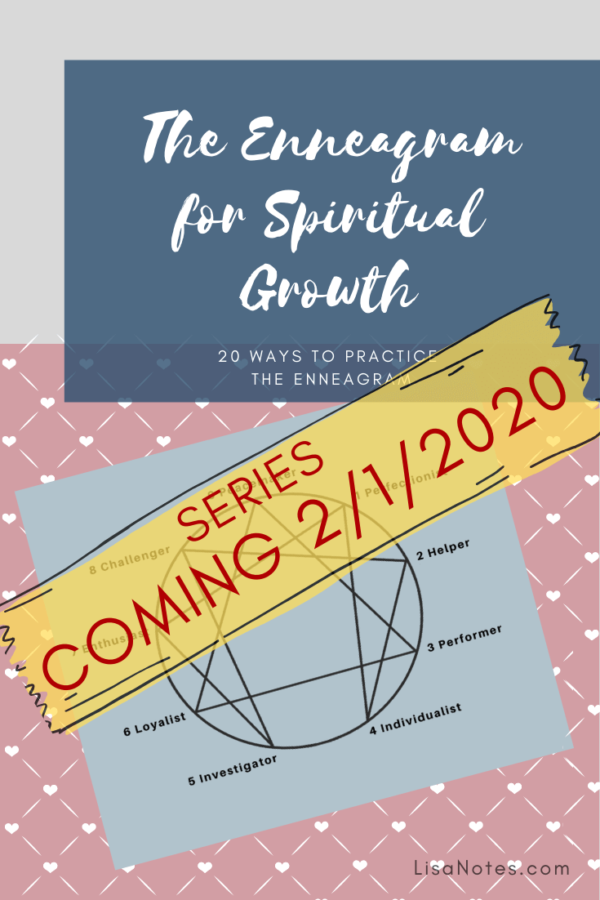
I hope to do a 28-day series on the Enneagram in February 2020. I’ll share lots more about the Enneagram and how to use it to grow spiritually and relationally, including more books I recommend, links to podcasts, Enneagram quizzes, how to use the Enneagram in your everyday life, etc. Stay tuned!

* * *

I’m sharing today with Katie at Doing Dewey for #NonficNov. This week’s assignment is to share three or more books on a single topic that you have read and can recommend.

Do you have a favorite Enneagram book or resource that you’d recommend? Please share in the comments.

More book recommendations from #NonficNov: