

Hit Reset
My mind can run away from me quickly. It darts through some dark alleys these days. When I read too many articles about the coronavirus or listen to too much news, my anxiety heightens. And my hope diminishes.
I need to hit the reset button.
One way I do that is through memorizing scripture. It gives me better words to focus on. It helps me remember the bigger picture, the bigger God, who knows everything going on around me and in me.
These are words I need to keep on repeat.
He who dwells in the shelter of the Most High will abide in the shadow of the Almighty.
Psalm 91:1
and
I will say to the LORD, “My refuge and my fortress, my God, in whom I trust.”
Psalm 91:2
So I’m going to memorize Psalm 91 over the next few weeks with the community at Do Not Depart.
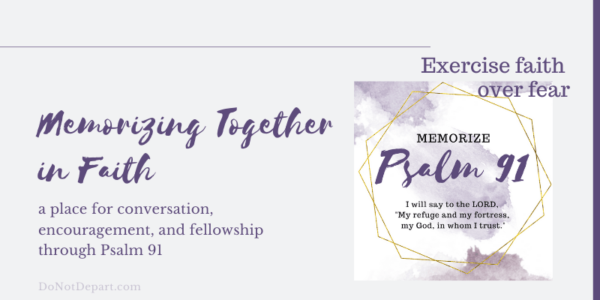
If you want to memorize Psalm 91, too, get the details here.
Psalm 91 is a calming chapter about God’s deliverance, God’s covering, God’s faithfulness.
Sign up lasts another week and a half (now–April 5). We’ll start memorizing the Monday of Easter week, April 6. We’ll learn two verses a week for eight weeks, ending on Pentecost Sunday (May 31).
Our memory challenges are no pressure, no rules, just a fellowship of believers setting our minds on higher things.

Our Featured Post
Our featured post this week is also about overcoming anxiety. Bettie G shares her story of anxiety as she walked through the door to the Infusion Center.
Bettie reminds us that we’re not meant to carry our burdens alone. Not only is Jesus with us, he also wants us to be there for each other, too.
Read Bettie’s words here, “Sharing: Lifting Shame in Our Praying.” And if you pray, also lift her up as she walks through new medication infusions and their aftereffects. Bettie is a true champion in the fight for faith.
Thanks for sharing, Bettie! Here’s a button for your blog.
MAREE DEE – Embracing the Unexpected
Blog | Facebook | Twitter | Instagram | Pinterest
HEATHER HART & VALERIE RIESE – Candidly Christian
Blog | Facebook | Twitter | Instagram | Pinterest
LAUREN SPARKS
Blog | Facebook | Twitter | Instagram | Pinterest
LISA BURGESS – Lisa notes
Blog | Facebook | Twitter | Instagram | Pinterest
We pray that Grace & Truth will point you to Jesus. Add your post to encourage others in the Christian blogging community.
1. Follow your hosts on their blogs and/or social media channels, if you’d like.
2. Share 1 or 2 of your most recent CHRISTIAN LIVING posts. (No DIY, crafts, recipes, or inappropriate articles.)
3. Visit and comment on 1 or 2 other links. Be an encourager. Please don’t link and run.
4. All links are randomly sorted. Link early or late. The playing field is even.
To Be Featured:
5. Post the button or link back to one of our hosts. It encourages new participants. (Not mandatory to participate, but required to be featured.)
6. Every host will feature and promote one blog every week.
Now Let’s Link Up!
How is your anxiety level? How do you reduce it? Please share your thoughts and concerns in the comments.
If you want to memorize Psalm 91 together, get details here.