5 Reasons to “Do” the Book Instead of Just Reading It (+ 5 Book Picks)
{Nonfiction November Week 2}

Week 2 of Nonfiction November is about Choosing Nonfiction. Here are a couple questions I often ask when I decide on a nonfiction book:

  • Can I do something with this book besides just read it?
  • How can I experience this for myself, too?
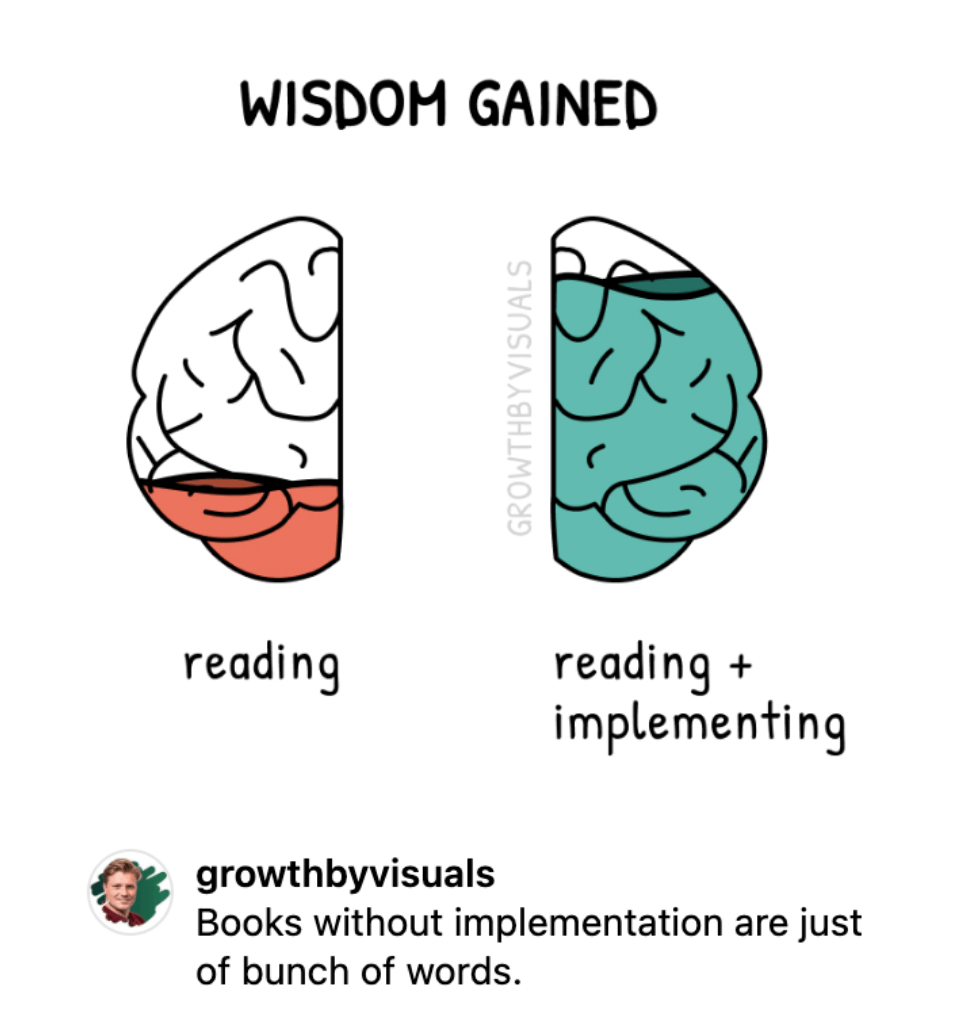
Follow @growthbyvisuals

(Disclaimer: I also love novels! But I read them for escape, for fun, and for entertainment. If it turns out to prompt action, too, well, that’s just bonus.)

5 Reasons to Do a Book Instead of Just Reading It

Here are 5 reasons why I find doing a book to be beneficial—and a book suggestion for each.

1. YOU UNDERSTAND BETTER WHEN YOU PRACTICE.

Reading about something is one thing. Doing it is another. To get better at basketball, for example, you don’t just read about plays and strategies; you pick up a ball and play.

“Doing” a book works the same way to me. Answer the journal prompts. Try the exercises. Experience the game, when possible.

My book club recently finished Priya Parker’s book, The Art of Gathering: How We Meet and Why It Matters.
The Art of Gathering

But instead of only reading it, we are trying to individually experiment with Parker’s ideas in our own gatherings. It’s been interesting to try new strategies in how we meet with others.

2. YOU DISCOVER BLIND SPOTS.

My friend showed me how to do something. It looked easy. Until I tried it myself. Sometimes you don’t know what you don’t know until you actually try it yourself.

Here’s a book that is perfect for this if you want to discover your blind spots: Seek: How Curiosity Can Transform Your Life and Change the World by Scott Shigeoka.

Seek How Curiosity Can Transform Your Life and Change the World

While reading about curiosity is one form of practicing curiosity, it’s more beneficial if you take the material outside the book to see where you can improve.

Shigeoka suggests practical tips, like acknowledge small bids for attention, take a “brave pause,” or ask yourself key questions before taking action.

While we want to learn from others’ mistakes, the strongest lessons still come when we experience our own.

3. DOING MAKES IT STICK.

We retain what we do longer than what we simply read. Books that get us out of our heads and into our bodies make knowledge stick around better.

This book did it for me: Democracy in Retrograde: How to Make Changes Big and Small in Our Country and in Our Lives by Sami Sage and Emily Amick.

Democracy in Retrograde

Some of its practical suggestions include:

  • Audit your news consumption
  • Create a civic calendar
  • Show up at local events
  • Join a nonprofit
  • Call your representatives
  • Celebrate small wins

At the book’s prompting, I finally downloaded the Five Calls app for calling Congress, and now I use it to keep up with my calls to representatives instead of starting every time from scratch.

4. DOING BUILDS CONFIDENCE.

This summer when I realized I was on my phone too often, I read this book for strategies: How to Break Up with Your Phone: The 30-Day Plan to Take Back Your Life by Catherine Price.

Book cover of How to Break Up with Your Phone The 30-Day Plan to Take Back Your Life by Catherine Price

In it, she instructs the reader to actually pull out their phone and do things like this:

  • Set a digital Sabbath
  • Assign a bedtime and wake-up time for your phone
  • Establish no-phone zones in your home
  • Unsubscribe instead of just delete unwanted emails

These are all actions I can do (well, some of the time anyway?), thus building my confidence (a little) that I can control my phone instead of my phone controlling me. This one is still a work in progress for me….

5. DOING TURNS KNOWLEDGE INTO WISDOM.

After watching the encouraging reels by James ‘Fish’ Gill on Instagram, I grabbed a copy of his book about relationships: How to Fall in Love with Humanity: 16 Life-Changing Practices for Radical Compassion. And I’m so glad I did.

How to Fall in Love with Humanity 16 life-changing practices for radical compassion by James'Fish' Gill

His insightful advice can improve relationships—but only if they’re practiced.

Here are some examples from his book, things you may already know but good reminders to practice them:

  • Share your experience, not your analysis
  • Listen to understand, not just to respond
  • Ask questions with curiosity, not assumption
  • Witness both the yearnings and the pains of others

Learning is rarely one-and-done. It takes time and repetition to go from head-knowledge to heart-wisdom. 

The Takeaway

Books aren’t only for your thinking—they’re also for your living.

The best nonfiction doesn’t just inform. It challenges you to act.

So read a book, then do it, and watch for the changes that follow.


Which book have you read recently that you could put into practice? Share your thoughts in the comments.

Read more about reading:

Find more posts on choosing nonfiction books at Frances’s blog, Volatile Rune, for week 2 of Nonfiction November.

blank


On the Blog – October 2025

Here are brief summaries and links to posts on the blog, Lisa notes, from October 2025.

blank

See previous months’ archives here


Seasons of Change: How Weddings, Trees, Books, and Rooms Remind Us to Grow
{Share 4 Somethings - October 2025}

Weddings, trees, books, rooms—they all told me the same story this month: things change, and that’s the point. Growth doesn’t mean erasing what used to be. It simply means building on the past’s foundation as new things unfold.

It’s like this quote I’ve been memorizing:

“I would love to live like a river flows, carried by the surprise of its own unfolding.”
― John O’Donohue

Each month I share 4 somethings that I have:

  1. Loved
  2. Learned
  3. Went well
  4. Let go of

And then I link up with Jenn.

~ * ~ * ~ * ~

Something I loved

  • THE BRIDE THAT TIME BUILT 

Last weekend, we attended what I’m calling the final wedding—the last of our neighbor’s four kids to get married. Brooke wasn’t even born when we moved into the neighborhood in 2001. I remember staying with her older siblings the night she was born, while her parents dashed to the hospital. I remember my daughter Jenna giving Brooke ballet lessons in our basement. Brooke later was the flower girl in my daughter Morgan’s wedding.

blank

Me and Brooke, 2011

Fast-forward several years:

Now Brooke is dancing with her new husband at her own wedding.

blank

blank

Time doesn’t just march on—it runs. I’m grateful for memories from the past as well as new memories we continue to make.

 ~ * ~ * ~ * ~

Something I learned

  • THE TREES THAT TEACH US

Our book club of several years hosted a family cookout a few Sundays ago called “Branches & Burgers.” The book we had been reading was The Art of Gathering by Priya Parker (which I highly recommend, by the way), so we were very intentional about following a theme.

We asked everyone to send a photo of their favorite tree and bring a tree-related item for show-and-tell. We later walked around outside for a tree identification contest (I lost, even though it was my own backyard). The kids participated as much as the adults.

blank

blank

blank

It was a wonderfully surprising day. No matter how well you know a person (or your backyard) already, there is always more to learn.

~ * ~ * ~ * ~

Something that went well

  • THE VOICES THAT LIFT US

The same book club took a field trip to hear Jen Hatmaker speak, alongside her boyfriend Tyler Merritt and friend Mary Kathryn Backstrom. The event, hosted by our local independent bookstore, was so nourishing—full of laughter, truth-telling, and community-building.

blank

It makes our next book choice an easy pick:

Jen Hatmaker’s newest memoir, Awake.

We’ll start it next week.

blank

~ * ~ * ~ * ~

Something I let go of

  • THE ROOM THAT REMEMBERS

After years of good intentions, we finally put in the work to redo our youngest daughter’s old bedroom. Once filled with her cow collection and childhood photos—including a professional photo with her pet duck—we’ve been using it as a playroom, but it felt chaotic to me.

But fresh paint, new carpet, and a few new bookshelves have transformed the room into a more joyful and inviting space for the next generation to spend time in.

blank

blank

Letting go of the past doesn’t mean forgetting it—it just means moving over a bit to make room for what’s still growing.


What’s changing in your life this month?

Share your thoughts in the comments.

I’m linking at these blog parties


Read What Matters Most: 5 Nonfiction Books To Use Your Time Well
{Nonfiction November Week 1}

Each November, nonfiction lovers pause to reflect on the books that have shaped us over the past year. Week 1’s theme—Celebrate Your Year of Nonfiction—invites us to look back at favorite books, topics, and what we want to explore next.

But here’s the challenge:

So many books, so little time.

Eventually we readers realize this truth—there’s not enough time left to read everything we want to.

So how do we choose wisely?

Unfortunately, there’s no magic formula.

You likely do what I do to decide what to read next:

  • take recommendations from trusted reader friends with similar tastes,
  • sample fresh books that break new ground,
  • reread old books that stand the test of time,
  • follow your personal curiosities, and
  • know when to stop reading a boring book.

This year, especially relevant with my year of Ripple, I’ve been drawn to this theme: making the most of my time while I’m here—both in reading and in life.

To help with that, two topics have stood out in my nonfiction stack in 2025: productivity (time management) and presence (aging well). These books encouraged me to use my limited days (and book time) with more focus and intention while also accepting my finitude with more grace and clarity.

Five Favorite Books on Using Your Time Well

Here are my five favorite books so far this year on managing our remaining years better. I hope they inspire you, too—not just to read more books, but to spend your reading time (and all your time) on what truly matters most to you.

1. Tranquility by Tuesday
9 Ways to Calm the Chaos and Make Time for What Matters
by Laura Vanderkam

Tranquility by Tuesday

I’ve been working through Vanderkam’s nine strategies this year to give me a better perspective about time. Such as, I now have a weekly planning session with myself each Friday about my week ahead (it only takes about 10 minutes). I see what things I have to do, such as appointments, but also create slots to fit in things that I want to do, like working a jigsaw puzzle.

I hope I keep this habit going forward because it’s made such a difference—this year I’ve already put together another photo album, almost finished my end-of-life documents (Jenna will thank me later for this one!), learned new piano songs, and begun reading my and my mother’s old journals.

2. Advice for Future Corpses (And Those Who Love Them)
A Practical Perspective on Death and Dying
by Sallie Tisdale

Advice for Future Corpses

This book about death and dying is fascinating, but not in a creepy way. Tisdale’s experience as a nurse in palliative care brings a wise perspective on what to say and not to say to a dying person; how the last few weeks of life can look; what options are available for the body after death; and how to grieve your own future death.

Death is a given for each of us, so why not be better informed about it?

3. Aging as a Spiritual Practice
A Contemplative Guide to Growing Older and Wiser
by Lewis Richmond

Aging as a Spiritual Practice

I used the schedule in this book last December to reflect back on my year (and life) and think about my years ahead in a more intentional way. I hope to do it again this year as I reread this book.

It is full of personal reflections and practical meditations with wisdom gleaned from Buddhist philosophy. I want my aging to be an opportunity for growth instead of something to dread.

4. Meditations for Mortals
Four Weeks to Embrace Your Limitations and Make Time for What Counts
by Oliver Burkeman

Meditations for Mortals

Highly recommend! (And it’s NOT about meditating.) I read the short 28 chapters during the 28 days of February as an apt reminder that I’ll never get everything done—and that it’s perfectly okay.

One idea that has stuff with me is Burkeman’s 70% rule—that a 70% readiness is fine to put most things into the world, even if they feel unfinished, imperfect, or below our best. Life is too short to wait for perfection. Focus most on what matters most—even with its imperfections—in your limited time here.

5. Joyspan
The Art and Science of Thriving in Life’s Second Half
by Dr. Kerry Burnight

blank

Joyspan is a very practical book. Dr. Burnight provides one idea after another on how to live a more joyful life, not just a longer life. While you’ll know some of these things already, it’s nice to hear how they all add up—things that help you grow, stay connected, be flexible, and give back.

Aging isn’t all downhill; there are many things that can actually improve as we age, and this book shines a light on those.

What’s a common denominator in these 5 books?

Not only is each book interesting to read, but each one prompts me to set the book down when I’m finished and go live a more interesting life.

That makes a book worth reading to me.


What helps you decide which books are worth your time? What’s a favorite nonfiction book you’ve read this year—or a topic you want to explore more?

Share in the comments.

Find more posts on Favorite books at Heather’s blog, Based on a True Story, for week 1 of Nonfiction November.

blank


Don’t Put It Off: 5 Questions to Ask Now to Discover Your 2026 Word
{One Word 2025 October Linkup}

It’s hard to believe it’s time again—but yes, start tuning in for your One Word for 2026. (Read here if you want 6 easy AI prompts to help you choose your word.)

Begin with your 2025 word. Does it still have lessons to teach you? Maybe it’s pointing you in a similar direction for the new year. Or maybe you’re sensing the pull of something entirely new for a fresh start.

Either way, don’t wait until later to begin reflecting. Now is the perfect season to start noticing glimmers of what your next word might be.

Take a few moments over the next few weeks to listen: Is there a word—or maybe a theme—that seems to be inviting you closer?

5 Questions to Help You Find Your 2026 Word

Here are a few questions that might guide your reflection and help your next word reveal itself:

1. What felt EASY OR HARD about living with your 2025 word?

My word RIPPLE has been super easy. I see and hear it everywhere as do my friends, so it has stayed front of mind. 

2. Is there any UNFINISHED BUSINESS with your word—or are you ready to turn the page?

I’ll never be finished with Ripple (our ripples continue on even after we’re gone!), but I am excited to shift in a slightly different—yet similar—direction for 2026.

3. What CHANGES, CHALLENGES, OR DREAMS do you sense stirring for 2026?

Because I’ve felt more healing this year, I’d like a word next year that asks a little more of me (but not TOO much!).

4. Do you want your next word to feel BOLDER, SOFTER, steadier, or more expansive? (Or maybe something else entirely?)

I’d like my word to be a bit more active, yet equally as expansive as Ripple. 

5. Is there a word that keeps popping up—a REPEAT VISITOR that’s asking for a deeper look this time around?

Yes! I’ve been excited about two different words that continue coming to mind. I’m still deciding between the two (or maybe something completely unexpected?) for 2026. 

Bonus Reflection

Take a moment to trace your One Word journey from past years. Do you notice any patterns or recurring themes? Sometimes our next word is waiting in that thread of growth.

I collaborated with AI to write a poem using my One Words from the past 10 years. Here’s what we came up with!

blank

Join the Conversation

I’d love to hear what YOU are beginning to sense for 2026. If you’d like, share your early ideas in the comments below. Add any updates about your old or new word from your own blog in our linkup. It’s open through Saturday, November 8.

Exploring new words is meant to be both fun and meaningful—it’s like giving yourself a small but powerful gift before the year-end rush begins.

Here’s to listening well and discovering what’s next. May your 2026 word find you right on time.


Do you see any glimmers yet of a 2026 One Word? Ready to share?

We’d love to hear in the comments.

Looking ahead: Our November linkup will open on Tuesday, November 25. Plan to join us with an update about your One Word.

If you’d like to receive our monthly One Word emails and ideas, join here any time of the year.

Link Up About Your One Word

You are invited to the Inlinkz link party!

Click here to enter

Ripples Through Time: Reading My Late Mother’s Words—Then My Own

Years before my mother died, she wrote letters to each of her children. To be read after she died. I didn’t wait.

But she also left other writings behind. Last week, I finished reading the final page that I have of my mother’s journals, mostly centered in 1991. She knew her thoughts might be read one day, so she began with a disclaimer: these were simply her unfiltered thoughts, written to help her survive a difficult season.

As I turned those last few pages, I was surprised by the sadness that overcame me. Reading her thoughts had brought back a piece of her—she’s been gone since 2010—and renewed a conversation (albeit only one direction) that death had interrupted but not fully erased.

Words In Time

Because I was reading her journals, I started wondering about my own journals.

I’ve kept journals off and on my whole life. They’ve always been private—a secluded space to process life. But as I read my mother’s reflections, I couldn’t help wondering: if my own daughters read my journals one day, what story would they hear? What kind of ripples am I leaving behind?

So, I’ve decided to take a year and at least glance through my old journals, if not read them thoroughly. It’s an undertaking I may or may not get through, but here I go.

To start, I randomly pulled one from my shelf. On the first page, I saw the date: 1991.
The same year I had just finished reading about in my mother’s journals.

Two women, two generations, living side by side in time on the pages.

Same Year, Different Worlds

In 1991, my mom was struggling as a daughter herself to care for her aging father, my granddaddy, while balancing her other roles of wife, mother, and grandmother.

That same year, I was a newly single mom, caring for my toddler, and trying to figure out how to create a new life that was totally different than what I’d imagined it would be.

We were both hurting in our own worlds.

And even though we loved each other deeply and talked to each other often about many things in our lives, our private journals revealed an unspoken truth: we were protecting each other from the full weight of each other’s pain.

5 generations with my daughter, mother, grandfather

Me with my daughter, mother, great-grandmother, and grandfather

The Quiet Legacy of Ripples

As I read through my mom’s pages, I saw things that were both familiar and strange. I recognized the basic outline—I had known back then when she was traveling and what had been hard or easy each week—but I hadn’t known how much agony she was experiencing through the decisions she was having to make. (I would feel that same agony years later when we had to make similar decisions about her care.)

In my own pages, I’m reading things I both remember and have forgotten. Some things cause me to laugh out loud; other things make me cringe (I’ve ripped up and thrown out several pages already that I definitely don’t want my daughters to read).

Reading both journals at once is shifting the way I think about legacy.

Not the grand, headline-making kind that we often hear about—“Create your own legacy!”—but the quieter, more ordinary, and maybe more human kind.

We each create tiny ripples every day—through our words, choices, and even our silences about the heartaches and joys we share, and the ones we keep close.

Lessons from the Ripples

Here’s what I’m learning from reading both my mother’s and my own words:

  • Our words matter, even the unspoken ones.
    Not all words have to be spoken—sometimes writing the words gives us power enough to uncover complex truths, things we may not verbalize, but things that make a difference nonetheless.
  • We are both senders and receivers of ripples.
    My mom couldn’t have known that her scribbles from 34 years ago in 1991 would one day help me see both of us more clearly in 2025.
  • Pain can be a bridge of connection.
    Even though the specifics of my mom’s struggles and my own were different, the ache running through our stories was similar and universal.
  • The past voice can comfort the present self—and vice versa.
    Hearing my mom’s voice and rereading my own has shown me the progress I’ve made in some areas, but also revealed how some things remain just the same. I can be compassionate toward each of those selves.

The Work of Words

I wish I could, but I can’t go back in time and be more aware of my mother’s hardest days, or be kinder to the fragile woman I was myself in those years.

But I can honor both of them now.

I can thank them—the woman she was, and the woman she raised—for doing their best with what they knew then.

Without realizing it, we were both rippling through time—catching old waves and creating new ones. Offering grace, making memories, and spreading love in the ways we knew how.

The Ripples Continue

Whether words in a journal are ever read again or quietly fade away through time, we can trust they’ve done their work.

They’ve met their purpose—helping shape who we are, who we’re becoming, and what we’re sending out into the world.

One sentence at a time, they continue to ripple throughout time, whispering:
We were here. And we mattered.


Who has rippled the most into your life—and who do you want to ripple into? Share your thoughts in the comments.

Read more:

Ripple - Read more here