
Mary Has One Good Hand
It’s 3:00 on a Monday afternoon. I’m already complaining about how sweaty I am.
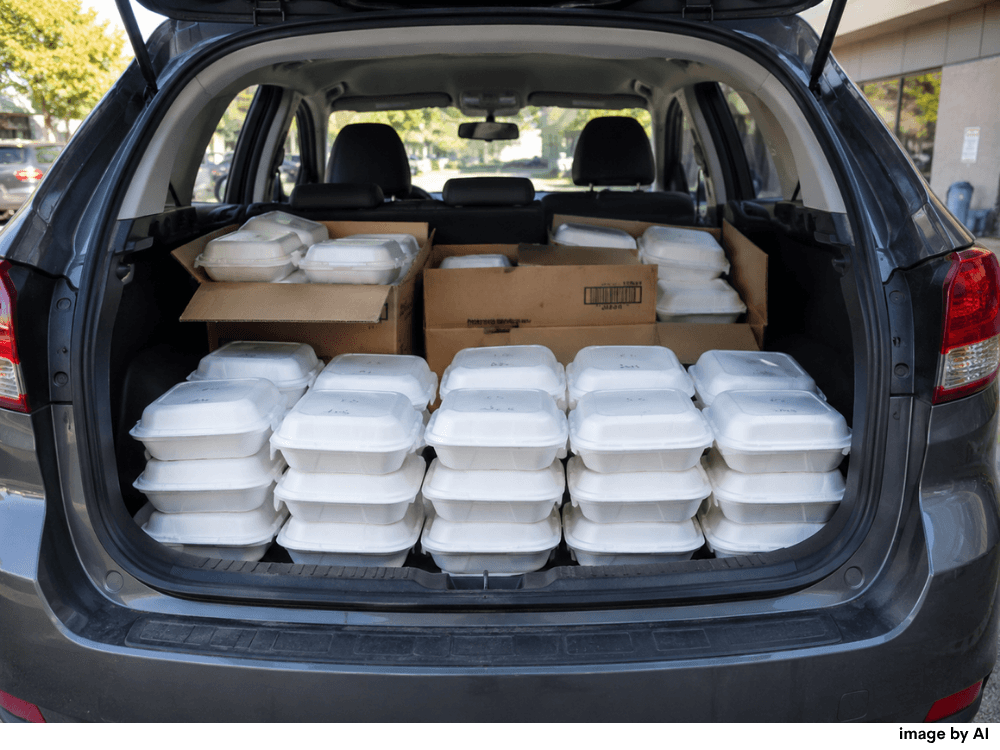
My friend Kay and I begin unloading the boxed meals from the back of my car into the shopping cart we use to deliver meals to our friends in the apartment complex.
We don’t cook or box the meals ourselves. Another group of volunteers does that hard work.
We count ourselves lucky to get the best job—handing meals to residents who we now count as friends.
That’s when our long-time friend Mary rolls up in her wheelchair from the nearby street.
We haven’t seen Mary in a while. And actually, I never know when we see her if it will be the last time. She used to live in an apartment here. We’d chat at her door and talk as friends.
Then one day, she was gone.
Her neighbors told us she was evicted after falling behind on her rent. We were all sad about it.
But every now and then, Mary shows up outside the apartment complex around the time we pull up, and we give her a meal.
This is one of those times. I hand her a meal. It’s an especially good one today. The cooks made lasagna—a real treat.
We’re happy to see Mary. She looks healthy enough.
She’s not, though.
One Working Hand
She says she was just released yesterday from the “crazy house.” I ask questions. She explains that someone turned her in for acting strangely, so she spent the night in the psychiatric ward of our local hospital.
She insisted to the staff that she’s not crazy, though. She told them to watch her and they’d see for themselves. After one night, they did release her, and she returned home to Tent City, where she lives.
Tent City is one of the more structured homeless camps in town, also now known as The Slab. After a fire erupted in Tent City in 2024, causing severe damage and making it uninhabitable for the people living there, the city stepped up. Last year they poured 84 12-by-12-foot concrete slabs for 84 10-by-10-foot tents, and set up a few community guidelines for those who stay there.
Mary is one of the people who got a place.
I ask if it’s better than before. She says yes. Her new tent is bigger than her old one. She can turn her wheelchair around in it.
When we first met Mary, she had one functioning leg and one partial leg. She had lost the leg from the knee down after a car accident a few years earlier.
Then last year, she kept having trouble with her remaining foot. So the doctors surgically removed it.
Now she has no feet at all.
And since we last saw her a few months ago, something else has happened.
Mary tells us she has had a stroke.
Her entire left side has stopped working for her. She demonstrates by picking up her limp left arm with her right hand.
Of her four limbs, she now has the use of only one. . .
one hand that still works.
But My Problem
Mary tells us she has a boyfriend. That he’s really good to her. That he helps her move into her wheelchair each morning because she can’t do it on her own.
But this morning, someone turned him in for sleeping beside her in her tent. She says a police officer pulled him out and took him to jail. She doesn’t know when he’ll be released.
I dig another meal out of the car and give it to her. She’s been through a lot.
I check my car for any leftover forks I have from takeout Panda Express. I find an unopened package and hand it to her.
She takes it with her right hand. But she can’t get it open. She hands it back to me, and I unwrap it for her.
She begins eating as we continue talking, balancing the meal on her lap and eating with her one working hand. She spills a little food on her shirt.
I’m torn. My first instinct is to help her eat. My second instinct is: just let her be.
I know she’s used to doing what she can with one hand. She doesn’t seem bothered that she has food on her shirt.
The discomfort is my problem, not hers.
She takes another bite of lasagna.
I watch her eat.
Will We See Her Again?
Sweat continues to pour off me. We still need to deliver the rest of the meals, so we awkwardly say goodbye to Mary. We tell her we hope we’ll see her again soon.
And we mean it.
But will we see her again?
I’m aware of the statistics. The average life expectancy for people experiencing homelessness in America hovers around 48 to 50 years.
Mary is 49.
She’s already lost so much. Her home. Her mobility. Three of her four limbs. And today, she’s also lost (at least temporarily) the one person who helps her in and out of her wheelchair.
Yet here she is. Eating lasagna on a hot Monday afternoon. Talking with friends. Making the best of the life—and the body—that she’s in.
With one good hand, she feeds herself.
With one good hand, she waves goodbye.
With one good hand, she rolls away with the freedom she still treasures.
I hope that her one remaining hand remains good to her.
I’ve stopped complaining about the heat.
Share your thoughts in the comments.
Read more true stories:
- He Knows Who the Survivors Will Be
The world of the homeless camp feels brutally real. Sometimes I’m not sure whose world is the strangest one: theirs or ours. - When to Say Thank You
She has so little to give. But when someone wants to repay you, accept it. Grace flows both directions. - This Is Not Fair
The homeless boys know the forecast. Cold and stormy. I’ll have to turn up my electric blanket tonight. Life is not fair.
Mary’s story is so sad, Lisa, yet I’m inspired by her upbeat, positive attitude. May God bless and keep her and may He bless those who work so hard to feed those in need.
Yes, Mary does have such a sad story. I hope I’ll see her again one day soon….
I hope you do, too, and that you will let us know what is happening with her.
Mary’s story is so very humbling Lisa.
Thank you for sharing your experience with us.
blessings, Jennifer
I appreciate Mary for sharing her stories with me. I always learn a lot about her and about myself too when I hear them.
what a powerful story. So glad you nourished both her body and her spirit with your love and friendship
Thank you, Jean. I always feel VERY inadequate in these encounters. Sometimes all we can do is be present in the moment with each other.
It’s unimaginable and tragic what some people have to deal with.
I agree. Being around Mary definitely helps me see my own problems in a very different light.