
- 6 Books I Recommend – May 2017 (5/30) – Recommended reading list from books I finished in May 2017
- Why Don’t You Ask? And Why You Probably Should (5/25) – There are reasons we don’t ask each other more questions. What are the reasons? Are they good ones or bad?
- Just Get Moving (5/22) – Often we don’t know which way to go next. But sometimes the best move is just to make one. Do the next thing. God is honored when we move forward in faith
- Is Christian Meditation Okay? (5/17) – I used to think meditation was bad. But this changed my mind.
- Where’s Your Phone Right Now? (5/15) – Is your phone near you right now? Probably so. Are you more attentive to it or to the people right beside you?
- Why Don’t We Share Our Good News? 3 Myths to Debunk (5/11) – We each have stories about Jesus to share. But we often hold them back. Why? And how can we overcome it? Guest post at Do Not Depart.
- Is Life Dangerous? Or Safe? (5/8) – Life can be dangerous. But is it safer just because we believe in Jesus?
- Meet the Answer to Your Prayer (5/3) – It doesn’t happen often. But when you get to meet the answer to a prayer, you remember it. I’ll remember this.
- Links, Books, and Things I Love – May 2017 (5/1) – Links and pictures of articles, books, and things I love for May 2017
6 Books I Recommend – May 2017
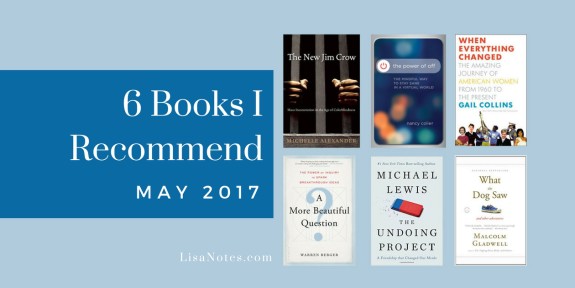
Here are six books I recommend from what I finished reading in May. Each month we share what we’ve been reading at Jennifer’s.
Books I Recommend
1. The New Jim Crow
Mass Incarceration in the Age of Colorblindness
by Michelle Alexander
This book is eye-opening. Read it. You’ll learn things you didn’t know. Such as, “more African American adults are under correctional control today—in prison or jail, on probation or parole—than were enslaved in 1850, a decade before the Civil War began.”
If we truly believe we’re all made in the image of God, we need to understand how we’re treating all segments of our population, not just some. Did you know that the majority of illegal drug users and dealers nationwide are white, but three-fourths of all people imprisoned for drug offenses have been black or Latino?
“We should hope not for a colorblind society but instead for a world in which we can see each other fully, learn from each other, and do what we can to respond to each other with love.”
2. The Power of Off
The Mindful Way to Stay Sane in a Virtual World
by Nancy Colier

Another very good book. Most of us constantly check our phones or computers. Yet we’d rather not. This book shows more mindful ways to engage with technology. It includes a 30-day digital detox program as well as spiritual practices to stay connected with life.
More here, “Where’s Your Phone Right Now?”
3. When Everything Changed
The Amazing Journey of American Women from 1960 to the Present
by Gail Collins
There’s so much I didn’t know. Even though I lived through these past five decades, this research and compilation of stories about women in America during this time period was enlightening. We truly have come a long way in a short time, and let’s not slow down yet.
4. A More Beautiful Question
The Power of Inquiry to Spark Breakthrough Ideas
by Warren Berger
It’s a simple tool we all have: questions. Yet one we underutilize in most aspects of our lives. This book encourages you to stay inquisitive and ask better questions.
More here, “Why Don’t You Ask? And Why You Probably Should”
5. The Undoing Project
A Friendship That Changed Our Minds
Lewis, Michael
Michael Lewis writes such interesting stories about real life events, such as The Blind Side, Moneyball, and The Big Short. This is another good story, about the friendship and work between two Israeli psychologists (Amos Tversky and Daniel Kahneman) on how we make decisions.
6. What the Dog Saw and Other Adventures
by Malcolm Gladwell
A hodgepodge of interesting topics, this is a wonderful compilation of Malcolm Gladwell’s articles previously published in The New Yorker. Stories include why we have more brands of mustard than ketchup, Cesar Milan as the dog whisperer, and the difference between our choking versus panicking in important moments.
Reading Now
- Small Great Things: A Novel
by Jodi Picoult - 12 Ways Your Phone is Changing You
by Tony Reinke - The Joy of Living
Unlocking the Secret and Science of Happiness
by Yongey Mingyur Rinpoche
I finished the novel Exit West by Mohsin Hamid, but it didn’t live up to its hype for me. Although I liked the storyline of refugees on the run, I wanted more emotional undertones.
I started the novel The Versions of Us by Laura Barnett, but oh my. I had to stop. The constant flipping between 3 different versions of the same story was mentally taxing and not enjoyable.
* * *
What good book have you read lately? Please share in the comments.
My books on Goodreads
Previous reading lists
Why Don’t You Ask? And Why You Probably Should
If We Ask
Until this morning, Mrs. B and I had been strangers. Now we were walking the food line together, choosing which items would be useful to her family.
We get to spend ten or fifteen minutes with each person at House of the Harvest on Saturday mornings to gather groceries.
But in those important minutes, we can find out a lot about each other.
If we ask.
I was asking Mrs. B questions about her kids, her grandkids, and she would answer.
But she also did something else. She would turn the questions back around, and ask me.
“And how many kids do you have? And did you grow up here, too?”
Back and forth. It felt delightful, this two-way conversation.
It was like a spontaneous version of “The Question Game” in the movie, It’s Kind of a Funny Story.
In the movie, teenagers Craig and Noelle play a game of ending every comment with a question. There’s no obligation to answer, but the next person still has to ask another next question.
Why don’t we ask more questions, too?
Whether we’re meeting someone for the first time, or having a conversation with someone we already know, what prevents us from continuing conversations with questions?
“Einstein was deliberate in choosing which questions to tackle: In one of his more well-traveled quotes—which he may or may not have actually said—he reckoned that if he had an hour to solve a problem and his life depended on it, he’d spend the first fifty-five minutes making sure he was answering the right question.”
– Warren Berger
4 Reasons We Don’t Ask, But Should
1. We Don’t Know
- Why We Don’t Ask – Because we’re scared of looking stupid.
Typically when I meet a new person in the food line, I say, “Hey, I’m Lisa. And you are?”
But if I think I should already know their name and their story, I freeze up. I want to skip the introductions and move on to more general topics. I don’t want them to think, “You said this same stuff to me last week! Why don’t you remember?”
- Why We Should Ask Anyway – Because we don’t know the answer.
Even if asking reveals our ignorance? Yes.
We’re not here to protect our reputations; we’re here to enhance our relationships.
I once introduced myself to the same new lady at church three weeks in a row. On the fourth week (yes, 4 times!) it was brought to my attention. I was highly embarrassed. (Lesson: Pay closer attention.)
But better to be embarrassed and friendly than preserve our reputation and appear snobby. (That’s what I tell myself anyway.) Let go of what others think of us and think of them instead.
2. We Don’t Want to Know
- Why We Don’t Ask – Because we really don’t want to know.
Ouch. Honestly, sometimes we just don’t care. We’re tired. We don’t have the energy to get to know somebody better. Or we lack the motivation or understanding that it matters.
- Why We Should Ask Anyway – Because God makes each person unique.
Each person has something special about them. Each person has something to teach us or to make us laugh or to help us think.
Each person can show us a new side of God that we have never seen.
3. We Think We Already Know
- Why We Don’t Ask – Because we think we already know the answers.
Why should I ask you about your beach trip if I’ve already heard from somebody else that is was fantastic? I know the answer.
- Why We Should Ask Anyway – Because asking is showing love. And we don’t know everything anyway.
Conversing with each other is more than exchanging facts. It’s showing interest and building history and getting closer.
There is more to learn about a person than what we think we know. Dig deeper.
There’s always another surprise.
4. We Don’t Want to Offend
- Why We Don’t Ask – Because we don’t want to offend or seem nosy.
At House of the Harvest, once we load the groceries in their car, we’re encouraged to pray with our new (or old) friend. But what if they’re not a Christian? Or what if they don’t believe in prayer? Or what if they think that’s too personal?
- Why We Should Ask Anyway – Because asking to pray for someone may be the best gift we offer.
“Before you leave, can I pray a blessing over you?” Rarely does anyone answer no. (Granted, I live in the south.)
But most people we meet are grateful for the concern, even if they’re not the praying type themselves. This is the time we often hear the things closest to their heart. This is the time we are drawn closer as friends and neighbors and family.
This is the time God pours his blessings on all of us.
Benefits of Asking
When we ask, we get more than answers.
- We gain insights.
- We improve relationships.
- We give and receive love.
And we get God.
This is our Father’s heart. Like any good parent, he wants his kids to talk to each other. It opens us up to each other and it opens us up to him.
We’re loving God when we love each other.
I hope to see Mrs. B again at House of the Harvest. And learn more about each other. There is so much more to know. And questions can get us there.
“Always the beautiful answer who asks a more beautiful question.”
– e. e. cummings
* * *
What are other reasons we don’t ask questions? Have you asked a good question today? Who in your life asks you questions? Who do you ask? Please share in the comments.
Related Reading:
A More Beautiful Question: The Power of Inquiry to Spark Breakthrough Ideas
by Warren Berger
“In many cases, our Google queries are so unimaginative and predictable that Google can guess what we’re asking before we’re three words into typing it. . . . We’re all hungry for better answers. But first, we need to learn how to ask the right questions.”
Just Get Moving
I had my purple bucket in hand. I walked down to the lake. My impatiens were thirsty and I wanted to water them.
I didn’t notice that Mama Duck and her six ducklings were by the water’s edge.
But as soon as I dipped my bucket into the water, I heard a flurry of activity. Mama and her babies were swimming away from me as fast as their little legs could flap.
They didn’t know they could trust me. They just knew that they had to go.
Sometimes dangers are on land. Other times, turtles in the water are their biggest enemy.
We used to raise ducklings when our daughters were tweens. We’d buy little yellow fur balls in the spring. Little by little we’d let them first play in the brook, then go out a little further into the lake, often rescuing one if they wandered too far away or began floundering.
But in order to keep growing, the ducklings had to keep moving, whether on land or in water.
Often we don’t know which way to go next ourselves. We don’t know who to trust. We can become paralyzed by indecision and just stay stuck in our corner.
But often the best move is just to make one. Just show up. Do the next thing. Trust that God will be beside you, whether to the right or the left.
God is honored when we move forward in faith.
And if we choose the wrong path? He’ll correct our course in due time and set things right again.
I wish these wild ducks had known my danger level to them was zero. I find baby mallards adorable. I’d never hurt them.
But not knowing that, they did the next right thing: they got moving.
May we get moving, too.
* * *
Is Christian Meditation Okay?

A Doctor’s Visit
This isn’t why I meditate.
But this happened.
I was sitting across from my doctor in his office. We were discussing a small medical issue. He suggested a biopsy, just to rule out cancer.
But the procedure is very painful, he said.
I said okay anyway, thinking I’d schedule something in a few weeks.
Until he stood up and said, “I’ll see you in a few minutes.”
Oh! You mean do it right now?
I had no time to mentally prepare. To pray about it, research it, discuss it with Jeff.
It would be me and God on the fly.
I quickly slipped into meditation mode, an awareness of God’s presence in this moment, in this situation, inside of me.
And surprisingly, the very painful procedure was only minimally painful. I endured it much easier than they expected me to. (And, praise God, no cancer!)
I joked with the doctor afterwards:
Years of meditating have finally paid off!
But that’s not why I meditate.
Is Meditation Okay?
I used to think meditation was bad. I associated it with Eastern religions and saw no use for it in my Christian faith. I had been warned that emptying the mind is dangerous because it leaves the door open for bad things to enter in.
Then I learned about Centering Prayer; i.e., meditation. For 20 minutes a day, the practice is to close your eyes, be still, and just sit with God.
- Is it okay to take a break from thinking about problems, from being productive?
- Is it okay to be in the presence of God without seeking something from God?
- Is it okay to just sit with God awhile without straining to hear his words or to speak your own?
I find it perfectly okay . . . to sit quietly, surrounded by God’s love, with no agenda.
Thoughts come in those 20 minutes—always—but they don’t have to be held onto (I rarely succeed at totally letting go, but that’s okay).
It’s not about becoming empty, but about becoming quiet.
It’s about being still to know that God is God.
All About His Presence
Now I see meditation as respecting God’s presence as more important than anything on my to-do list. It’s one way I show him I value his company.
Can’t we also be aware of his presence while we’re on the go? Of course! And in the other 23 hours, 40 minutes, of the day, we can practice that. Centering prayer or meditation is a supplement to, not a replacement of, our running conversations and activities with God.
But for 20 minutes a day (or so—I rarely make it 4 days in a row—I’m always a beginner), I need to remind myself that God is in control and that the world won’t stop spinning if I just sit with him to refresh my spirit. It slows me down and restores my soul.
And for those times in a doctor’s room or elsewhere when pain surprises me unexpectedly or when circumstances begin spinning out of control?
I can escape to calmness, even if just a little and for only a minute, into that spiritual space that I hold open for just me and God.
Genuine friendship belongs to those who can sit together in silence and still feel love.
* * *
My favorite book on Centering Prayer: The Path of Centering Prayer by David Frenette
My favorite meditation app: Insight Timer
More Reading:
Where’s Your Phone Right Now?
Where’s your phone?
Most of us know where our phone is. At all times. Because usually it is right beside us.
What do you check most often? Email? Facebook? Surf the internet?
We’re addicted.
- We turn to our phones when we’re bored.
- When we want to know something immediately.
- When we need affirmation that we’re heard.
But our phones can’t give us what we really want.
They can, however, take it away.
True connection doesn’t come through a device. It comes through conversations and looks and gestures and meals and silence and tone and touch.
Used wisely, our devices can facilitate those things.
But more often, our phones take us away from true connection, not lead us to it.
They steal away our presence from the moment we’re in.
The Power of Off
See if you relate to this scenario by Nancy Colier in The Power of Off:
“These days, the instant something happens, we are immediately on our devices, texting everyone we know to tell the story of who we are, the story of our lives.
After the personal texts have gone out, we start posting on social media.
As soon as we are finished getting it out to the world, we start checking to see the responses coming in about it.
In a sense, the whole event, our life, takes place outside of us and on the screen; life is not something we live directly but rather something we use to establish our self-image and existence.”
Are we living life directly, or buffered by a screen?
How is this changing us and our relationships?
I’m bothered enough that I’m trying to change. I’m putting more distance between me and my phone. I’m leaving it in other rooms or keeping it off or refusing to check it as soon as I hear a beep.
It’s not easy. But it’s important.
Collier says:
“Paradoxically, leaving ourselves endlessly available results in our being unavailable to others and to life.”
I do want to be available to those who need me via my device.
But not at the expense of those who need me in person.
* * *
Where is your phone right now? How connected are you to it? How often do you disconnect? Please share in the comments.