
Update
See my new series here on 20 Ways to Practice the Enneagram
“Who am I? This is the fundamental question of our human experience, the one that compels us to search for meaning.”
– Christopher Heuertz
So What?
Now you know.
So what?
Oftentimes, we learn things that feel valuable. But we still don’t know what to do with them. How are they useful in our everyday lives?
The more I learn about the Enneagram, the more I ask myself, “So what?” I don’t want to accrue knowledge for its own sake. I want to do something with it.
“What Is the Enneagram? It exposes nine ways we lie to ourselves about who we think we are, nine ways we can come clean about those illusions, and nine ways we can find our way back to God.”
So I’m looking hard for the how-to’s with the Enneagram. And I’m finding them.
“If we can’t self-observe, then we can’t self-correct.”
The Sacred Enneagram
In particular, I’m zeroing in on practices to counteract the weaknesses and to harness the strengths of my type. All nine types of the Enneagram have specific strengths and weaknesses.
Why does it matter? According to Christopher Heuertz in his new book, The Sacred Enneagram: Finding Your Unique Path to Spiritual Growth, the purpose is “to find our way back home, back to our essential nature, our True Self, and back to God.”
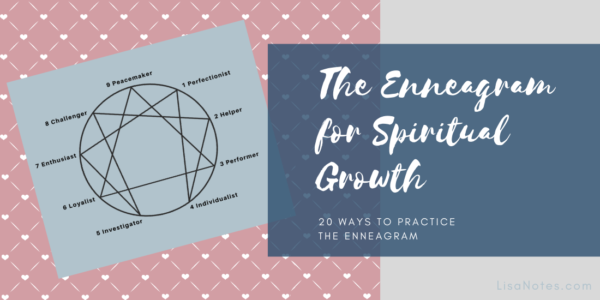
Here’s a quick review of the Nine types and their desires.
- Type 1: Need to Be Perfect
- Type 2: Need to Be Needed
- Type 3: Need to Succeed
- Type 4: Need to Be Special (or Unique)
- Type 5: Need to Perceive (or Understand)
- Type 6: Need to Be Sure/Certain
- Type 7: Need to Avoid Pain
- Type 8: Need to Be Against
- Type 9: Need to Avoid
How to Practice It
How do we meet those needs? In Parts 2 and 3 of Heuertz’s book, he suggests unique paths for spiritual growth for each triad of types in the following Intelligence Centers (Head, Heart, and Body):
- For the Heart Center types (types 2, 3, 4), who are obsessed with connections, it requires:
Solitude
“Solitude, time by ourselves, teaches us to be present—present to ourselves, present to God, and present with others.”
- For the Head Center types (types 5, 6, 7), who are obsessed with competence, they need:
Silence
“Silence actually teaches us to listen. . . . In silence we hear the truth that God is not as hard on us as we are on ourselves.”
- For the Body Center types (types 8, 9, 1), who are obsessed with control, they need to engage in:
Stillness
“Stillness teaches us restraint, and in restraint we are able to discern what appropriate engagement looks like.”
By integregating knowledge with practice, we can form contemplative practices that bring us into more wholeness and less chaos.
Expect resistance at first.
“At first, solitude, silence, and stillness trigger the most accessible emotion of each of the centers (anxiety or distress for the head types, guilt or shame for the heart types, and anger or frustration for the body types).”
Yet keep pressing into the practice. It can unlock future spiritual growth, even when it feels like it’s not “working.” (I’ve been practicing centering prayer for a few years now, and it is still difficult on most days.)
“But listen to yourself: usually the way you judge yourself or ‘feel bad’ about your practice is the very thing that begins to open your type to the graces of the practice.”
The more we show up in the present moment, where God is, the more permission and awareness we give him to shape us into who he created us to be.
Intention with God
“Our Intelligence Centers illuminate how we see the world, and our Harmony Triads illuminate how we relate to and engage the world . . . thereby exposing how we see and engage God.”
This book goes deeper into other areas as well, such as paths of integration and disintegration, the Intelligence Centers, and the Harmony Triads, which includes:
- With the Relationists (types 2, 5, and 8), the intention is consent,
- with the Pragmatists (types 3, 6, and 9), the intention is engagement, and
- with the Idealists (types 1, 4, and 7), the intention is rest.
I’ve read several Enneagram books and this one may be the most complex so far. But possibly also the most practical.
As with any personality framework, the Enneagram isn’t the end-all approach. But it is a useful avenue for traveling alongside God, exploring more about our humanity and his divinity, as we enjoy the journey together.
“Waking up is the first step in the spiritual journey—a courageous alternative to the fantasies we fashion to keep us asleep.”
Other Book Recommendations
If you’re interested in learning more about the Enneagram, specifically for spiritual practices you can implement, I strongly suggest the book I mention here:
- The Sacred Enneagram by Christopher Heuertz
For a simpler, yet still a solid introduction, try:
- The Road Back to You by Ian Morgan Cron and Suzanne Stabile
For a thorough yet accessible guide, I recommend:
- The Wisdom of the Enneagram by Don Richard Riso and Russ Hudson
And for an overview of multiple personality frameworks (including the Enneagram), read the short but thorough new book:
- Reading People by Anne Bogel
* * *
Do you know your Ennegram number?
Which is hardest for you: Silence, Solitude, or Stillness? Please share in the comments.
More on the Enneagram here:
- The Enneagram for Spiritual Growth (Series): 20 Ways to Practice the Enneagram
- What’s Your Number?
- 5 Things I Learned at the Enneagram Conference
- How to Love That Other Number on the Enneagram (All 9 Types)
My thanks to NetGalley
for the review copy of this book
