Define It, Find Its Twin, Meet Its Opposite: 3 Ways to Revisit Your One Word
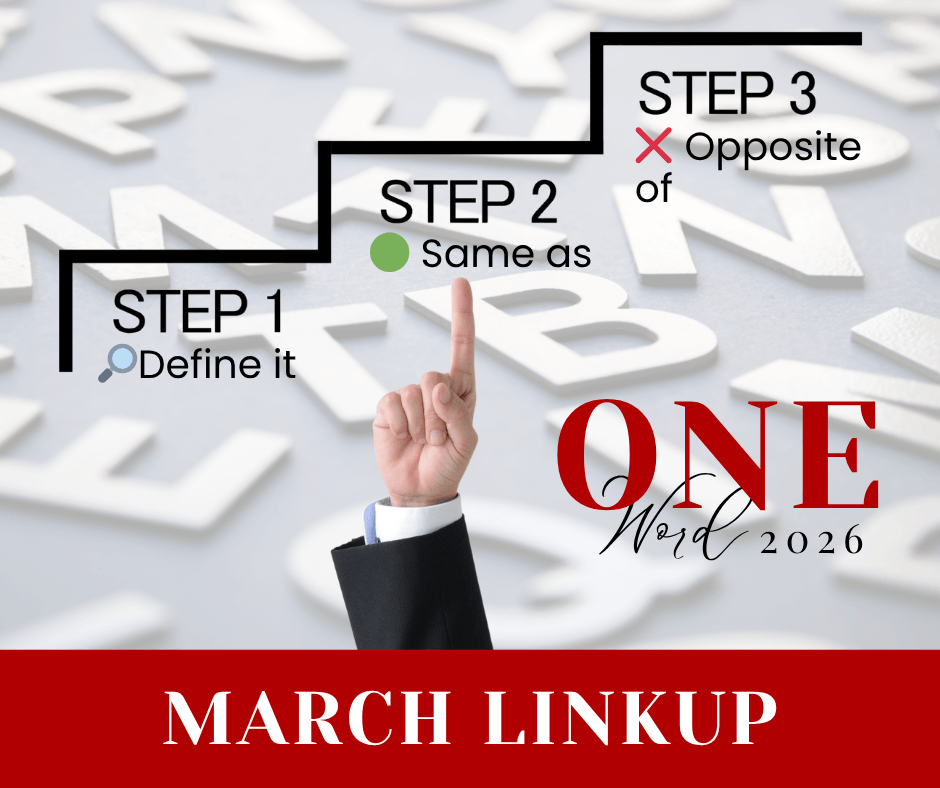
{One Word 2026 March Linkup}

This month try getting more curious about your One Word of the Year.

Revisit your one word by taking a few minutes with a dictionary and a thesaurus (paper or digital) to get a closer look at your word—and gain some fresh insights about it.

Step 1: Define Your Word

Start by looking up your word in a dictionary.

You might already think you know what it means—but pause and read through all the definitions anyway.

  • Are there multiple meanings?
  • Does one stand out more than the others for this season?
  • Is there a definition you hadn’t considered before?

Sometimes a fresh definition can shift how you see it for the rest of the year.

For my word Shift, I found many meanings:

    • Move from one place to another
    • Change gear in a vehicle
    • A slight change in position or direction
    • Scheduled work period
    • A type of loose-fitting dress
    • A key on a keyboard
    • Irish slang, to kiss or make out

The definition I’m using the most this year is the third: shift = a slight change in position or direction.

I was most surprised to learn of the last one: shift = to kiss or make out. 

Step 2: Find What Your Word Is the “Same As”

Next, look up synonyms—words that are similar in meaning.

As you read through them, ask yourself:

  • Which of these feels closest to what I need right now?
  • If I had to choose a “backup word,” what would it be?

This isn’t about replacing your word—it’s about expanding it.

A few synonyms for Shift are:

    • Change
    • Move
    • Fluctuate
    • Turn
    • Strategy
    • Impermanence

If I had to choose a backup word, it would be Impermanence because I know that everything is always changing. 

Step 3: Explore Your Word’s Opposite

Now, look up antonyms—words that mean the opposite.

This step may surprise you.

  • What feels like the clearest opposite of your word?
  • Where do you notice that showing up in your life?

Understanding what your word isn’t can often bring clarity to what it is.

Some antonyms for Shift are:

    • Sameness
    • Stagnation
    • Directness
    • Permanent
    • Remain

The surprising opposite for me is: Directness. I haven’t thought of Shift as being indirect. I’m looking in my life to see if I’m being too direct or inflexible about something instead of being willing to bend and shift where needed. 

Share What You Discover

We’d love to hear what you notice about your word.

Our March One Word linkup opens today, March 26, and will stay open for two weeks.

You can share in whatever way feels easiest:

  • a quick comment
  • a short reflection
  • a full blog post

There’s no right or wrong way to do this.

We’ll link up again next month on Sunday, April 26 (linkups are always on the 26th for 2026).

What is your word showing you right now?


Question for you:
Is there a definition, synonym, or antonym of your word that surprised you?

Share your thoughts about your One Word or monthly theme in the comments. 

If you’d like to receive our monthly One Word emails and ideas for 2026, join here.

Link Up About Your One Word

You are invited to the Inlinkz link party!

Click here to enter

When the Body Shows the Score

The Final Buzzer

It happens every year. In almost the exact same way. And yet every year I am equally moved by it.

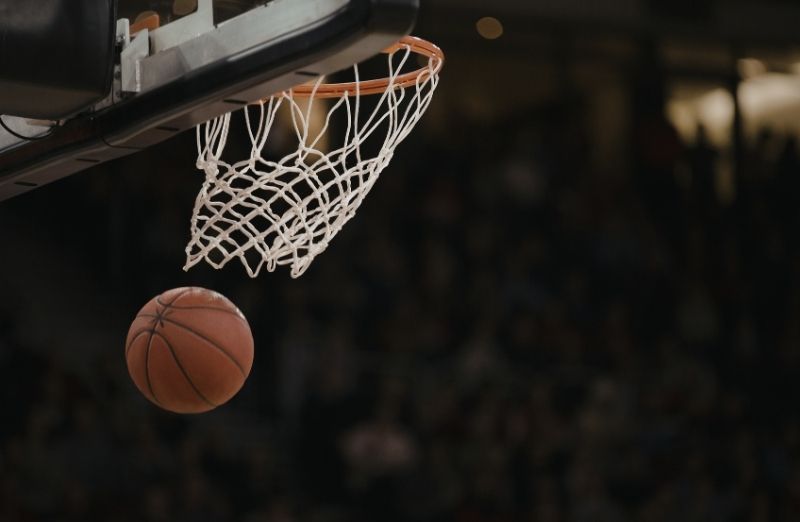
It’s the body language after a basketball game.

One weekend a year, my husband Jeff and I travel to Birmingham, AL, to spend the weekend watching high school basketball state finals, one game after another. (It’s our annual lead up to watching college’s March Madness on TV.)

And after each game, once the final buzzer sounds, without looking at the scoreboard, it’s always obvious who won and who lost.

The bodies tell the score.

Expansion and Contraction

On one side of the gym, arms fly up. Legs leap up and down. Loud hoots and hollers spill out of mouths. Everyone hugs everyone near them. Exhilarated.

Complete expansion.

But on the other side of the gym, hands cover eyes. Heads go down. Everybody is quiet. Individual bodies may crumple onto the floor, solitary, alone. Exhausted.

Complete contraction.

It’s so human of us.

Body language expressions of disappointment after competition

What Our Bodies Reveal

Sometimes we remain in tight command of our bodies, disguising what we’re feeling, but often our bodies give us away.

Happiness and sorrow we feel on the inside have a way of showing up on the outside. And again this year, I’m amazed as I watch it. Over and over and over.

Bessel van der Kolk may have said that the body keeps the score.

But we all demonstrate that the body shows the score, too.

Texas basketball players reacting to final buzzer with visible emotion

Texas women celebrate win in Round 2 of the NCAA college basketball tournament, Sunday, March 22, 2026 (AP Photo/Eric Gay)


What’s one small way your body reveals how you feel? Did you pick a winner for the NCAA tournament? (I chose Purdue; my bracket is in bad shape, but I still have a chance.)

Share in the comments.

Read more:


Do You Assume the Best or the Worst? And a Barking Lady

blank

I double-check my notes. I’m on the second floor of my local public library. The call number for the library book is correct. But where is the book? Maybe it has been shelved wrong by mistake.

That’s when I hear the noise.

A loud bark! Directly in my ear.

I jerk around . . . to find a woman brush past me, not a dog, like it sounded.

After barking, she smirks. Then she walks away.

A couple other people come rushing up beside me now. They are clearly disturbed, and ask, “Did that woman just bark at you, too?”

I pause for a split second. I know I have options for my response.

We almost always have options, even when we’re not aware of them.

The Agreements

In 2014, I read a small book of Toltec wisdom by Don Miguel Ruiz called The Four Agreements. (I recommend it.)

Ruiz shares four statements he lives by. They are virtuous and respectful toward all humans. (Read Ruiz’s four agreements here.)

After I finished the book, I tweaked the statements to create my own four agreements for life.

I wrote them on a sticky note and put them on my bedroom mirror. I don’t live them as well as I’d like, but I’m not finished yet.

My first agreement is this:

# 1. Give others the benefit of the doubt.

[Here are all four agreements.
1-Give the benefit of the doubt | 2-Let go of being right | 3-Don’t take it personally | 4-Just show up]

But how? How can we practically give others the benefit of the doubt?

5 Ways to Assume the Best

5 Ways to Give the Benefit of the Doubt

1. Create a Better Story

It’s not easy. We’re wired to distrust uncertainty.

So when we don’t know the whole story (which we rarely do), our minds fill in the gaps. And we don’t naturally assume innocent until proven guilty.

Instead of assuming the best, we think:

  • My husband must hate my new haircut because he said nothing about it
  • My friend just wants to make me mad by bringing up that topic
  • The world is against me because I had a flat tire this afternoon

But if we really don’t know, why not create a good story instead of a bad one?

Can’t we assume a positive what-if scenario instead of a negative one?

2. Use the Golden Rule

Would we want others assuming the worst motives about us when we do something they don’t understand? No.

We think they should know us better than that.

We can treat others’ motives the same way we want ours to be treated.

3. Let Go of Self-Protection

Often our cynicism arises because we don’t want to be hurt. We want to protect ourselves by staying on the defensive, not risking pain through naiveté or being caught off guard.

But is being skeptical the best way to live?

No. We will sometimes get hurt by giving others the benefit of the doubt, but more often we’ll create a brighter world, bringing light into darkness instead of spreading even more darkness.

Safety is an illusion. Take chances with love.

4. Forget Revenge

When we sense we’ve been treated unfairly, we can grow stingy with doling out understanding.

But who among us hasn’t received far more compassion at times than we’ve deserved?

By tuning into the kindnesses that we have been given, we can be more compassionate to others too, all things considered.

In everyday situations, when possible, err on the side of grace instead of judgment. It makes for healthier relationships. And happier ones, too.

5. Do It for You

Lastly, we often show the least compassion to ourselves.

Even when we assume the best in others, we may place unrealistic expectations on ourselves. If our bodies get tired or our tongue gets edgy or a relationship turns sour, we may shame ourselves with labels like Lazy or Selfish or Stupid.

Granted, we do need to take responsibility for our actions.

But we also need to give ourselves the benefit of the doubt as well, knowing we tried, that we wanted the best for everyone. Even when you fail, don’t abandon yourself yourself just because you made a mistake

Choose Your Response

Back at the library, instead of causing a ruckus about the barking woman, I choose to let it go. The woman looked homeless and had more important issues to deal with than receiving a lecture from me on keeping reverent silence in the library.

I laugh off the incident alongside the other people who heard the barking, hoping they will let go of their fears that she’ll be waiting outside to harass them.

The woman seemed completely harmless, just coping with life as best she can.

While some people in the world may be out to get us—and yes, let’s be cautious with those!—most of the people in our circles are decent human beings.

Like us, they too are doing the best they can with what they have.

Fill in the gaps with compassion.

And the library barker?

I’m agreeing to assume the best, not the worst, about her, too.

I’m giving her the benefit of the doubt.

* * *

Are you more naturally trusting or skeptical? Please share your thoughts in the comments.

See all 4 agreements (click on individual infographics)

1-Benefit-Doubt 2-Being-Right 3-Take-Personal 4-Show-Up

image map infographics

1-Give the benefit of the doubt | 2-Let go of being right | 3-Don’t take it personally | 4-Just show up

revised from the archives


The Day I Sat on My Hands Instead of Taking Notes
A March update on my One Word Shift

Sitting on My Hands

I am in my seat in the beautiful auditorium. I’m listening intently as the poet gives her talk. Rosemerry Wahtola Trommer is speaking amazing truths.

But I’m sitting on my hands.

I’m fighting with myself to not take notes.

Often when I hear a great speaker, I’m clicking on my phone keyboard to write down key points as they say them. The practice has served me well through the years. I have both paper and digital notebooks holding insights I might never have remembered otherwise.

Take notes on a phone while listening to a speaker

I like capturing wisdom while it’s fresh—then having a record I can return to later to reread and maybe incorporate into my life.

All good things.

But there’s a tradeoff.

While I’m copying down one brilliant sentence, the next one is already being spoken. My attention splits because my brain can’t record one thing and fully listen to another at the same time. Neither task gets my full presence.

Who can truly pay attention to two things at once?

So as I listen to Rosemerry, I try to do just one thing:

Listen.

The Leaves That Don’t Let Go

For the month of March, my singular focus with my One Word Shift has been Nature.

I’m paying closer attention to the subtle shifts happening outside: the yellow daffodils pushing through the soil, the tiny unfurling of new leaves, and the stretching of daylight hours that brings us more life.

But I’m also noticing something else.

The dead leaves.

In early spring, when most trees have stood naked for months, a few are still dressed in last year’s leaves. Brown and brittle, long past their prime, these leaves have been hanging on stubbornly all winter long.

Marcescent oak leaves still clinging to branches in early spring

The internet tells me there’s actually a name for this: marcescence.

Certain trees—especially some oaks and beeches—hold onto their dead leaves instead of dropping them in the autumn like most deciduous trees.

Scientists aren’t exactly sure why, but they theorize that the dead leaves stay on the branches to protect new buds, discourage deer and other animals from nibbling tender growth, and provide fresh nutrients in the spring when they do fall.

Nature, it seems, isn’t in any rush to let go. Not until it’s time. Not until the baby leaves arrive and gently push the old ones out of the way.

Our Own Marcescence

As I sit listening to Rosemerry, I wonder about my own connection to holding on and letting go.

I’ve always liked holding onto words the way those marcescent trees hold onto leaves. Notes from talks. Quotes from books. Lines that strike me as important enough to keep, too meaningful to drop.

Sometimes that’s helpful. Last year’s leaves serve a purpose, after all.  So do old words.

But other times I wonder if my intellectual marcescence—clinging to old words even after their season has passed—keeps me from noticing what I’m hearing right now.

The Vase or the Sieve

During her talk, Rosemerry shares a story. She had told a friend about trying to become a bigger vase so she could hold all the emotions she was feeling. (Read the poem here: Pourous)

But her friend gently challenged the premise.

Why be a vase?

Perhaps instead of trying to hold everything, she could be a sieve and let the experiences simply move through her.

Ahh.

I hear the lesson.

I don’t write it down.

One Leaf Worth Keeping

Later, after the talk ends, I pick up my phone. I type the line into my notes:

Be a sieve, not a vase.

That simple nugget of wisdom feels like a leaf worth keeping.

Hopefully the rest of the talk has done its work simply by passing through.

New spring leaves pushing out on a tree branch

Maybe that’s a shift worth noticing: knowing when to hold tight and when to let go.

Some words need to stay with us a long while, until their message is buried deep in our soul or until something new and improved pushes them out of the way.

Other words can drop away quickly once they’ve completed their seasonal work, like leaves returning to the soil in the autumn months.

And like the trees outside our windows, we don’t have to force either approach.

Just let the shifts happen, each in their best time.


Question for you:

Do you write it down when you hear something meaningful—or do you prefer to just listen? Share in the comments.

Read more about Shift:

Read more here about Shift - One Word 2026


What a Smelly Elevator Taught Me About Questioning Beliefs

The Elevator Test

When the elevator door on the right opens, we immediately smell something.

It stinks.

It’s Monday afternoon at the apartment complex where we deliver free meals. Our grocery cart is full of food containers, and we’re ready to start making our rounds.

A woman gets out of the elevator. She warns us, “Watch out for the puddle on the floor,” she says. “Someone peed there.”

Now I smell it even stronger.

We pause to debate what to do next.

Do we get on the elevator anyway? Do we wait for the second elevator on the left, hoping it comes quickly?

Apartment elevator representing a moment of hesitation and questioning beliefs

I believe this may be too much for me.

I start leaning toward a third option: maybe we should just call it quits, leave the food in the lobby, and go home.

It surprises me how strong my reaction is. I had wanted to be here. And yet just the idea that someone chose to relieve themselves in an elevator fills me with disgust.

A strong enough belief that I’m ready to walk away.

But as we stand there, I notice I’m reacting strongly to something I don’t actually know for sure.

  • What if someone had been sick?
  • What if it was from a small child?
  • What if it was something else entirely?

Would a different answer make a difference in our decision?

While we linger in the discussion, the elevator door closes. Without us.

A Book for Questioning

Lately I’ve been reading—and experimenting with—a new book by Nir Eyal called Beyond Belief.

The premise is simple but powerful: many of the things that limit us may not be based on evidence, but on false beliefs we’ve unconsciously adopted.

Book cover of Nir Eyal's book Beyond Belief

These are the definitions that Eyal uses to explain the differences between these three things:

  • Fact: An objective truth that can be verified with evidence
  • Faith: A conviction without need for objective evidence
  • Belief: A firmly held opinion, open to revision based on new evidence

The book is primarily about beliefs—our strongly held opinions. Eyal describes beliefs this way:

“Beliefs aren’t simply thoughts or feelings. They’re tools—working models we use to navigate reality when the truth isn’t fully knowable.”

The problem comes when we allow our opinions to limit our lives.

Examples of these kinds of beliefs include:

  • Believing someone doesn’t like you if they had to cancel your lunch date, so you never reschedule
  • Believing you’re not smart enough to graduate so you never enroll in college
  • Believing you’re too old to learn a new skill so you let yourself fall behind

None of these are facts. These beliefs are simply interpretations.

According to Eyal, the way to challenge limiting beliefs isn’t through argument. It’s through finding evidence.

He suggests asking questions like:

  • Does this belief hold up to real-world feedback?
  • Am I ignoring evidence that contradicts it?
  • Is this belief open to revision?

Beliefs matter because what we believe shapes what we see, and what we see shapes what we do.

The Quiet Power of Belief

Not every thought we have is true.

Some thoughts are.
Some thoughts aren’t.

The same goes for beliefs.

But the way to find out isn’t through overthinking—it’s often through trying something and seeing what happens.

Books like Beyond Belief encourage me to do just that. It lists three powers of belief:

  • Attention: the power to see what you believe
  • Anticipation: the power to feel what you believe
  • Agency: the power to do what you believe

Experiment with beliefs by starting with evidence. Focus where it counts. Shape the stories you tell yourself.

Practicing Small Experiments

Since reading the book, I’ve been trying some of these experiments in my own life.

For example, when lying in bed I sometimes believe I’ll never fall asleep. Yet when I pause and look at the evidence, I know I always eventually fall asleep. Every night. Believing my body will suddenly forget how to sleep is a belief that doesn’t hold up.

Or when I believe my whole day will be ruined if I don’t finish my to-do list. I experiment by intentionally leaving a few things undone and see if I survive. Spoiler alert: I do.

And when I believe I can’t finish my rounds if someone urinated in the elevator, I can question that too. Is it possible I actually can endure a 10-second elevator ride while stepping around whatever is on the floor?

Apartment hallway symbolizing small experiments and stepping into new possibilities

The Elevator, Revisited

The elevator door that opens next is the left one. Whew. We get in and go to the second floor. But after finishing the meal deliveries on the second floor, it’s time to return to the elevator to head up to the third floor.

Two doors. Two choices.

Which one will open first? It’s the one on the right. Ugh.

This time, though, something is different.

There’s no odor. No puddle. Just a leftover paper towel from a cleanup.

We step inside and laugh. Whatever had been there before—urine, spilled liquid, something else entirely—is gone.

And either way, we would have survived it.

I’m grateful I didn’t give in to my earlier belief that the situation was simply too horrible to endure. (Shout-out to my companions who helped me persevere.)

The moment feels small, but it sticks with me.

Sometimes testing an experiment isn’t necessarily to prove yourself right or wrong, but to see what is possible.

Maybe it can be as simple as stepping into an elevator that you were sure you couldn’t tolerate.

As Eyal writes:

“Extraordinary lives aren’t built on grand declarations. They’re built on small efforts—actions that create evidence, evidence that strengthens belief, and belief that fuels more action until possibility itself expands.”

And every life deserves to be extraordinary.

Question for you:

Have you ever believed you couldn’t do something, only to discover later that you were more capable than you thought?

Share your thoughts in the comments.

thanks to NetGalley for the review copy of this book


8 Books I Recommend: Being Human, From Memoir to Plague to Fiction

I get a warm feeling among my books. 
—Anthony Powell

I love being surprised at a thread that runs through a random stack of books on my nightstand and Kindle.

For March, the books stretched from memoir to science to history to fiction.

And yet, each book indirectly asks some version of the same question I often ask myself: What does it mean to be fully human—embodied, flawed, unique, and purposeful?

Here are the eight books I just finished that I recommend, all circling that shared question from very different angles.

[See previously recommended books here]

NONFICTION

1. The Look
by Michelle Obama

The Look by Michelle Obama book cover

Such a beautiful book in every way.

The rich photography, the gracious commentary, and the honest reflections show us the amazing human being we’ve come to admire in former First Lady Michelle Obama. Through the many “looks” she took on in her White House years and beyond, she reminds us that our look is about far more than appearance.

I highly recommend reading this in print instead of as an ebook or audiobook, so you can fully experience the stunning, glossy images.

2. The Extinction of Experience
Being Human in a Disembodied World
by Christine Rosen

The Extinction of Experience book cover

This will likely be one of my top 10 books for 2026.

Christine Rosen makes the case that our digital lives may be stripping away the very things that make us human—our embodied experiences. I found myself pausing again and again to think about what we lose when we replace real-life bodily participation with watching others live life through screens.

But this is not an anti-technology book. It just urges us to be intentional about prioritizing what we value most—especially our real-world experiences.

3. Awake: A Memoir
by Jen Hatmaker

Awake: A Memoir by Jen Hatmaker book cover

In this candid memoir—because how else would Jen Hatmaker write?—she weaves together childhood memories and adult experiences with her signature vulnerability and humor. She is very open about how she is navigating life after her husband left and as her faith shifted. I’ve always admired her honesty and humility, and both are as evident in this book as previous ones.

4. This Changes Everything
A Surprisingly Funny Story About Race, Cancer, Faith, and Other Things We Don’t Talk About
by Tyler Merritt

This Changes Everything book cover

I first became aware of Tyler Merritt in 2020 when his YouTube video, “Before You Call the Cops,” went viral (it originally aired in 2018). After reading his first book, I Take My Coffee Black, I became a fan—and now with this book, I love him even more. Here he shares his cancer journey with honesty and vulnerability.

I highly recommend you listen to this book instead of just reading it. Tyler narrates it himself (and sometimes his mom, his cancer doctor, and others), adding such nuance and humor even beyond the words on the page.

Having heard him speak and meeting him in person two weeks ago, I find him just as delightful a human being face-to-face as he is on Instagram. This week he is starting radiation and chemo for his most recently diagnosed colon cancer. (And as an aside, I love that he and Jen Hatmaker are a couple.)

5. Truly
An Inspirational Journey Through the Life of a Musical Legend
by Lionel Richie

Truly by Lionel Richie book cover

Having grown up as a Commodores fan and later a fan of Lionel Richie’s solo career, I thoroughly enjoyed learning the backstory behind his songs and life (plus, he’s an Alabama native like me). Such an interesting journey he’s had.

By watching him as a judge on American Idol since 2018, I’ve come to appreciate his humility and genuine desire to help young artists pursue their dreams as he pursued his.

This book is also exceptional to listen to (but see the hardback book for photos). It is narrated by actor Blair Underwood, who does a phenomenal job in capturing Lionel’s voice, tone, and laughter.

6. The Genetic Lottery * * *
Why DNA Matters for Social Equality
by Kathryn Paige Harden

The Genetic Lottery book cover

This book was a little too academic for me in places, but it’s still worth the effort to better understand how genetic differences can influence life outcomes in ways we don’t always expect. Harden argues that acknowledging biology can actually strengthen our commitment to social justice rather than weaken it.

I recommend it because it opens up new ways of thinking about fairness, opportunity, and inequality in our country.

FICTION

7. Year of Wonders
by Geraldine Brooks

Year of Wonders book cover

Based on true events, this novel is set in a 17th-century English village struck by the Great Plague of 1665–1666. It follows Anna Frith, a young housemaid to the local pastor and his wife, as she chooses courage and sacrifice in the face of unimaginable tragedy. Though heartbreaking, the storytelling is so well done. The book is a haunting caution to me of what helps—and what harms—when communities are hit by disasters.

8. Out of Darkness
by Ashley Hope Pérez

Out of Darkness book cover

This is another difficult but powerful novel. It’s based on the 1937 school explosion in New London, Texas, that killed nearly 300 students and teachers. It centers on the growing love between Naomi, a Mexican American teen, and Wash, a young Black boy who befriends her and her twin siblings. The racial injustice back then is painful to witness, yet remains important to continue to remember and confront even now.

WHAT I’M READING NOW

  • How Donating a Kidney Fixed My Jump Shot
    And 73 Other Short Essays
    by Jim Sollisch
  • Nations Apart
    How Clashing Regional Cultures Shattered America
    by Colin Woodard
  • The Unfolding: Poems
    by Rosemerry Wahtola Trommer
  • The Let Them Theory
    A Life-Changing Tool That Millions of People Can’t Stop Talking About
    by Mel Robbins
  • Speak
    by Laurie Halse Anderson

A Closing Reflection

Across these different genres, these books remind me that being human is complicated. We are each shaped by so many factors: culture, technology, biology, faith, history, and chance.

And yet, through every story, I see the importance of finding our common ground, respecting our differences, and learning how to live well together, things that matter the most.


*** Books from Daniel Pink’s 21 Favorite Books list; you can find it here. I’m working through the list. I’ve read 16 so far, and have 5 more to go. Getting closer!

Have you read a good book lately? I’d love to hear in the comments.

I’m sharing at these linkups