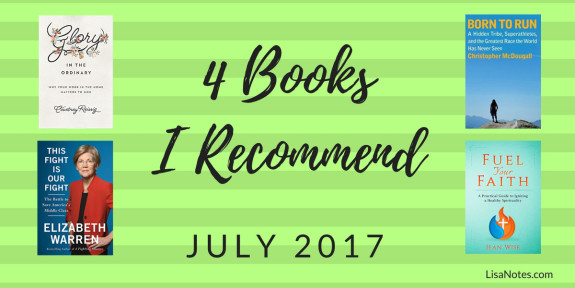
Here are four non-fiction books I recommend and two fiction books that I half-heartedly recommend from what I read in July. Once a month we share our current reading lists at Jennifer’s.
Books I Recommend
1. Glory in the Ordinary
Why Your Work in the Home Matters to God
by Courtney Reissig

Do you ever wonder if your work at home matters? To your family? To society? To God? This book gives a thorough look at why your work DOES matter. I could have used this pep talk when I was in the thick of it, raising kids and homeschooling, but I find Courtney’s words still pertinent to me now in my empty nest.
My review here of Glory in the Ordinary
2. This Fight Is Our Fight
The Battle to Save America’s Middle Class
by Elizabeth Warren

I don’t know if I agree with all of Elizabeth Warren’s politics, but I do love her passion for people. This was a library book that caught my eye when I was perusing the shelves. Warren is a U.S. Senator from Massachusetts who has a lot to say about how the American middle class can be helped.
3. Born to Run
A Hidden Tribe, Superathletes, and the Greatest Race the World Has Never Seen
by Christopher McDougall
These are some crazy runners. Not just marathoners. Ultramarathoners. This book is an intriguing story about a tribe in Mexico (the Tarahumara Indians in the Copper Canyons), American distance runners, the mysterious runner Caballo Blanco, and a reporter’s journey in the middle of it all. It mostly reads like a novel, with a strong narrative thread throughout the whole book.
4. Fuel Your Faith
A Practical Guide to Igniting a Healthy Spirituality
by Jean Wise
I love reading Jean Wise’s spiritual blog at HealthySpirituality.org, so I knew her book would be good. She writes chapter after chapter on ways we can keep our faith on fire for God, including downloadable resources, prayers, and practical suggestions. I highlighted over 50 passages, including this one:
“Remember God is the fire. We cannot begin to contain him, to harness him, or to control the heat of his spirit. But we can nurture the sparks, awaken our conscious, and open the flue of our hearts to let his light inward to our souls.”
And right now you can get the Kindle ebook of Fuel Your Faith for free on Amazon!
Half-Heartedly Recommend
5. The Goldfinch
by Donna Tartt
I liked it and I didn’t. This novel begins with a 13-year-old boy whose life is changed by a terrorist attack in NYC. The plot always moved along nicely. But I had trouble connecting with the main character and his decisions. In the end, I am glad I read it, but it is long and investment of time.
6. Me Before You
by Jojo Moyers
This novel was very engaging. Like The Goldfinch, part of me liked this one, too, but part of me didn’t like it at all. It’s about an out-of-luck common girl who becomes the caregiver for a rich quadriplegic man. I thought I’d predicted the ending early in the book, but I was wrong.
Reading Now
- Reading People
How Seeing the World through the Lens of Personality Changes Everything
by Anne Bogel - The Turquoise Table
Finding Community and Connection in Your Own Front Yard
by Kristen Schell - The Better Angels of Our Nature
Why Violence Has Declined
by Steven Pinker - Small Victories
Spotting Improbable Moments of Grace
by Anne Lamott
* * *
What good book have you read lately? Please share in the comments.
My books on Goodreads
Previous reading lists