
The Day I Sat on My Hands Instead of Taking Notes
A March update on my One Word Shift
Sitting on My Hands
I am in my seat in the beautiful auditorium. I’m listening intently as the poet gives her talk. Rosemerry Wahtola Trommer is speaking amazing truths.
But I’m sitting on my hands.
I’m fighting with myself to not take notes.
Often when I hear a great speaker, I’m clicking on my phone keyboard to write down key points as they say them. The practice has served me well through the years. I have both paper and digital notebooks holding insights I might never have remembered otherwise.

I like capturing wisdom while it’s fresh—then having a record I can return to later to reread and maybe incorporate into my life.
All good things.
But there’s a tradeoff.
While I’m copying down one brilliant sentence, the next one is already being spoken. My attention splits because my brain can’t record one thing and fully listen to another at the same time. Neither task gets my full presence.
Who can truly pay attention to two things at once?
So as I listen to Rosemerry, I try to do just one thing:
Listen.
The Leaves That Don’t Let Go
For the month of March, my singular focus with my One Word Shift has been Nature.
I’m paying closer attention to the subtle shifts happening outside: the yellow daffodils pushing through the soil, the tiny unfurling of new leaves, and the stretching of daylight hours that brings us more life.
But I’m also noticing something else.
The dead leaves.
In early spring, when most trees have stood naked for months, a few are still dressed in last year’s leaves. Brown and brittle, long past their prime, these leaves have been hanging on stubbornly all winter long.
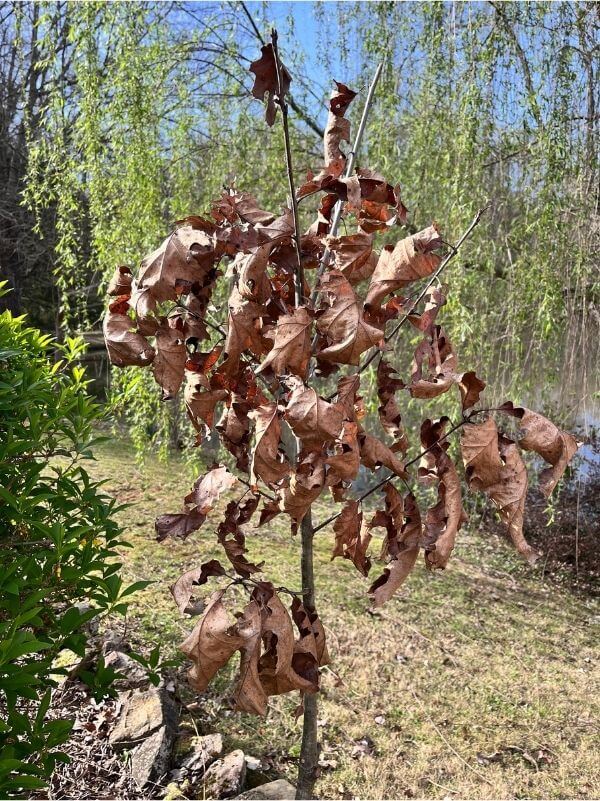
The internet tells me there’s actually a name for this: marcescence.
Certain trees—especially some oaks and beeches—hold onto their dead leaves instead of dropping them in the autumn like most deciduous trees.
Scientists aren’t exactly sure why, but they theorize that the dead leaves stay on the branches to protect new buds, discourage deer and other animals from nibbling tender growth, and provide fresh nutrients in the spring when they do fall.
Nature, it seems, isn’t in any rush to let go. Not until it’s time. Not until the baby leaves arrive and gently push the old ones out of the way.
Our Own Marcescence
As I sit listening to Rosemerry, I wonder about my own connection to holding on and letting go.
I’ve always liked holding onto words the way those marcescent trees hold onto leaves. Notes from talks. Quotes from books. Lines that strike me as important enough to keep, too meaningful to drop.
Sometimes that’s helpful. Last year’s leaves serve a purpose, after all. So do old words.
But other times I wonder if my intellectual marcescence—clinging to old words even after their season has passed—keeps me from noticing what I’m hearing right now.
The Vase or the Sieve
During her talk, Rosemerry shares a story. She had told a friend about trying to become a bigger vase so she could hold all the emotions she was feeling. (Read the poem here: Pourous)
But her friend gently challenged the premise.
Why be a vase?
Perhaps instead of trying to hold everything, she could be a sieve and let the experiences simply move through her.
Ahh.
I hear the lesson.
I don’t write it down.
One Leaf Worth Keeping
Later, after the talk ends, I pick up my phone. I type the line into my notes:
Be a sieve, not a vase.
That simple nugget of wisdom feels like a leaf worth keeping.
Hopefully the rest of the talk has done its work simply by passing through.

Maybe that’s a shift worth noticing: knowing when to hold tight and when to let go.
Some words need to stay with us a long while, until their message is buried deep in our soul or until something new and improved pushes them out of the way.
Other words can drop away quickly once they’ve completed their seasonal work, like leaves returning to the soil in the autumn months.
And like the trees outside our windows, we don’t have to force either approach.
Just let the shifts happen, each in their best time.
Question for you:
Do you write it down when you hear something meaningful—or do you prefer to just listen? Share in the comments.
Read more about Shift:
- A Small Shift: Learning to Notice Instead of Fix
This is what a missing glove is teaching me about letting go. - What If This Moment Is Asking for a Different Pace?
When plans fall apart, learning to shift your pace can change things. - Noticing the Shift: What Keeps Blooming When We Pay Attention
A Share Four Somethings post about discovering what keeps blooming in everyday life.
- What a Smelly Elevator Taught Me About Questioning Beliefs
- Do You Assume the Best or the Worst? And a Barking Lady
I love this imagery of being a sieve, not a vase, Lisa. Rosemerry’s poem is amazing, too. When I was in college, I took notes like crazy because I had to. It’s so nice to simply sit and listen instead. Blessings!
I keep thinking about the imagery too, Martha. Especially when I get out my colander. I’ve always been a serious note-taker too. It feels both refreshing and quite different to NOT take notes.
I stopped taking sermon notes a while back for that reason–I was so caught up in trying to get the important points down that I missed a lot. Plus, I rarely did anything with the notes I had taken, yet I was loath to throw them out.
Interesting about marcescence. I never thought about the name or reason for some tress and bushes to hold onto their leaves. We so need wisdom about when to hold on and when to let go.
I like the thought of being a sieve rather than a vase.
Same with me about notes. I rarely went back to look at all those sermon notes I took through the years. I do think it helped me pay closer attention at the time I took them, but now I see how it also keeps me from really hearing the next thing. So it’s a catch-22. I finally did throw away lots of notebooks last year that had notes from many, many years ago. 🙂
Lisa, I think it’s nice to just be & listen at times rather than always having to do.
I find I get more out of just listening. And on rare occasions I will write a poignant quote down in my journal.
Blessings, Jennifer
I’m trying to find that middle ground because yes, sometimes it is nice to just listen and not feel like I have to capture every little thing. 🙂
Lisa, this was such an interesting thought for me, mainly because I am a notetaker from WAY back! Especially when it comes to sermons. But reading here has given me some food for thought. I plan to try being a sieve instead of a vase and see what happens.
It’s an odd feeling to NOT take notes for people like us who are used to taking them. I think I’m just trying to find that middle ground instead of leaning too heavily one direction. I definitely love having notes to refer back to when I want to remember an insightful point that someone made. Because when I think “Oh, I’ll just remember it,” I typically don’t. ha. But I also like being as present in the moment as possible without having to write things down. I’ll just keep experimenting with what works best. 🙂
They say you learn something every day, and I’ve just learned about the leaves not falling off some trees. I would love it if you would join me for my monthly Sharing Serenity link party at https://serenityyou.com/sharing-serenity-the-monthly-link-party/ – Natasha xxx
It is amazing how there is still SO much to learn, even about things that we see year after year. I like that. 🙂
Oh you’re so right, Lisa. I’ve always been an avid notetaker and looking back, realize that I missed so much of what was being said and how it was presented and what was happening around me. More often than not, when all is said and done, I seldom if ever looked at those notes again.
* sigh *
Yes, I’m trying to be more intentional about which notes I think I’ll look at again, and which notes I know I won’t. Sometimes there is a pattern. But full disclosure, with Rosemerry’s talk, I knew I would get a recording of it later, so it definitely took the pressure off trying to record everything in the moment. 🙂
Until recently I never went to a church where people took notes and I often left not remembering what was said.
I’ve found writing helps me remember. For me it’s a way of staying present and not allowing my mind to drift.
I can see how it can be a contest to get every word but I’ve never tried that and I don’t worry if I review them later. It is what I need to do to stay in the moment and keep myself from wandering.
If I find myself getting caught up in a sermon I often find I’ve taken fewer notes as I lacked the need to hold myself present and it doesn’t worry me.
I do agree with you–taking notes does help keep my mind on the speaker instead letting my attention drift away. I can sometimes just take it too far. ha. I remember taking notes at church even as a teenager along with my friends. I can’t say those notes were very helpful themselves, but they did keep us focused. 🙂
Wonderful post, Lisa. And yes, I’m a note-taker, because I don’t want to forget. I used to prefer extemporaneous sermons, of course, after a pastor studied hard, b/c I don’t like for speakers to read aloud from a script. That said, when what a speaker says is meaty, even for note-takers like me, a scribe, it’s hard to get it all. So then a printed sermon (I ask for one later), is beneficial.
I don’t have time to reread this post to comment intelligently, but I loved that I learned a new word from you, and WILL write that down! 🙂 It’s marcescence! Wow! I didn’t know that that had a name.
I had written a shifty essay called “Eastering,” not realizing that though I don’t use the word it captures the ideas of a shift from death to life. I’ll share two paragraphs here, b/c it is the essence of marcescence.
“I have already ventured outside earlier this morning, chilled to the bone, on a walk by the wind-whipped lake. I prefer now to cloister inside the heated cabin and watch the woods from my ringside seat behind a window¾my window on the world, the world awaiting the transition from winter to spring, from death to life.
All is dun-dulled: The trees’ mostly leafless limbs weave a wintry web of browns, grays, camels, charcoals, crisscrossed against the pewter-rinsed sky. Fallen leaves, crumbled and lifeless, spread a crushed carpet of decay across the dampened earth. A few forlorn leaves, pitifully shriveled, shockingly petrified, still cling to branches, as if they had refused to let go and die a graceful death.”
I often have too much I have too much marcescence going on in my life. I need to shift from dead leaves to flourishing blossoms!
xo
Lynn
You’re such a beautiful writer, Lynn. Thank you for sharing this shifty piece with me. I just learned a new word too: dun-dulled. 🙂
I so get what you’re saying about wanting a speaker to speak extemporaneously (after having properly prepared to do it well!). It’s more captivating than just listening to someone read their script, although I understand sometimes there is a time and place for that as well. What I like is when I know I’ll have the opportunity to listen to a recording again later if I need to catch something I missed, which serves the same purpose as you asking for a printed sermon later.
So many great insights, Lisa, thanks for sharing them with us.
Thanks, friend. I’m a note-taker at heart, so anytime I’m not taking notes, it’s a challenge. ha.
I am a huge note-taker too. I tend to remember things better if I write them down. I’m proud of you for taking the time to listen with intentionality.
Same, Barb – I remember things much better if I write them down, even if I never go back and look at what I wrote down. So to NOT do it feels strange, so sometimes it’s a good exercise for me to instead just hang on every word in the moment.
This is so good, and it reminds me too of the way taking photos of a sweet event impedes my ability to stay PRESENT to the moment. (See how our words keep intersecting?)
Yes, I see what you did there with the intersection. 🙂 And what a perfect parallel you draw about taking photos. Jeff and I were at a concert last night (a cover band of the Bee Gees!) and there were a few moments when I was so enthralled with looking at the videos I was taking that I missed out on paying attention to the song itself.
This is so beautiful and poignant, Lisa! I love taking notes, but I also love listening to feel. I have learned over time that both have merit. You’re right about dividing your time and your focus when you take notes–I’ve learned that as well.
I really enjoyed reading about marcescence! That is a phenomenon I noticed when I lived in western New York, especially with oak trees. In fact, I lived in NY when Hurricane Sandy blew through, and in our town I was STUNNED to drive through the next day and see a few 40-foot trees *uprooted* and yet those brown leaves still clinging to the oaks like nothing had happened. You make a good point about hanging on to some things for a reason, while other things might be from a season ago. Great thoughts. Visiting from the Sweet Tea & Friends linkup.
I do love images and wow this one saturated with wisdom. And to hear Rosemary. = I do enjoy your poems. what a gift to hear her in person. I agree with you as I am a notetaker too. Fear of forgetting the details instead of savoring the present moment. You WILL remember that moment and didn’t need to write it down on your phone – it’s is in your heart! Great lesson.
Happy Easter, Lisa!
I love the imagery of being a sieve. Now that I think about it, I believe I’m a listener. If I’m reading something online and I want to reflect further I bookmark it.
Thanks bunches for sharing with Sweet Tea & Friends this month dear friend.