
Do I Stay Christian or Not?

He was sitting in the front row. He was waiting his turn to speak.

I was sitting in the second row behind him, waiting to hear what he would say, along with a couple hundred other people also waiting in the audience.

I watched as he discretely pulled out his phone. Maybe he was answering a text. Maybe he was typing a note.

And something about this made me smile as he typed . . .

Because he was typing on his phone with just his pointer finger.

Not texting with both thumbs. Not swiping. Not even using both pointer fingers.

He was just using one lone index finger to strike one tiny letter at a time, like many of us do in our generation who didn’t grow up texting like today’s kids.

He then finished his note. And put his phone away.

It turns out Brian McLaren is just as normal as the rest of us.

It was endearing. Because it was so human.

Stay or Go?

Listening to Brian speak at the Christian conference we were attending lit even more fire within me about his latest book, Do I Stay Christian?: A Guide for the Doubters, the Disappointed, and the Disillusioned.

Image: Do I Stay Christian book review

In person and in writing, Brian infers that the American Christian church is in trouble.

Doesn’t everyone see it? I sometimes wonder how much further back into the pews Christ can be shoved until he is eventually kicked out of the door altogether of many Christian churches, just another unnecessary hindrance to the latest Christian agenda.

Who is ready to walk away from this troubled Christianity? And who is determined to stay?

And for those who do choose to stay, can their Christianity include more Jesus, more grace, and more love?

Part 1: Do You Stay Christian? No

These are the types of questions that Brian poses to his readers in Do I Stay Christian. He divides the book into three sections: reasons not to stay Christian, reasons to stay Christian, and how to be good, honest, and loving regardless of what you decide about staying Christian.

In Part 1 of Do I Stay Christian?, Brian lists 10 reasons why many people choose not to remain Christian.

Here are five of those reasons:

  • Because Christianity has been vicious to its mother (anti-semitism)
  • Because of Christianity’s suppression of dissent (Christian vs. Christian violence)
  • Because of Christianity’s real master (money)
  • Because of the white Christian old boys’ network (white patriarchy)
  • Because of Christianity’s great wall of bias (constricted intellectualism)

Behind each title is a wealth of information included in each chapter, plus five more chapters.

Part 2: Do You Stay Christian? Yes

But what are some reasons you would want to stay Christian? In Part 2 of this book, Brian lists ten reasons.

Five of these reasons for staying are:

  • Because leaving defiantly or staying compliantly are not the only options
  • Because where else would you go?
  • Because of its legendary Founder
  • Because you’re human
  • Because Christianity is changing (for worse and for better)

Again, these titles alone don’t tell the story. Brian goes into depth inside every chapter and the remaining five chapters.

Part 3: How to Be Loving, Whichever You Decide

In Part 3 of the book, Brian writes about how to live in a loving way that is good for ourselves and for our fellow human beings, regardless of our decision to stay a Christian.

Some of the ways include:

  • Start with the heart
  • Create positive alternatives
  • Prepare yourself for turbulence
  • Nurture the practice of spiritual resilience
  • Stay loyal to reality
  • Stay human

But the book really doesn’t even end there. If you stick it out to the end, you’ll also find five appendices, including this one: “Do I Stay in My Denomination?”

All Humans Together

In the end Brian decides for himself, “So, no. I will not quit. Not today. Today I will stay Christian.“

I appreciate this humble, intelligent, kind, and spiritual leader to listen to and learn from.

I also like having a leader like Brian who isn’t afraid or ashamed to share his doubts, disappointments, and disillusionments. Like the ones I have. Perhaps you, too?

As Brian says, we aren’t looking for a cure for being human; what we need is help to become humane.

“Our problems are not just religious problems. Nor are they merely political, economic, or scientific problems. Our problems are human problems.”

Being human by ourselves can feel exhausting. But true spirituality is meant to bring people closer, not push them further apart.

When we see our own humanness in others—even in the smallest ways, such as texting each other with our pointer fingers—we smile in recognition.

We’re all humans together.


I highly recommend the book Do I Stay Christian? for those who are prepared to ask themselves the hard questions, and who don’t give up even when there aren’t clear answers.
Share your thoughts in the comments.


Romans 8:26 – Memory Verse for June 19-25, 2022

This week’s memory verse for the 8-8-8 Bible Memory Challenge is Romans 8:26.

Likewise the Spirit helps us in our weakness. For we do not know what to pray for as we ought, but the Spirit himself intercedes for us with groanings too deep for words.
Romans 8:26

.

  • . 
  • . 
SCHEDULE
June 5-11, Romans 8:1
June 12-18, Romans 8:15
June 19-25, Romans 8:26
June 26-July 2, Romans 8:28
July 3-9, Romans 8:31
July 10-16, Romans 8:37
July 17-23, Romans 8:38
July 24-30, Romans 8:39


What Will You Do This Juneteenth?
—Grace & Truth Linkup

I don’t know when the tradition started with my in-laws.

But long before I even married into the family (which has been almost 30 years), my in-laws have hosted a huge July 4th picnic at their home on the lake. Friends and family (and friends of families) are all invited, come one, come all.

We know what to do on July 4.

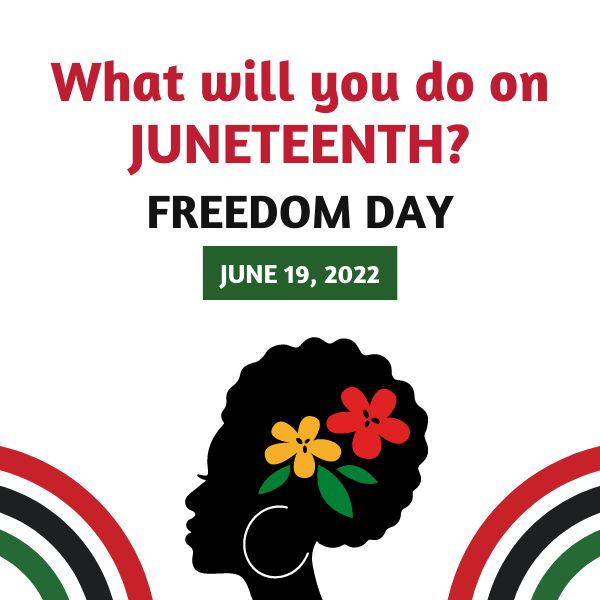
Our newest national holiday, Juneteenth (“America’s second Independence Day”), is Sunday, June 19.

I don’t have years of traditions celebrating Juneteenth. Yet. 

Image: Juneteenth

Juneteenth National Independence Day is also called Emancipation Day, Freedom Day, Jubilee Day, or Black Independence Day. It became an official holiday for everyone last year on June 17, 2021.

But Juneteenth has been celebrated by generations of African Americans for years. (I’m genuinely hoping we white folk won’t mess it up for them now that we’re getting involved in the celebrations.)

It marks the symbolic end of enslavement in the United States. The story goes that while President Lincoln signed the Emancipation Proclamation into law on January 1, 1863, the news didn’t reach the southernmost outpost of slavery in Texas until two and a half years later on June 19, 1865, two months after the Confederacy surrendered.

The cities near me will each have celebrations on Saturday and Sunday to mark the significance of the day, and also to remind us that racial equity still hasn’t been fully achieved. I like what historian Mitch Kachun has said the three goals of Juneteenth are: to celebrate, to educate, and to agitate. 

While we’ve made definite progress since 1865, we still have white supremacy implanted in many of our institutional structures and often still rooted in our hearts, consciously or unconsciously. This must change.

So taking time to look back to 1865, to acknowledge the journey we’ve been on, is critical if we want to move forward from a foundation of truth.

I’m looking forward to attending my first Juneteenth celebration this year. In addition to the celebration stuff (food and music!), they’ll also be offering voter registration, a blood drive, covid vaccines, and more.

Who knows? Maybe this will begin a new tradition for my family for years to come. 

Featured Post

Is today a dot or a dash for you?

In our featured post this week, Robin Gonzalez says,

“The Holy Spirit works within you and changes you by the dots and dashes of ordinary life-every situation, circumstance, and relationship.”

The small dots are everyday life. The larger dashes are challenges in life. They both can be times of growth in our relationship with the Lord.

__ __ * ___ ___ ___ __ ** ** *** * ___ ** ___ ___ ___ ***_ *

Read all of Robin’s post here, then link up your own blog posts below.

“Dots and Dashes”

Thanks for sharing your post, Robin! Here’s a button for your blog.

blank

Have you celebrated Juneteenth before? Share your thoughts in the comments.

I’m linking at these blog parties


Review the rules here about adding your most recent Christian Living posts and how to become our next Featured Post. Visit all four hosts’ social media here or websites here: Maree Dee | Lisa notes | Lauren Sparks | Tammy Kennington.

Now Let’s Link Up!

You are invited to the Inlinkz link party!

Click here to enter

Can You Let Go of How You Want Life to Be, and Accept Life as It Is?

The Questions I Ask Myself

The title of my own post makes me uncomfortable:

Can You Let Go of How You Want Life to Be, and Accept It as It Is?

For me, it begs the questions:

  • If you accept life as it is, are you implying that everything is fine as it is?
  • If you accept life as it is, are you giving up on changing bad situations into good situations?
  • If you accept life as it is, are you admitting that nothing can improve?

If there are things I don’t like about life (and there are things I don’t like, such as, mass shootings, religious infighting, racial inequity, relationship conflicts, debilitating illnesses, on and on…), isn’t it counterproductive to “accept” them?

Photo: Accept Life as It Is

The Answers I’m Finding

No. Acceptance is not counterproductive.

In my year of Release, I’m learning more and more that I need to let go of my discontent that life isn’t fully how I want it to be right now.

I need to stop fighting against accepting things as they are.

I can never make things better if I’m not first willing to accept them as they are. Even if I don’t like them.

  • Before we can apologize, we must accept we’re wrong.
  • Before we can heal, we must acknowledge the wound.
  • Before we can grow, we must recognize we’re stunted.

Trying to change the future before we understand the present doesn’t work well.

And we often get too far ahead of ourselves in our rush for improvement. When our thoughts drift too far into the future, we’re wise to acknowledge them, notice them, but then return again to the present moment. Without avoidance. Without suppression. Without denial.

Facing reality is the necessary first step. This is what acceptance is. This is the foundation. Until we know where we are, where we’re starting, as accurately as our minds can allow, we can’t map out proper directions to get where we want to end up.

And then, based on this knowledge, we can more clearly pursue God’s wisdom and more accurately understand God’s guidance to set goals and take action:

  • to restore relationships,
  • to make the world safer for everybody, and
  • ultimately to grow into more loving human beings.

It still won’t be easy. And it might not even be successful, especially if it involves other people and things out of our control.

But it’s a path worth pursuing.

Face it first. Move forward second.


How do you handle facing reality? Share your thoughts in the comments. 

Image - One Word 2022 Release

sharing at these linkups


Romans 8:15 – Memory Verse for June 12-18, 2022

This week’s memory verse for the 8-8-8 Bible Memory Challenge is Romans 8:15.

For you did not receive the spirit of slavery to fall back into fear, but you have received the Spirit of adoption as sons, by whom we cry, “Abba! Father!”
Romans 8:15

.

.

.

SCHEDULE
June 5-11, Romans 8:1
June 12-18, Romans 8:15
June 19-25, Romans 8:26
June 26-July 2, Romans 8:28
July 3-9, Romans 8:31
July 10-16, Romans 8:37
July 17-23, Romans 8:38
July 24-30, Romans 8:39

What’s in Your Pocket?
—Grace & Truth Linkup

Always check the pockets.

That’s my golden rule for laundry. Mix darks and lights if you must. But always check the pockets for the stray kleenex that will shred tissue onto every freshly-washed article of clothing.

In Bob Goff’s newest book, Undistracted: Capture Your Purpose. Rediscover Your Joy, we’re reminded to check our pockets.

“It’s what we put in them or keep in them that can become distractions. Regrets, resentment, hurts, and misunderstandings are all things that can become huge distractions.”

What's in Your Pocket? + Book Review of Undistracted

Physically, I usually have my phone in my pocket. Too often, I know. Phones are one of our major distractions. Bob says,

“Lose the handheld distractions. Think of phone use as cheating on your family.”

Ouch.

But mentally, the contents of my pockets can carry more weight than my phone.

  • Some days I stuff my pockets with the distractions of a rigid schedule.
  • Or ruminating on events from the past.
  • Or wasting time trying to solve a situation beyond my control.

These distractions keep me from focusing on my most important purpose. . . loving who I’m supposed to be loving at this moment, in this place.

That doesn’t mean I shouldn’t plan, or think about things from the past, or try to solve potential problems on the horizon. Those also can be loving things. God gives us brains to be used for good.

But as Bob points out, it matters less what we are doing, and more why we are doing it.

“It doesn’t matter what the work is; it is who we become in the process of doing our work that does, and the goal is to look and act more like Jesus while we do it.”

So I’m cleaning out my pockets again this morning. I’m working on clearing my head, thinking healthy thoughts, and having clearer vision.

I won’t do it perfectly. I never do.

But at least I can keep a few shredded tissues out of the laundry today.

Quotes from Undistracted

Here are a few of my favorite quotes from Bob Goff’s book, Undistracted:

“Don’t be distracted by how different you are from everyone else. Our hearts were meant to beat together, not the same.“

“Boundaries are good; barriers aren’t. If you build a wall, make sure you install a door or two.”

“Don’t get distracted thinking about what your next move is or whether you will be acknowledged for your efforts. Go love people in extravagant, wildly inefficient ways by speaking words of beauty into their lives. Your words have that kind of power.”

“It’s been said that there are two kinds of people. Humble people and those about to be. Be humble and you won’t be distracted trying to look important.“

“I used to spend my time doing things that worked. Now I’m trying to do things that last. It’s a subtle difference but an important one.”

Featured Post

Bob Goff is a wonderful storyteller. But telling our stories is something we ALL can do.

Our featured post this week is from Leslie Newman. Read her post here for motivation on telling your own story more often, then add your own blog links below.

“5 Reasons Why Your Story Matters”

What is in your pocket? Share in the comments.

my thanks to NetGalley & Nelson Books
for the review copy of Undistracted

Thanks for sharing, Leslie! Here’s a button for your blog.

blank

I’m linking at these blog parties


Now Let’s Link Up!

You are invited to the Inlinkz link party!

Click here to enter