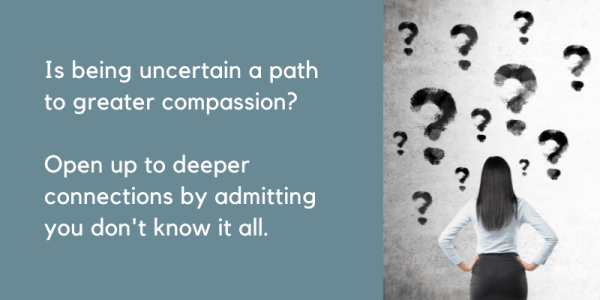
The Curiosity of Arguments: It Depends If It’s Yours or Mine

The two older gentlemen were amusing me. But they weren’t amusing each other.

Their volume was increasing. Their voices were losing their calm sheen. Their facts were volleyed back and forth to prove their own point right, and the other man wrong.

Along with several others, my husband Jeff and I had gathered at our local public library for an interesting presentation on the history of our town. The speaker traced it back to the indigenous peoples, the Revolutionary War, the Civil War, up to current city growth.

But the stumbling block came when a date was questioned from the crowd. Exactly when was the elementary school for the African American kids built in the 1950s?

Gentleman A spoke up from the audience and said the school was built in 1949. Gentleman B countered with 1951.

“No,” Gentleman A said, “it was before 1950 because I joined the Air Force in 1950 and the school was already there.”

“Wrong,” Gentleman B said. “I was born in 1945. I attended school first at our Black church because the elementary school wasn’t built yet. Plus, I have lived across from that school all my life, so I oughta know.”

How easy it is to be entertained by the gentle arguments of others, especially when the crossfire doesn’t involve me.

But with my curiosity now piqued about who was right, I pulled out my phone and googled the school’s construction date.

Both men were wrong (well, assuming the article I found was accurate). The school had been built in 1953.

I smiled to myself, but kept my mouth closed. The meeting continued on.

After it ended, I stayed behind to chat with some fellow citizens from my youth. One woman commented on how close I had lived to the elementary school years ago.

“No,” I said. “I never lived close to the school. My family’s house was several streets over.”

“But not when you were really young,” she replied. “You lived by the school.”

I responded negatively one more time.

Then I realized what I was doing. It was the same thing I had seen the older gentlemen do just thirty minutes earlier.

When they were disagreeing over a fact, it was amusing. But now that I was doing it? It was annoying.

Catching myself right in the act was startling. My curiosity piqued again. How human of me to argue over minor details! The awareness of this common tendency among us all was enough to stop me in my tracks.

Instead, could I hold space in my imagination for amusement about my own disagreeableness? Could I allow curiosity to win the argument instead of insisting on being right?

Some facts can be proven as right or wrong. Where I once lived was a provable fact. But not right then and not right there.

Sometimes you just have to let things go for the greater good, and let memories remain a mysterious and curious thing.

I stopped arguing. And continued the conversation with the friend as if she were right. It had been a lovely evening. Why spoil it?

The importance of maintaining a relationship was stronger than winning an argument.

* * *

When I got home, I did text my siblings though. We never lived near the elementary school, right??? They agreed we did not. (Maybe I haven’t totally lost my mind yet.)

Share your thoughts in the comments.

More articles on Curiosity


Silent Escape: A Nun’s Journey from Confinement to Freedom

A Leap of Faith: Joining the Convent

After Catherine Coldstream’s father died when she was just 24 years old, she felt unmoored, unsure which direction to go next in her life.

So she did what few do: she became a nun.

She joined the rigidly-tight community of sisters at Akenside Priory. In her memoir—Cloistered: My Years as a Nun—Catherine shares what it was like when she entered the confines of the basically silent monastery to live the Carmelite life. She took vows of poverty, chastity, and obedience so that she could be married to God.

Parts of the monastic life went well for Catherine.

“The teachings were all so extreme, and the prevailing atmosphere of faith so powerful, that the material sacrifices came relatively easily, and seemed almost natural once you put your mind to it.”

The Downside of Monasticism

But bit by bit, life in the convent became suffocating.

“Both in and out of choir, eyes were to be kept lowered, and, like all the other senses, suitably restrained. We were to mind God’s business and our own, never other people’s.”

Being cut off from society wasn’t in itself horrible to her, but being cut off from even the people in her own small community was.

“It was odd. We were meant to be suffering, uniting our pains with those of our spouse, the great Redeemer of the world, but if ever you let on that you were in pain you were told to Pull Your Socks Up, and Get On With It, and – Elizabeth, I had now begun to notice, loved the words – not be such a Cry Baby.”

Sister Catherine longed for human touch, for human communication, for human joys. Instead, she was given distance, silence, and isolation. As the years went by, Catherine grew increasingly suppressed by the autocratic leadership of the Mother in charge and the cliques among the sisters.

“If I’d been able to be honest with myself, I would have admitted that my dream had turned into the beginnings of a nightmare.”

Shaking Loose the Shackles

Eventually what happened made her life torturous. After a decade of trying to make it work, Catherine decided she needed out, if she would remain sane.

“Psychologically, of course, things were far more complicated. No one felt genuinely free to leave at any point, however nominally enshrined the possibility might have been on paper.”

In the book, she details her frantic escape from the monastery, where she went next, and the plans she made afterward.

“After over a decade of straining for the highest monastic ideals (and being shocked when others didn’t) I’d broken one of the most fundamental of our rules, that of enclosure. I’d broken it, not out of laziness, or because I didn’t care, but because I cared too much.”

This is a fascinating true story of good intentions in a community gone bad, set in the backdrop of faith and the human spirit.

blank


Share your thoughts in the comments.

My thanks to Netgalley
for the review copy of this book


Are you a new one?

Ms. Willie is always our last visit. She lives on the top floor of the public-housing apartments that Kay and I deliver supper to on Wednesday afternoons.

With all the others, we knock on their door, give them a box meal, ask how they’re doing, and move on.

But Ms. Willie is different.

She steps out of her apartment in her nightgown to chat for several minutes. She rarely wants the food because she says her stomach has been upset. (Because she also has no teeth, we show her what’s easy to chew; sometimes she takes it, sometimes she doesn’t.)

Yet she never knows who we are.

Every time.

Every week she asks us, “Aren’t y’all new ones?”

We used to say, “No, Ms. Willie. We’re not new. We were here last week, too. Remember?”

But now I’ve started just saying, “Yes, we’re new. I’m Lisa and this is Kay. It’s nice to meet you!”

She then proceeds to tell us how she got her name (from her sweet little ol’ daddy), she asks us to pray for her sister, and eventually says, “I thank you for coming, but I know you’re busy so I won’t keep you.”

But even though I’m sad her memory is fading further and further away, I’m glad she reminds us that we are new every day.

Today is a new one. And we are new in it. We’re not exactly who we were yesterday. We’re not exactly who we’ll be tomorrow.

We’re refilled with a new measure of grace every morning. Every morning we wake up with a fresh supply.

May you remember, too, that you are new today. Everyday. Like new buds opening every day now (I’m so glad it’s spring!), may you also open up to new possibilities every day, new views, new graces.

Embrace the renewed you. You’ve never been the person you are right now.

Today is a new day and you’re a new you in it!

blank

* * *

Where do you hope to see new mercies this week? Let’s talk in the comments.

revised from the archives


On the Blog—April 2024

Here are brief summaries and links to posts on the blog, Lisa notes, from April 2024.

blank

See previous months’ archives here


6 Books I Recommend—April 2024

“If you only read the books that everyone else is reading, you can only think what everyone else is thinking.”
– Haruki Murakami

Here are 5 nonfiction books + 1 novel I recommend from what I finished reading in April 2024. 

[See previously recommended books here]

NONFICTION

1. Supercommunicators
How to Unlock the Secret Language of Connection
by Charles Duhigg

Supercommunicators

If you’re able to talk about difficult topics, if you’re able to discuss opposite viewpoints, if you’re able to get others to speak up, you might be a supercommunicator. And if you’re not, you can read this book to improve. I highly recommend it. 

[Read more hear about Supercommunicators in “Which of These 3 Conversations Are You Having?”]

2. Curious
The Desire to Know and Why Your Future Depends On It
by Ian Leslie

Curious

Being curious is not being nosy. It’s being engaged in life and wanting to understand and know more. Lots of practical advice in this book. It was a perfect read for me since my One Word of the Year is Curiosity.

3. Oath and Honor
A Memoir and a Warning
by Liz Cheney

Oath and Honor

Representative Liz Cheney goes into detail about the facts gathered surrounding the insurrection at the U.S. Capitol on January 6, 2021. She writes even-handedly and cites multiple sources of credible witnesses leading up to the day, the day of, and the days following January 6.

4. Preparing for War
The Extremist History of White Christian Nationalism—and What Comes Next
by Bradley Onishi

Preparing for War

Bradley Onishi is a religion scholar and Associate Professor of Religion. His book explains both the origins of Christian Nationalism and where he sees it heading. While this is a troubling book, it can serve as a wake-up call for all Americans who are serious about keeping democracy alive in the U.S.

5. How to Know a Person
The Art of Seeing Others Deeply and Being Deeply Seen
by David Brooks

How to Know a Person

If you like to really know a person, this is the book for you. Brooks is so engaging and practical in his advice to better see other people and to allow yourself to be more seen. This will be one of my top 10 books of the year, I already know!

[Read more thoughts here on How to Know a Person]

FICTION

6. It Starts with Us
by Colleen Hoover 

It Starts with Us

This is the sequel to It Ends with Us, a novel that show you what it looks like for a woman to live with an abusive spouse. Colleen Hoover wrote this book as its follow-up at the request of her fans. I’m glad she did because I wanted to hear more about what happened to Lily and Atlas.

WHAT I’M READING NOW

  • The Latecomer
    by Jean Hanff Korelitz
  • Cloistered
    My Years as a Nun
    by Catherine Coldstream
  • Say Good Night to Insomnia
    by Dr. Gregg D. Jacobs
  • The Exvangelicals
    Loving, Living, and Leaving the White Evangelical Church
    by Sarah McCammon
  • No Bad Parts
    Healing Trauma and Restoring Wholeness with the Internal Family Systems Model
    by Richard C. Schwartz
  • Write a Must-Read
    Craft a Book That Changes Lives―Including Your Own
    by A.J. Harper
  • Life After Doom
    Wisdom and Courage for a World Falling Apart
    by Brian D. McLaren
  • Hidden Potential
    The Science of Achieving Greater Things
    by Adam M. Grant

blank


What good book have you read lately? Please share in the comments.

sharing at these linkups


Share 4 Somethings in the “How to Know a Person” Edition—April 2024

For the 2024 edition of “Share 4 Somethings,” Jennifer asks us to share each month:

  1. Something loved and/or disliked
  2. Something accomplished
  3. Something improved upon and/or that needs improvement
  4. Something noticed

~ * ~ * ~ * ~

Something Loved

  • HOW TO KNOW A PERSON 

I just finished reading a book I now love so much: How to Know a Person: The Art of Seeing Others Deeply and Being Deeply Seen by David Brooks.

How to Know a Person

The book is about humans (I’m still partial to the topic; it was my One Word for 2023). About relationships between humans. And about learning how to make better connections with other humans.

Brooks is an experienced columnist for the New York Times, so his words flow smoothly and can be read easily. But that doesn’t mean his words or message is simple. He addresses many hard topics and gives us difficult advice.

Here is a snippet of one action step in the book that we can all work on.

“As soon as somebody starts talking about times when they felt excluded, betrayed, or wronged, stop and listen. When somebody is talking to you about pain in their life, even in those cases when you may think their pain is performative or exaggerated, it’s best not to try to yank the conversation back to your frame.

Your first job is to stay within the other person’s standpoint to more fully understand how the world looks to them. Your next job is to encourage them to go into more depth about what they have just said.”

 ~ * ~ * ~ * ~

Something Accomplished

  • READ ONE BOOK AT A TIME? WHAT?

My normal mode of reading is to keep several books going at one time. It’s my favorite approach. I like having options when I sit down to read.

But because How to Know a Person was a library book, with others waiting in line for it, I had to read it within my allotted two weeks. Which meant foregoing other books.

And I did it! I read just one book at a time. This is an accomplishment for me. (Maybe the internet hasn’t totally ruined my attention span yet?)

But I’m not giving you advice to only read one book at a time (I won’t continue it myself). But neither will I give you advice to read several books at once. Do whatever works for you.

Here’s a caution from Brooks about giving advice.

“I told [my depressed friend] he should [do his service project] again, since he has found it so rewarding. I did not realize that it was energy and desire he lacked, not ideas about things to do.

It was only later that I read that when you give a depressed person advice on how they can get better, there’s a good chance all you are doing is telling the person that you just don’t get it.

I learned, very gradually, that a friend’s job in these circumstances is not to cheer the person up. It’s to acknowledge the reality of the situation; it’s to hear, respect, and love them; it’s to show them you haven’t given up on them, you haven’t walked away.

~ * ~ * ~ * ~

Something that Needs Improvement

  • WRITE ABOUT FRIENDSHIP

For the past two and a half years, I’ve been wrestling with a deeply painful circumstance in my life. I’ve been learning a lot about myself (and learning I have more to learn), but I’ve been learning more about other people, too.

I’ve had some friends/family members/spouse who have been amazing human companions alongside me on this difficult journey. They didn’t give up on me and walk away. They’re still here, staying beside me through the emotional trauma. And I’ve wanted to capture this phenomena in words.

But I can’t seem to pull it together yet. Maybe it will be a project for this summer.

In How to Know a Person, Brooks calls these helpful people Illuminators because they shine the brightness of their care on people.

“The Illuminator is not just there to see the depths of your pain, she’s there to see your strength, to celebrate with you in your triumphs.”

I’ve had Illuminators shine on me. They’ve helped save my life. Maybe one day I’ll be able to express my thanks for them more clearly.

~ * ~ * ~ * ~

Something Noticed

  • LISTEN TO THE WITNESSES

I’ve been sharing lately about my special friend V. She had a bout in the hospital this week with an infection. When I visited her yesterday, I couldn’t get her to wake up and talk. Not even when I played her favorite Elvis songs and Hall & Oates music (although I’m certain her feet moved a bit on the livelier tunes).

But her stillness worried me. The nurse on duty noticed.

So a couple hours after I got back home, the nurse called me. She said that V had woken up in great spirits, talking and cutting up and telling everyone how much she loved Elvis. Maybe she had been more awake than I’d realized.

I was so grateful for the nurse who noticed my concern, and followed up with the phone call.

In How to Know a Person, Brooks quotes Pope Paul VI on witnesses: “Modern man listens more willingly to witnesses than teachers, and if he does listen to teachers, it’s because they are witnesses.”

Then later Brooks says himself:

“People don’t see the world with their eyes; they see it with their entire life.”

I’m thankful for people like that nurse who saw me not with just her eyes, and heard me not with just her ears, but used her whole life experience to understand what I was feeling. And then cared enough to do something about it.


What is something you are loving, accomplishing, improving, or noticing this month? Have you read How to Know a Person?

Share your thoughts in the comments.

I’m linking at these blog parties