I went to church for years and never understood it. Never heard much about it. And surely never believed much in it.
Grace.
I finally discovered it, and wow! Now I can’t hear enough about grace and the freedom it brings me.
But why are there many in our churches who still don’t believe in grace?
“The thought means nothing to them; it does not touch their experience at all. Talk to them about the church’s heating, or last year’s accounts, and they are with you at once; but speak to them about the realities to which the word ‘grace’ points, and their attitude is one of deferential blankness. . . .
They do not accuse you of talking nonsense, but . . . the longer they have lived without it the surer they are that at their stage of life they do not really need it.”
– J. I. Packer
In chapter 13, “The Grace of God,” in Knowing God, J. I. Packer suggests these four reasons why many can’t grasp grace.
4 reasons we don’t appreciate grace:
1. We think we’re good enough without it.
Instead of us being made in the image of God, we tend to create God in the image of us. And we think highly of ourselves. We’re pretty good people, yes?
“Modern man, conscious of his tremendous scientific achievements in recent years, naturally inclines to a high opinion of himself. He views material wealth as in any case more important than moral character.”
2. We see no need for it.
We’d rather put off any thoughts of punishment. Ignore evil as much as possible. So we assume God feels like that, too. With no worldview of punishment, who needs grace to counter it?
3. We believe we can talk our way out of trouble.
Who can say no to us? Aren’t we capable of repairing our own relationships—even with God? We have the power within ourselves, right?
“. . . by putting God in a position where He cannot say ‘no’ any more. Ancient pagans thought to do this by multiplying gifts and sacrifices; modern pagans seek to do it by churchmanship and morality.”
4. We think God is obligated to love us anyway.
To quote a French freethinker, “God will forgive—that’s his job.” We feel he is bound to show us pity because of who he is.
But, but, but . . .
As Packer points out, we aren’t as good as we think we are.
We are guilty, unclean. So we do need grace to cover our otherwise deserved punishment. God is the one with the power, not us, to mend our broken relationship with him. We are dependent upon him for mercy—he doesn’t owe it to us—but by his own choice and goodness, he gives it to us.
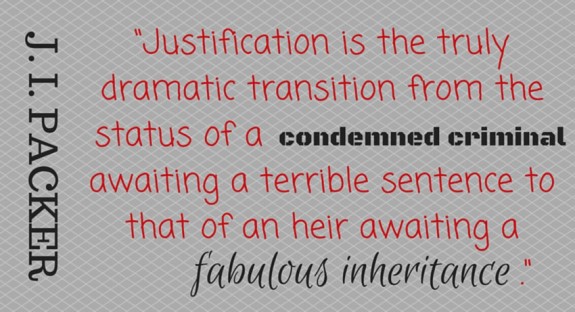
“Justification is the truly dramatic transition from the status of a condemned criminal awaiting a terrible sentence to that of an heir awaiting a fabulous inheritance.”
Thank God for his grace.
Believe it.
Receive it.
Be changed by it.
“For love awakens love in return.”
* * *
Are you early or late to grace? I’m late, but better late than never! Please share in the comments.
Previous chapters:
- Why do you want to know God? (chapters 1-2)
- What does it mean to know God? (chapters 3-4)
- You know God & Jesus. But the Holy Spirit? (chapters 5-6)
- Is reading the Bible worth it? (chapters 7-8)
- Does God toy with us in his wisdom? (chapters 9-10)
- Why doesn’t God give up on us? (chapters 11-12)
Next week:
- Chapter 15 and 16, “The Wrath of God” and “Goodness and Severity”