Day 9: Share it with others {Tools for memorizing}

Isaiah-12-1

TO MEMORIZE

Repeat 3-5 times, twice a day.

You will say in that day: “I will give thanks to you, O LORD, for though you were angry with me, your anger turned away, that you might comfort me.”
Isaiah 12:1 (ESV)

Say your verse looking only at 1st letters, twice a day.

Y w s i t d: “I w g t t y, O L, f t y w a w m, y a t a, t y m c m.”
Isaiah 12:1 (ESV)

TO DO

1. Share it.

The words you’re learning aren’t just for you. Let them minister to others as well. When something is on your mind this much, be aware of opportunities God gives you to spread it around.

How? Here are a few ways. 

  • In personal conversation. Directly or indirectly, share with someone in conversation the lessons you’re learning from your verse.
  • In prayer. When you’re praying with or for your loved ones and community, scripture is a great way to speak truth over their lives and situations.
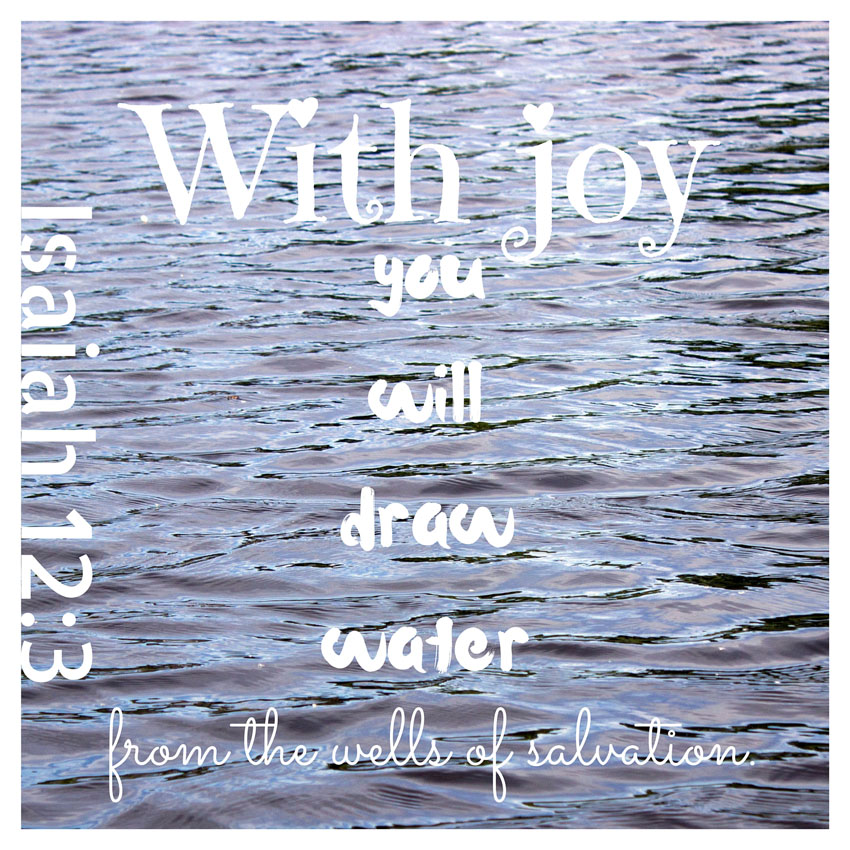
  • On social media. Post an Instagram photo of your verse. Start a Pinterest board. Write about it on your blog. Send out a tweet. Make a Facebook status about it.

2. Practice in Scripture Typer.

Friday is usually the last day of the week that I use Scripture Typer (I take the weekends off). Give your best today on the Memorize It step.

TODAY’S TIP

* Be creative.

Actively seek to express the message of your verse in ways other than just words. God is the master of Creativity, so let God work through you outside the box.

  • If you’re a photographer, look for photo opportunities through the week that remind you of the verse.
  • If you’re a musician, create a song expressing the intent of the message.
  • If you love to decorate, organize a corner of a room as a place to meditate on God and set up items that remind you of God’s presence.

FINAL WORD OF ENCOURAGEMENT

None of the time you spend in the spiritual discipline of scripture memory will be wasted. Maybe you won’t see the fruit of it in “exact recitations,” but that’s not the goal anyway. God is embedding truth in you in ways that may or may not be visible to you now, or maybe not for years to come. That’s okay.

But trust that God is at work. And that God’s work is always effective, always good, always loving.

LINKS

* * *

What are some ways you like to share scripture with others? Please share in the comments.

31-days-memorize-bible-chapter


Day 8: Make it personal {Tools for memorizing}

day-8-journal

TO MEMORIZE

Repeat 3-5 times, twice a day.

You will say in that day: “I will give thanks to you, O LORD, for though you were angry with me, your anger turned away, that you might comfort me.”
Isaiah 12:1 (ESV)

Say your verse looking only at 1st letters, twice a day.

Y w s i t d: “I w g t t y, O L, f t y w a w m, y a t a, t y m c m.”
Isaiah 12:1 (ESV)

TO DO

1. Write down why.

This might be one of the more important things to do. By Thursday of each week, you’ve already spent several days with a verse. The words have been soaking in, and now it’s time to look at what they’re doing in your heart.

Get a journal (or just write on a piece of notebook paper—that’s what I do). Write the verse number (and actually write out the verse, if you’d like) and the date. Then write a couple of sentences about what this verse means to you. Spend as little or as much time as you like.

  • What is God showing you?
  • How have the words come to life in your world?
  • Why are you memorizing it anyway?

I do this directly underneath commentary notes from Tuesday so I have it all in one place. From my journal on Isaiah 12:1: “No more anger. Instead, a sign of relief. I breathe out words of worship.” 

But even if you don’t write it down, spending a few minutes intentionally thinking and praying about what you’re learning will likely prove beneficial in your relationship with God.

2. Practice in Scripture Typer.

If you haven’t already tried Step 3 (Memorize It), do it today in Scripture Typer. You’re ready for it.

TODAY’S TIP

* Keep it together.

I keep all my Bible verses in one notebook. I keep the current chapter on a clipboard that I use daily, but the rest are filed by Bible order in my Bible notebook. (See how to make a Bible notebook here.) It’s easy to flip through the pages and review. I try to review one older chapter per week.

FINAL WORD OF ENCOURAGEMENT

Even if the words are slow to stick in your mind, remember that the larger purpose is for more awareness of God in your soul. Periodically reminding yourself why you’re memorizing is good practice to keep you motivated. Memorizing is just a means to an end, not the end itself. God is always the end goal.

LINKS

* * *

Why do you memorize scripture? Please share in the comments.

31-days-memorize-bible-chapter


Is God mad at you?

packer-wrath-quote

I’m uncomfortable around angry people. And more so if they’re mad at me.

I don’t really like feeling angry myself. While it is empowering, it leaves a bad aftertaste.

So thinking about God being angry makes me uncomfortable, too.

I was most uncomfortable this week with our reading assignment in J. I. Packer’s Knowing God. It’s chapter 15, “The Wrath of God.” (Can we substitute a more modern word for “wrath”? I’m going to use “anger” here.)

Packer says he knows we play it down. We don’t like talking about God’s anger for these reasons:

  1. We think anger isn’t God-like.

Yes, I admit it. I don’t want to equate God’s anger with how I see man’s anger: bad tempers; out of control behavior; violent mood swings. I agree with how James speaks of anger: “The anger of man does not produce the righteousness of God” (James 1:20). (For more on this, check out Brant Hansen’s book, Unoffendable.)

But Packer reminds us there is a difference between God’s anger and our anger. Ours is often self-indulgent, whereas God’s is always a reaction to evil.

  1. We wonder if God’s anger is cruel.

We know God is good. But don’t his judgments sometimes come across as too harsh?

Packer says no. He says God is always fair. Agreed.

(Except when God isn’t fair. It doesn’t seem fair to me that I get forgiveness for every sin I’ve ever committed or will commit just because Jesus paid the price instead. Grace goes beyond fair.)

But my bigger disagreement with Packer is here. Packer says that God’s anger isn’t cruel because we choose it for ourselves.

Well, I wouldn’t put it quite that way. If it were my choice, I’d always choose less pain and more pleasure as my consequence. Let’s all eat Krispy Kreme donuts and lose weight, not gain it.

So while I understand what Packer is alluding to (such as, if we choose to play with fire, we’ll get burned as a consequence), I think he’s underestimating our foolishness.

Our decision-making skills aren’t as refined as they need to be. We don’t always think the consequence will apply to me, or at least not until a very long time from now. (No need to start saving for retirement now, right? It’s so far down the road.)

So with all respect to Mr. Packer, I can’t agree with his statement:

“The essence of God’s action in wrath is to give men what they choose, in all its implications: nothing more, and equally nothing less.”

But where we do agree is here:

“Between us sinners and the thunder-clouds of divine wrath stands the cross of the Lord Jesus. If we are Christ’s through faith, then we are justified through His cross, and the wrath will never touch us, neither here nor hereafter.”

So is God mad at us? All I know for sure is this: Not if we’re his.

However God’s anger works or doesn’t work, it’s no longer directed at me. He sees me differently now; he sees me through the eyes of Jesus. His anger has turned away. Now he comforts me instead. (Thanks, memory verse, Isaiah 12:1).

I’m not uncomfortable with that at all.

* * *

What do you think? (I won’t get angry if you disagree with me—I know I still have much to learn.)

We’re on Week 8 of reading Knowing God together with Tim Challies.

Knowing-God-Packer-summary

Previous chapters:

Next week:

  • Chapter 17 and 18, “The Jealous God” and “The Heart of the Gospel”

Day 7: Map it {Tools for memorizing}

day-7-map

TO MEMORIZE

Repeat 3-5 times, twice a day.

You will say in that day: “I will give thanks to you, O LORD, for though you were angry with me, your anger turned away, that you might comfort me.”
Isaiah 12:1 (ESV)

Say your verse looking only at 1st letters, twice a day.

Y w s i t d: “I w g t t y, O L, f t y w a w m, y a t a, t y m c m.”
Isaiah 12:1 (ESV)

TO DO

1. Map it.

This is a fantastic visual tool that hardcore memorizers use to memorize random things in sequence (like cards in a deck). But we can use it to help us memorize our verses in the correct order.

  1. Get the number.
    Count the number of verses you’re memorizing (for Isaiah 12, it’s 6 verses).
  2. Select your map.
    Visualize a familiar path or sequence equal to that number (6 for Isaiah 12)—in your house (front door to foyer to living room to kitchen to bedroom to bathroom) or down your street (Smith’s house, empty lot, Jess’s house, stop sign, etc.) or your kitchen (sink to pantry to refrigerator to oven, etc.).
  3. Make the connections.
    Create a connection between the idea in verse 1 and your physical item or location 1, verse 2 and item 2, etc. For example, I’m correlating Isaiah 12 with my office. Isaiah 12:1 (not anger but comfort) is the glass doors because they’re very welcoming and comforting to me. Isaiah 12:2 (don’t be afraid) is my desk because it’s sturdy and strong. Isaiah 12:3 (water from the well) is a glass of water sitting on the desk. You getting the picture? You don’t have to actually tape the verse there, but if you can, even better.
  4. Walk the path.
    As you memorize, walk your path mentally (or literally!) saying each verse, anchoring each verse with the visual.

I’ve memorized a few chapters through mapping (an example here), and have been pleasantly surprised each time at how much it helps.

2. Look for word patterns.

Look for words that repeat, noun/verb patterns, pronoun usage, etc. This particularly appeals to us word geek types.

With Isaiah 12:1, I notice this: It begins with “You”, then moves to a direct quote with “I” do this or that, immediately followed with “you” do this or don’t do that. You—I—you—you—me—your—you—me. I don’t try to memorize the pattern, but just being aware of it helps.

3. Move up a level in Scripture Typer.

Try to move out of Step 1 (Type It) to Step 2 (Memorize It) or Step 3 (Master It) today with your first verse in Scripture Typer. If you want to work ahead, start typing in next week’s verses (Isaiah 12:2-3 or your own) for practice.

TODAY’S TIP

* Borrow techniques from other disciplines.

I picked up the mapping technique from Moonwalking with Einsteina book by a journalist Joshua Foer who entered the USA Memory Championship tournament for an assignment. As he shared what he learned from other contestants, I learned from him on how to apply this for my own use.

* Recruit your kids.

If you have kids in the house, ask them to help you review your verses. They will enjoy watching you learn something new and do your homework. And they often end up learning the verses themselves by hearing you say them. Although this link is primarily for children, 10 tips to help kids memorize scripture, many of these tips are applicable for us adults as well.

FINAL WORD OF ENCOURAGEMENT

If we want to think better thoughts throughout our day, let’s put better ideas into our heads to start with.

Scripture is a great resource from which to gather truths and encouragement about life and love and God. Memorizing scripture is an effective way to have those truths ready to pull out at a moment’s notice when we (or others) need that boost of strength or comfort or healthy thinking.

LINKS

* * *

Have you thought of a “map” through your house or neighborhood that would work? Please share in the comments.

31-days-memorize-bible-chapter


Day 6: 1st letters and commentaries {Tools for memorizing}

TO MEMORIZE

Repeat 3-5 times, twice a day.

You will say in that day: “I will give thanks to you, O LORD, for though you were angry with me, your anger turned away, that you might comfort me.”
Isaiah 12:1 (ESV)

Practice reciting your verse looking only at 1st letters, twice a day.

Y w s i t d: “I w g t t y, O L, f t y w a w m, y a t a, t y m c m.”
Isaiah 12:1 (ESV)

TO DO

1. Get 1st letters

Using the first letter of each word is another effective review method that I use almost daily.

Here’s how it works. Practice saying “I will give thanks to you, O Lord,” while looking at these 1st letters, “I w g t t y, O L.”

But you don’t have to come up with the first letters yourself! Use this link to copy whatever text you’re memorizing. It will convert it to first letters for you.

Or print these if you’re memorizing Isaiah 12. Here are the 1st letter cards and 1st letter one-page text.

2. Add and practice new verse in Scripture Typer

Start practicing Isaiah 12:1 in Scripture Typer. Start with step 1: Type It. Move to step 2 when you can: Memorize It. Then finally step 3: Master It.

3. Look up commentaries

If you want to actually study the text, many online commentaries are easily accessible. Bible Gateway shows you how to look up commentaries as you’re reading text. Here is Matthew Henry’s Commentary on Isaiah 12.

Or if you downloaded e-Sword from Day 5, you can add many free commentaries to have at your fingertips. This is what I use.

I like to jot down notes every Tuesday from what I read in the commentaries. I only take 5-10 minutes. Here are some tidbits I wrote from background reading on Isaiah 12:1 . . .

  • In that day—what day? – day of victory and joy (Isaiah 10:20,27) for them, the time of the Messiah still to come.
  • Who will say? “Everyone” or “all.” Originally the nation of Israel who was delivered.

commentaries-bible-gateway-lg

TODAY’S TIP

* Experiment with different methods.
A review method that works for one person may not work for another. But you never know what will work for you until you try. Give different methods a couple weeks to see if they help you (such as Scripture Typer and 1st letters). If they do, great! If they don’t, discard them.

FINAL WORD OF ENCOURAGEMENT

Like studying root words, using commentaries to actually study the verse will cement it in your mind, and help you more fully understand and appreciate it.

But again, it’s not necessary. If you don’t have time or interest for it, don’t worry about it. Use your time with God as best suits you and him. 

LINKS

* * *

Have you ever memorized using 1st letters? Did it help you? Please share in the comments.

31-days-memorize-bible-chapter


Day 5: Dig up the root words {Tools for memorizing}

Today we begin memorizing Isaiah 12:1. (Or whatever you’ve scheduled for yourself.)

TO MEMORIZE

You will say in that day: “I will give thanks to you, O LORD, for though you were angry with me, your anger turned away, that you might comfort me.”
Isaiah 12:1

TO DO

1. Say it 3-5 times, twice each day.

Get out this week’s 3×5 card, and read the verse aloud, slowly, to yourself three to five times, paying attention to each word. Carry the card with you throughout your day. Or set it somewhere you often look. Say the verse to yourself throughout the day.

Repeat three more times later this afternoon or tonight. Breaking up ten recitations into two sessions of five times each, is more effective (so they say) than one session of ten times.

2. Print the chapter on a full page.

If you haven’t already, print a full-page copy of your chapter. Isaiah 12 (ESV) on one page is here. Use liberal spacing between the lines, leaving room for notes. Then date this page with today’s date. It’ll be interesting to you later to know when you began learning this chapter.

3. Look up the root words.

Spend about 5 minutes each Monday looking closely at each word in its original language (Hebrew for Old Testament, Greek for New Testament). If you’re going to spend concentrated time with a verse, digging into its words’ original meanings can be enlightening.

But you don’t know Hebrew and Greek? Neither do I! But other people do, and they spell it out for the rest of us.

My favorite Bible study software is e-Sword.net. I’ve used it for years to help me with Hebrew and Greek as well as Bible study in general. It’s a free download for your PC, or $9.99 for your Mac. The iPhone version is $3.99 (I don’t know of an Android version).

You can also look up the words online. Studylight is a great resource for Strong’s Interlinear Bible words. Just scroll over the word you want defined and click. Or if you know the original word already, look it up in their Hebrew lexicon or Greek lexicon.

Isaiah-12-1-lexicon

Words of interest to me from Isaiah 12:1 . . .

  • “give thanks” = yadah (H3034) = to use the hand; to revere; to worship with hands
  • “LORD” = yehovah (H3068) = self-existent one
  • “angry” = anaph (H599) = to breathe hard; be enraged
  • “turned away” = shub (H7725) = to turn back
  • “comfort” = nacham (H5162) = to sigh; to breathe strongly; to be sorry; to pity

I jot down brief notes on my one-page printout of the text. As you learn more verses, you’ll find words repeating, and you can go back to your original notes to see the meaning.

isaiah-12-1-roots

4. Download desktop wallpaper

Isaiah-12-1-wallpaper

[click here then download]

TODAY’S TIP

* Do it.
Our memory verses will always give us something to meditate on. But sometimes they also give us things to do. If so, take action. With Isaiah 12:1, let’s do what we’re memorizing—give thanks to the Lord! 

FINAL WORD OF ENCOURAGEMENT

Expanding a verse by amplifying each word is a great way to dig deeper into a text. It can illuminate new meanings that we’d miss at first glance.

But while profitable, we don’t want to get too caught up in this, and miss the true meaning of the text. Words are just symbols, after all.

Rely more heavily on the truths deeper than words; they should always point us back to God in all his marvelous glory. 

LINKS

* * *

What’s your favorite Bible study tool? Please share in the comments.

Tomorrow I’ll share another of my favorite tools: 1st letters! 

31-days-memorize-bible-chapter