
Every month I share my list of Favorite 5’s.
- 5 interesting things online
- 5 articles about books or podcasts
- 5 pictures of things I love (and yes, at least one will be my granddaughter)
- 5 blog posts from the month
What is bringing you joy in April?
1 Second Everyday
[If you can’t see the 1 Second Everyday video, click here]
~ * ~ * ~ * ~ * ~ * ~
5 Things Around the Web
1. Why Do We Ask God for What He’s Already Given?
by Brad Jersak
God has already forgiven us, given us mercy, blessed us with his constant presence. So why do we keep asking him for those things again? Jersak responds.
2. Win a Free Ticket to This Online Conference
at DoNotDepart.com

Here are 4 ways to win a free ticket to the Enjoy God’s Word online conference taking place April 23-25 from your own home, hosted by Katie Orr. Deadline to enter the giveaway is Thursday, April 4.
3. Teach Kids What to Do Instead of Only Saying “Sorry”
by Michelle Woo
We want our children to say “I’m sorry” when they hurt someone. But what else?

“Our guys said — as soon as he went down — they said, ‘Let’s pray.’
“I think in those moments, you begin to see what these guys are made of, both teams, the fabric,” Coach Bruce Pearl said. “We started to pray. We asked God to watch over our brother. And Carolina did it, and our guys did it.”
Auburn’s Chuma Okeke, our star player, tore his ACL in the middle of our Sweet 16 appearance. (Watch Coach Bruce Pearl’s emotional response after the game.)
#DoItForChuma quickly popped up as a Twitter hashtag. And Auburn won the next game, too! Now Auburn is going to the Final Four! It’s a big deal for a football school to make it this far in the basketball tournament. We’re very excited.
5. 100 Things to Throw Away Now
Things like: window bill envelopes, expired batteries, dried-up nail polish, etc. Just seeing this list helped me throw away quite a few things.
~ * ~ * ~ * ~ * ~ * ~
5 Things with Books
1. 6 New Nonfiction Books Perfect for Spring Reading
Here are 6 new books picked by some of my favorite authors (Malcolm Gladwell, Susan Cain, Daniel Pink). The Next Big Idea Club sounds like an interesting book group.
2. How to Declutter Some of the Hardest Things of All: Books
by Jennifer Geddes
Ugh. I know I have too many books, but it’s hard to get rid of any of my friends.
3. Why Many Introverts Are Drawn To Writing (And Are Really Good At It)
by Jenn Granneman
Not all writers are introverts, but many are, including J.K. Rowling, John Green, Agatha Christie, Charlotte Brontë, Edgar Allan Poe, William Shakespeare, Homer, Jane Austen, C.S. Lewis, George R.R. Martin, Ayn Rand. Why does writing appeal to a certain type of person?
4. Recommend Reading 2019
by Farnam Street
This is a good recommended reading list that also includes older books. I also like looking at their past lists. (The “new” books on the old lists are more available at the library by now.) See Recommended Reading for 2018 and Recommended Reading for 2017.
Here are 3 non-fiction books I recommend from my own readings last month.
~ * ~ * ~ * ~ * ~ * ~
5 Pictures of Things I Love
1. Tornado Cleanup
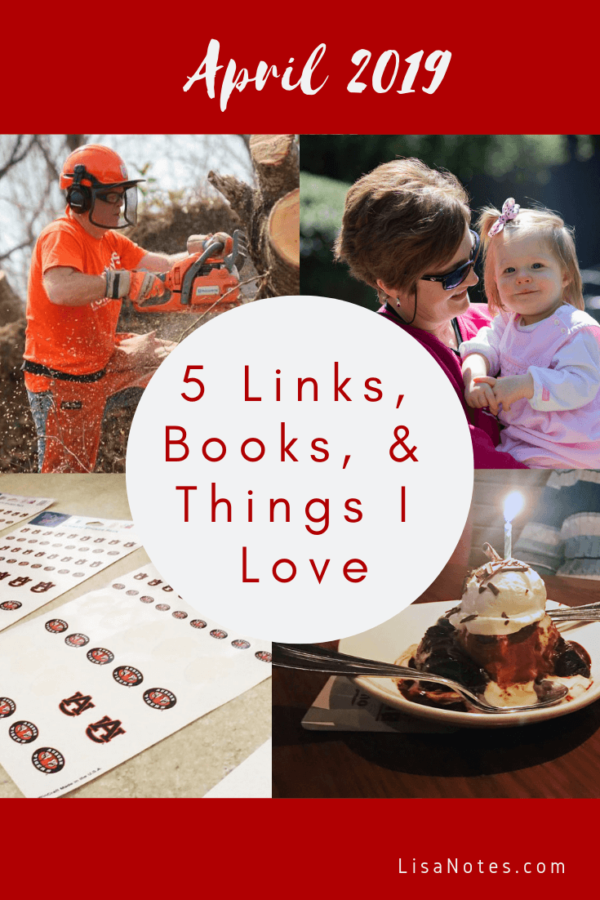
Although I don’t use a chainsaw like Jeff, I’m still glad I get to participate in tornado cleanup with our PAR group. They always need helping hands to drag limbs to the road, etc. On this trip we worked through Samaritan’s Purse.
I got to meet Monica on our trip to Columbus, Georgia. Her front yard was covered in broken trees after the tornado came through. She had quite an amazing story and is an incredible woman.
~ * ~
2. Stan’s AU Funeral
If you picked up on it above (we’re going to the Final 4!), we are big Auburn fans around here (and okay, we have quite a few Alabama fans here also). Nobody has been a bigger Auburn fan his whole life than my friend Stan. For his funeral, his daughter suggested orange and blue clothes for those who had it. Stan would have loved seeing that (and hopefully he did see it). There were also Auburn stickers available for everyone to wear.
~ * ~
3. And for his birthday . . .
The day after Stan died, he would have turned 60 years old. So the Four Corners (including Kathy, Stan’s wife) went to Outback and celebrated his life. He is leaving a huge vacuum. We all have our own special and funny memories with him.
~ * ~
4. Took My Grandbaby to the Zoo for the 1st Time!
Jenna and I met Morgan and Riley at the zoo. We had a wonderful trip introducing her to the animals she had only seen in books. Hopefully it’s the first trip of many to come.
~ * ~
5. Just for fun – 636 Months Old
We’ve all seen the pictures from new moms of their babies at 1 month, 2 months, 10 months, etc. So this meme made me laugh out loud.
~ * ~ * ~ * ~ * ~ * ~
5 Things on the Blog
1. Make a Spiritual Growth Notebook + More
Do you keep up with your spiritual history? Learn how to make a spiritual growth notebook. Coming soon at Enjoy God’s Word 2019 Conference.
God is still writing His story. Bring your two fish. How God started House of the Harvest. Review of Adam Walker’s book,Two Fish.
Here’s to the nurses, doctors, caregivers. Thank you for what you do with your hands. But also for what you do with your hearts. We need the healers.
4. 3 Things to Do with Your Stuff
Do you have too much stuff? What are you supposed to do with it all? See how these parables relate to our stuff.
5. When God’s Plan Isn’t Our Plan
Do you find it easy or hard to release your own plans when God surprises you with a different plan? He is still trustworthy.
* * *
What was a highlight from your March? What do you have planned for April? Please share in the comments.