
Is This Safe?
Here was another lighthouse. This one was on the Canadian side of our border. We’d been going into several lighthouses in Maine, all interesting, all unique. Why not one more?
The East Quoddy, or Head Harbour Lightstation, was built in 1828. The light was to guide sailors safely around dangerous rocks and shoals of Campobello Island and the Maine coast.
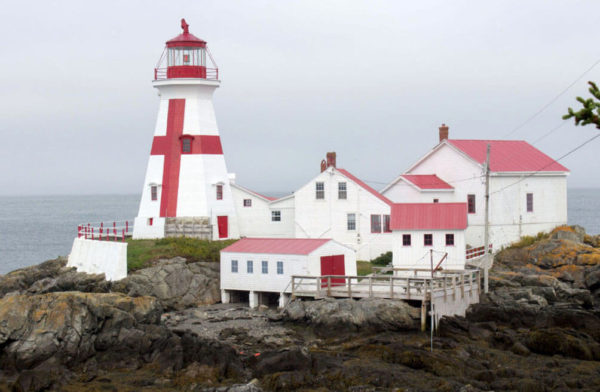
But I had a problem with this one.
Maybe it’s a Canadian vs. American thing, but where were all the safety features I’d grown accustomed to?
- No guard rails in the area.
- No sturdy handrails on the staircases.
- No clear signage warning of the dangers.
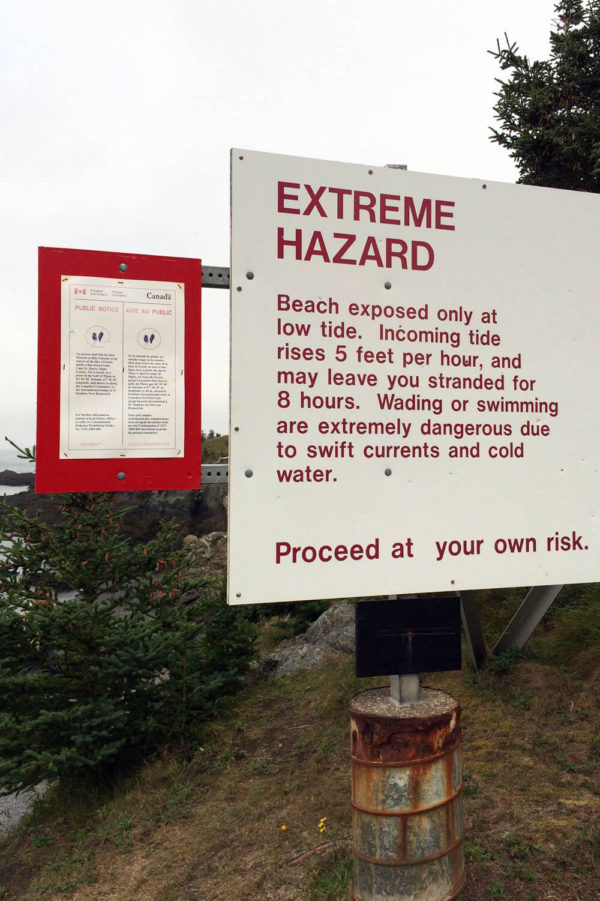
Except this one sign. And it was only warning you of getting trapped at the lighthouse if the tide came in, not about the perilous journey you’d have to take to get to the lighthouse and back.
I wanted to turn back.
Is the Risk Worth It?
But, no, let’s keep going, we decided. There were three metal staircases to get from here to there (well, “staircase” is generous; they felt like rickety, rusty ladders). I climbed the first one.
The next obstacle was a series of slippery rocks. They were covered in seaweed. After surviving them, we saw the next staircase/ladder, which looked even more dangerous than the first.

We started. Then I balked.
Even if, per chance, we did make it across to the lighthouse without plunging to our deaths here in the middle of nowhere, we would still have to repeat the entire journey again to get back to the other side.
Did I really want to put myself through this, all in the name of fun?
Was the risk worth the adventure?
Are Safety Nets a Moral Hazard?
I personally like safety nets.
I want to know that:
- If I get sick, there will be medicine for my malady.
- If I fall, someone nearby will help me up.
- If I fail, I’ll be loved anyway.
Because we all have stumbled. And will stumble again.
But when we know there are safety nets, are we more likely to take unnecessary risks? Do we drive faster if our seat belts are on? Do we eat fattier foods if we’re taking cholesterol medicine?
Sometimes, yes.
This has a name: Moral Hazards.
A moral hazard is taking extra risks when you feel protected from the consequences.
[Listen to this Hidden Brain podcast or read the transcript on Moral Hazards about the opioid crisis. Some studies are showing that the availability of the safety net Lazarus drug (naloxone) that reverse overdoses may unintentionally encourage heavier use of heroin and fentanyl. Some agree it’s a moral hazard; others disagree.]
Moral Hazards and Faith
But what about moral hazards and faith? It’s the apostle Paul’s argument: Do we sin more because we know there is grace to cover it (Romans 6:1)? His answer is an adamant no.
I’d rather use my safety net of grace another way. Instead of sinning more, what if we used our safety net to love more?
- When I’m tempted to back out of an encounter from fear of rejection, I can remember my safety net that Christ won’t abandon me.
And take the risk of engagement. - When I’m scared to serve in a new ministry, I can remember that Christ will show up with me.
And take the risk of uncertainty. - When I don’t want to forgive yet one more time, I can remember that my heart is protected in Christ.
And take the risk of vulnerability.
When we remember our safety nets, we can take more risks in the name of love.
We’ll still get hurt, have pains, make mistakes, and eventually die from something. But in Christ, those things are only temporary. Even death.
In Christ, life (and death) are safer than they look.
Even the Risk of No
I stopped midstep on the second ladder. I wanted to cry. I told Jeff I didn’t want to go forward anymore. I wanted to return to firm, dry land and forget this lighthouse. I would look from a distance instead of up close.
He could go on, but I was going back.
I had mentally weighed the odds. The lighthouse wasn’t worth the risk.
I took the risk of saying no.
Because he’s been married to me for over 25 years, Jeff understood. He turned around with me. We made it back to the car.
I hadn’t said yes to the adventure.
But sometimes saying no is an adventure, too. It’s a risk in its own way. It is saying yes to grace.
I trusted that the trip would still be a success—and Jeff wouldn’t resent it—even if I failed to go up this one lighthouse.
Life isn’t about perfection. It’s about love. It’s covered in grace.
And I felt loved by a man who would turn back with me instead of forcing me ahead.
Life may be risky. But love is the ultimate safety net. I’m secure there.
* * *
Do you take more risks when you have insurance? Please share your thoughts in the comments.