
Is Forgiveness Always Necessary? When My Kindle Starts a Debate
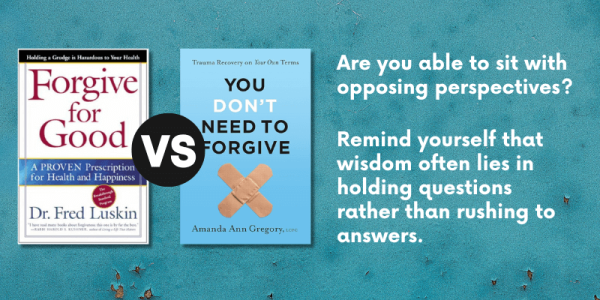
If the books on my Kindle could talk, I imagine they’d be deep in a heated debate right now. Two of the books I’m currently reading are Forgive for Good alongside You Don’t Need to Forgive.
On one hand, Forgive for Good makes the case for peace that comes with forgiveness. Fred Luskin writes:
“The most important benefit of forgiveness is our assertion that we are not victims of the past. We cannot change the past so we must find a way to resolve painful memories. Forgiveness provides the key to acknowledge the past and move on. When we can forgive we have less to be afraid of.”
But on the other hand, Amanda Ann Gregory writes in You Don’t Need to Forgive:
“My point is that forgiveness should not be regarded as a compulsory component of any trauma-recovering process, or as a prerequisite for ‘moving forward.’ . . . Forgiveness is not required to recover from trauma, but safety is.”
I didn’t intentionally choose to read these books at the same time. But here they are, staring at each other every time I open my Kindle each morning, challenging me to hold two viewpoints at once.
They remind me that while some truths are black and white—actions speak louder than words, love is stronger than hate, holding a grudge is harmful—other things live in gray spaces.
- Is forgiveness one of those gray areas?
- Does recovery come only if there is forgiveness?
- Is there a level of harm so great that forgiveness becomes an unfair burden to demand?
Both authors agree that when possible, forgiveness can be a healthy, healing process. Their disagreement seems to be whether forgiveness is the sole path to healing. (And another complicating factor is how you define forgiveness; it’s complex.)
But this is what I love about reading books that seem to contradict each other: they force me to ask questions beyond my initial assumptions. They require me to dig a little deeper than I would on my own.
My brain isn’t always happy about the challenge. It’s easier to stick with what we already know. Don’t challenge the status quo. Stick with the familiar stories.
But more often than not, wisdom comes from considering opposing ideas instead of packaging a quick resolution into tiny, tidy boxes.
So as my Kindle quietly hosts the ongoing debate on forgiveness (and more), I’ll also keep the conversation active in my own mind. Maybe I’ll come to a new conclusion. Or maybe not.
Either way, maybe the most important thing I’m learning is there may not be a final answer to every dilemma. Rewards come through staying open to the questions.
Share your thoughts in the comments.
I agree that two things can be true at the same time, Lisa. What a stark contrast on forgiveness and its importance for healing these authors have put forward! It makes me think, too. Blessings!
Always so many things to be thinking about. 🙂 I have to remember to give my brain a break at night! lol.
“Rewards come through staying open to the questions.” wow what wisdom is that sentence!! put that on your wall. I know it will go in my journal. I chuckled at the war in your kindle though it really isn’t funny but good for you for allowing your mind to wrestle and go deeper. Forgiveness has many layer and lots of baggage. Grief is the same way. In my grief course one thing we discuss is the value of “staying in the uncomfortable wilderness” longer instead of escaping back to normalcy. it’s’ easier to accept quick answers to forgiveness and/or grief than to stay and wrestle and grow deeper…. You sure would be fun to sit and have coffee with and discuss this sort of thing with…..you make me think….
Oh, Jean, how much I would love to gather with you, sitting around a table with our blogging friends to talk and laugh and ponder these deep things of life! I’m sure I would benefit from your grief course. Such wisdom you impart there, I’m certain!
Hi Lisa, I’m Amanda Ann Greogry, the author of You Don’t Need to Forgive. I’m so glad my book challenged the status quo in your mind AND that your mind was open to such a challenge. Many minds are not. I have always sought comfort and safety in black-or-white conceptualizations, and it took me a long time to embrace the fact that living in gray is closer to the truth. However, it’s still uncomfortable, and I don’t prefer it. I wish that the field of Psychology would discover one concrete experience that would help everyone. If that turns out to be forgiveness, then I would be its most prominent advocate. However, we don’t have a panacea, so we must heal together in the gray.
PS: I sent an advance copy of You Don’t Need to Forgive to Dr. Luskin, and although we disagree on aspects of forgiveness, he reiterated that we agree that forgiveness that is forced, pressured, or pursued when it’s not in one’s best interest of the forgiver is not beneficial for anyone.
I’m so appreciative of you chiming in here, Amanda! I love how much your book is making me think. Your title alone was enough to pique my curiosity, and your message inside the book is keeping me reading. I appreciate that you point out we need to listen when someone says “but we need more research” and that’s there just not been enough solid research on forgiveness. This is a courageous book to put out into a culture where the consensus is often that we “must” forgive in every circumstance. “Healing together in the gray” isn’t as popular a message, but I find more reality in it.
I’m glad you and Dr. Luskin agree that forgiveness isn’t beneficial to anyone when it’s forced. I’ve read both his books on forgiveness and I’m actually finding more agreement between the two of you than disagreements (despite the titles of your books, ha). I think he would approve of the section in your book about our typical definitions of forgiveness not even being accurate. I look forward to continuing reading more of what you write in this book!
Hmmm…you, Girlfriend, always make me think! It’s one of the many things that I love about you. 🙂
I understand that you have clearly stated that the debate is about whether or not we can experience full recovery without forgiveness in the picture. Should we try and define forgiveness? How do we do it?
Given the emphasis that Jesus places on forgiveness in the Gospels, I can’t envision that complete recovery could be through any other means than forgiveness. It doesn’t mean that we forget, necessarily. Neither does it mean that we allow ourselves the opportunity to be hurt by the same people again. But I do believe that forgiving the person of their wronging me will free me from bitterness.
An example out of my own life would be from a while back when a couple of family members were constantly stirring up trouble in the family. We were being accused of things that simply were not true, and the accusations hurt deeply. I became filled with bitterness as a result of it all. I became so miserable that it was hard for me to stand myself. I went to Father in prayer and asked Him to help me to forgive these two family members…but ” how do I do it?” I asked. Pray was His answer and I began praying for both of these individuals on a daily basis and one day when I was praying, I realized I no longer held any bitterness toward them.
My brain and my heart both thank you for being brave and putting this out there for us.
Thank you, Dianna. You definitely hit one of the nails on the head (there may be many nails in this!) when you talk about the definition of forgiveness. Even that is hard to pin down! But however we explain forgiveness, you’re also right that living in bitterness is definitely not the way to go. Thank you for sharing your personal example of this. I’m sorry that you had to go through having your good name spoken ill of. But glad you found a way to return back to peace. I appreciate your loving ways and tender heart you have as you move through our world!
The definition of forgiveness is essential! Moral strictures that come from the outside are not really helpful to anyone, we need to find out for ourselves what is healing. For me, forgiveness has come to mean not making my own recovery dependent on another person’s repenting, realizing what they did wrong, or changing in any way — becoming independent of them and turning toward other sources of healing. But I think there are other definitions against which one might rightfully rebel. There is certainly much to say about the topic and many ways to navigate it, sounds like you found some that are thought-provoking from different sides.
Hi, Lisa – Great questions, and great war on your Kindle. I believe that we can absolutely forgive someone without trusting them further; forgiveness is about releasing ourselves from the emotional burden of a hurt, while trust is about believing someone will act reliably in the future, and the two concepts are distinct from each other; you can choose to forgive someone for their actions while still maintaining boundaries and not fully trusting them again. At least, that’s how I currently see it.
We grow when we entertain opposing viewpoints, even if we end up retaining our original opinion. We are more likely to know why we hold the opinion we do in that case. (Honestly, it drives me nuts when I ask someone why they hold a certain opinion and they respond with “I don’t know.”)
As for forgiveness, life has taught me that some things are unforgivable. And perhaps counterintuitively, I was able to make peace with the trauma and move on after I realized this. But I think we are all different.
The Lord calls us to forgive but He does not demand fellowship with those that have hurt us. I feel like I could write an illustrated book on this topic.