
Platonic – How the Science of Attachment Can Help You Make—and Keep—Friends {A Book a Day 23}
“When you choose to be a friend, you choose to show up.”
– Marisa G. Franco
Eating our breadsticks at Olive Garden yesterday, my friend Kay and I talked about our friendship through the years.
We acknowledge our ups and downs. But we’ve made it work. Through changes and conversations and commitment, we’ve built a strong relationship. I’m grateful Kay consistently shows up for me.
Did our attachment styles also play a role in keeping our friendship strong?
We’re both new to learning about attachment styles, so we can’t say for sure. (But I can say for sure we’ll talk more about it. It’s the kind of conversation we love.)
Do you know your attachment style?
In this new book by Dr. Marisa G. Franco, Platonic: How the Science of Attachment Can Help You Make—and Keep—Friends, you’ll learn more about the three attachment styles.
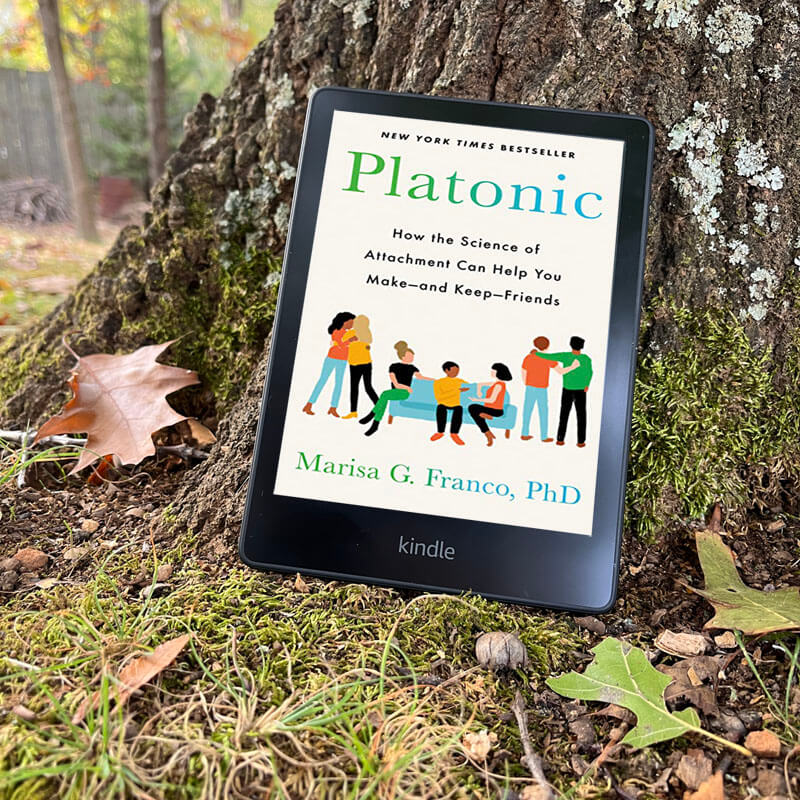
The attachment styles are:
- SECURE ATTACHMENT
Secure people assume they are worthy of love, and others can be trusted to give it to them, leading them to give others the benefit of the doubt, open up, ask for what they need, support others, assume others like them, and achieve intimacy. - ANXIOUS ATTACHMENT
People who are anxiously attached assume others will abandon them, so they act clingily, are overly self-sacrificing to accommodate others, or plunge into intimacy too rapidly. - AVOIDANCE ATTACHMENT
Avoidantly attached people are similarly afraid of abandonment, but instead of clinging, they keep others at a distance, eschew vulnerability, and leave relationships prematurely.
In other words, the rich get richer in friendships, at least when it pertains to attachment styles. Because when we feel accepted and loved (secure attachment style), we develop qualities that lead us to continue to connect better.
“Assuming the best sets secure people up to receive the best.”
But when we’re anxious or avoidant, we may self-sabotage our friendships in harmful ways.
I was surprised by the depth of this book about friendships, including chapters on initiative, vulnerability, authenticity, anger, etc.
You’ll find lots of practical advice here based on scientific data (yet easy to understand) about making and keeping friends.
“The crux of these theories is that people like people who like them.”
And don’t we all need strong friendships?
“Out of 106 factors that influence depression, having a confidante is the most powerful. Loneliness is more fatal than a poor diet or lack of exercise, as corrosive as smoking fifteen cigarettes a day.”
Quotes from Platonic
“One study found the most pronounced difference between happy and unhappy people was not how attractive or religious they were or how many good things happened to them. It was their level of social connection.”
~ * ~
“If someone has a history of being rejecting in your moments of need, don’t assume they’ll change. Don’t look for water in an empty well. Your vulnerability is too precious for that.”
~ * ~
“If we can’t tolerate sadness, we may avoid friends who need support. If we can’t tolerate tension, we may withdraw from friends instead of addressing problems.”
~ * ~
“Studies have found that expressing anger is more likely to benefit a relationship than destroy it. . . . Addressing your hurts makes the friendship better.”
~ * ~
“Not every friend has to be a best friend. Maybe we expect less from them, share less of ourselves, and compartmentalize the friendship to what feels most fulfilling about it.”
~ * ~
“The more contacts we have, one study found, the less time we spend with each one. The larger our network, the weaker our relationships tend to be. If we try to invest in everyone, we may end up investing in no one. We first need to figure out who our friends are.”
~ * ~
“What is the distinguishing quality of the super friends? It’s security.”
Did all your friendships survive the pandemic? Share your thoughts in the comments.
You are on Day #23 of the series, A Book a Day {Nonfiction Favorites}.
Each day of February 2023 I’m recommending one book a day from favorite nonfiction books I’ve recently read.
The Table of Contents for all 28 books is here, updated daily.

Previous:
“Nonviolent Communication” {Book 22}
Next:
“The Fire Next Time” {Book 24}
- 3 Ideas for Your Word {One Word 2023 February Linkup}
- Share Four Somethings—The Fire Next Time {A Book a Day 24}
Being adopted, I am fascinated with attachment theory. This sounds like a book I need!
Lisa, this is really interesting and sounds like a great read. I’m going to have to keep this in mind.
visiting today from #Write28Days
Sounds like another winner, Lisa. Thanks!
I might look this book up, although my problem isn’t in making or keeping friends – right now it’s in meeting people in order to make them my friends! LOL I’m happy to say that all my friendships did survive covid, although there were some definite hiccups as it was so much harder to connect with people. In that sense, a lot of things changed. Sadly, my relationship with a couple of family members suffered because they were of a very different mindset over the whole thing and were hateful and hostile about the differences of opinions. 🙁
Lisa, I’ve never thought of attachment theory in terms of friendships. This is fascinating … I’m off to add this title to my TBR list.
Good stuff! Thanks.
Thanks for this, Lisa. If you want more on the attachments topic, I recommend Attachments by Dr. Tim Clinton and Dr. Gary Sibcy. Dr. Clinton is president of the American Association of Christian Counselors and a faculty member of Liberty University. Very good reading and resource.
I studied attachment in my psychology classes and know I tend to be an avoidance attachment kind of person… so I have to really work at making and keeping relationships.
I’ve not thought about attachment in terms of friendships but it makes sense. I’m avoidant too but I’ve worked on being open and vulnerable and it has deepened my friendships. Some of my friendships were certainly made stronger by lockdown – definitely with the two women I ran with (when we were allowed to!) every week!