
10 Ways to Think Bigger About Time
“I can trust that if I just keep working at it, and keep coming back to it, time will help me see things that I couldn’t see before.”
—Laura Vanderkam
A few years ago, I started keeping a time log for one week out of the year.
I expected the results to confirm what I already believed: that my days were too packed and there wasn’t enough time for all the things I wanted to do.
Instead, I discovered something different.
Yes, it did show that I crammed a variety of things into a week. But I was surprised at how much time I also categorized as play and rest, which was good. (I was also surprised at how much time I spend eating in any given week!).
What I learned was my assumptions about my schedule didn’t match reality.
That’s one reason I enjoy Laura Vanderkam’s books so much, including her newest, Big Time: A Simple Path to Time Abundance.
Her message is simple and reassuring: you have more time than you think. She wants us to stop seeing time as scarce and to “fall in love with how we’re spending our days.”
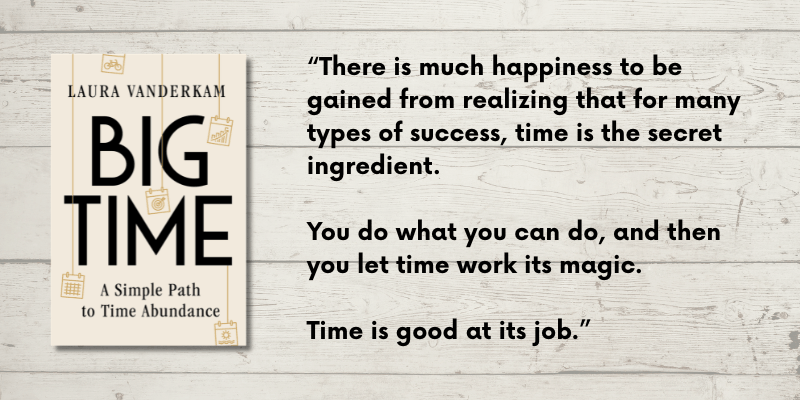
As I read, I took notes on how to practice this book. What shifts could I make in my own relationship with time?
Here are 10 ideas from Big Time that I want to experiment with.
1. Realign My Reading Expectations
Instead of overestimating how many books I can read this summer, I looked at how many reading hours per week I’d previously logged, and then figured out how many books would fit in that time. Starting with more realistic expectations will help me prioritize my summer TBR stack and enjoy each book without rushing to the next one.
2. Stop Saying “I Don’t Have Time”
Vanderkam encourages replacing a scarcity time mindset (I too often say “I don’t have enough time!”) with one of abundance. I don’t know if I’ll be able to authentically say “I have lots of time!” but I’ll try. I want to remember that time isn’t the problem nearly as often as my choices and expectations are.
3. Track Time More Often
I usually track my time one week in the winter, but I’d like to track it in the summer too and see if it’s different. If nothing else, it holds me accountable during that week to use my time a little more wisely because I don’t want to write down that I was mindlessly watching Instagram reels for an hour.
“Time tracking provides accountability. Most people don’t want to document a three-hour YouTube binge on their time logs, so they choose to do more fulfilling things. Then they feel better about the day.”
4. Experiment with “21 Pods”
One idea in the book is dividing the week into twenty-one four-hour blocks (8am-noon; noon-4pm; 4pm-8pm). I’m curious whether thinking in larger chunks of time would help me organize my days differently.
5. Treat Weekends Like Vacations
Vanderkam suggests that people enjoy weekends more when they approach them like mini-vacations. I already do this somewhat, but I’d like to be even more intentional about noticing and savoring those hours. (Granted, this assumes you can do this. Not everyone has that option.)
“When people were instructed to treat their upcoming weekends like vacations, they wound up happier, less stressed, and more satisfied. They spent less time working and on housework. They did a few more fun things than they might have, but most important, they paid more attention to the happy things they did—perhaps feeling more like this time was special.”
6. Dream Big and Plan Small
I love Vanderkam’s philosophy that small steps add up. Big projects feel managable when broken down into baby steps. That’s how I’ve been organizing my bloated folders of digital photos. Just 10 or 15 minutes a night really makes a difference over several months.
“People overestimate what they can do in the short run. They underestimate what they can do in the long run.”
7. Leave More Open Space
I tend to want to schedule everything. But not every hour needs a plan. I want to create more blank spots on my calendar to allow room for spontaneity and for “wasting” time.
8. Make Small Bets
I sometimes forget that not every commitment has to last forever. Vanderkam encourages experimenting with smaller doses. I don’t need to create rigid rules for myself when they’re not necessary (and usually no one is asking me to do that anyway!). So I want to give myself permission to adjust course as often as needed.
9. Think in Years, Not Days
One of my favorite ideas in the book is focusing on the 8,760 hours in a year instead of just the 24 hours we have today. A single day can fly by so fast, but a year offers more time for growth, change, and progress. (Especially when looking ahead. When I look backwards, a year flies by quickly too.)
10. Celebrate Patience Points
Vanderkam suggests celebrating ordinary milestones when you’ve completed a set number of things. I’d like to incorporate this with a writing project I’ve been working on this year. Pausing to celebrate and reward myself for showing up consistently is a good use of my time.
The Gift of Looking Again
After finishing Big Time, I found myself looking back again at my previous time logs. And remembering how surprised I am each time to see how my hours played out.
I have more agency than I realize over how I fill those hours.
The gift of this book isn’t creating more hours or time hacks. It’s about developing a healthier relationship with time itself. Instead of seeing time as something that’s slipping away, Vanderkam encourages us to see it as something working alongside us.
“When you believe in big time, then you can afford to be patient.”
I need that reminder. When I stop treating time as an enemy and start trusting it as an ally, I relax a little more, enjoy life a little more, and focus more clearly on what matters.
Maybe that’s the biggest lesson I took from Big Time: time is always big enough for the things that matter most.
What’s your relationship with time? Share your thoughts in the comments.
My thanks to NetGalley for
the review copy of Big Time
Read more on time:
- 5 Nonfiction Books To Use Your Time Well
Explore these inspiring nonfiction books on productivity and aging to help you use your time wisely, live intentionally, and read what matters most to you. - Four Simple Tools I Use to Live with Time—Not Against It
A reflective Share 4 Somethings post on four simple tools—calendars, AI, journaling, and reflection—that help me live with time, not against it. - Experiment with a Shift in Pace
Four somethings about slowing down, time tracking, friendship, and meaningful awareness.
I quote Roch Voisine, Canadian singer – I do time so time doesn’t do me. That translates into living with purpose based on my values. Each day is filled with something that needs doing and something that wants doing which provides a good balance for me of knocking off the to-do list & R&R.
I love that line from Roch Voisine. And your interpretation of it. Agreed! I’ve been doing a little of both “needing” and “wanting” so far today. It feels balanced to me too. Thanks, Mona!
I truly enjoyed reading your review of this book here, Lisa. You certainly inspired me to look at time differently and more positively than I would have thought was possible. Thanks!
It’s a really interesting book, Martha. Laura Vanderkam has a great perspective on time. She also has a lovely short podcast that I listen to as well.
I enjoyed reading one of her books a few years ago. I should read more of hers. I don’t think I have tracked my time since college days. I tend to operate in those big chunks now. It’s so easy to take a little break watching Instagram reels that then turns into an hour. Someone has said that often our struggle isn’t between good and bad uses of time, but between better and best.
My goal is to try to do the things I “have” to do on weekdays so I can use Saturday to do other things. Not just to play the day away, though sometimes that’s good. But to get to things I don’t normally get to during the week, like dabbling in watercolors.
All of her books on time have been really insightful to me. (I think she also wrote a novel? I haven’t read it tho.) Yes, those “just a minute” to look at Instagram reels can easily turn into much longer. Sometimes I’ll set a timer for myself so I’ll not get sucked into spending too much time watching – they’re always so interesting! 😉
I didn’t realized you dabbled in watercolors, Barbara. That’s fantastic. I’ve always been intimidated by it and never tried it.
I’m so aware of the passage of time and monitor my use of it to a fault, I think. I love days at home when I can get caught up in what I am doing and forget about the clock for a few hours.
I’m typically an excessive time-watcher too so I hear what you’re saying, Michele. Isn’t it delightful when we’re so engaged in something though that we lose track of time? I’m always amazed and pleased when that happens.
wow love the points you listed. I have not done a time study for a number of years. thinking of doing so now and again in fall. I like how looked again and what you learned. And I love the idea of reading hours possible instead of number of books. that puts a whole different perspective on how much I actually read compared to wishing I read more. I find playing the time game – Can I get this done in the next 30 minutes. Helps me focus and makes it fun.
Oh, the time game – I’m all about that too, Jean! I actually have a timer going right now as we speak. ha. I’m flitting back and forth between answering comments and reading books. Not a bad way to spend a Thursday afternoon.
I don’t want to jinx it, but I think my new plan for my book stack is working splendidly so far. It isn’t changing how much or how little I read, but it’s making me more content to stick with the books in front of me instead of always wanting to squeeze in one more, one more, before I finish what I have. We’ll see how long I can maintain the self-discipline to do it, though. ha.
Laughed as I read your reply. I have my timer going this morning too.
Oh, my goodness. Lisa! Thank you for both the introduction to and informative summary of this book. I need to read it! In my work as a photo preservation guide, “I don’t have time” is one of the most common reasons/excuses I hear for not getting photos permanently backed up, preserved in print, old home movies digitized, or whatever the person’s top goal is. The truth is WE ALL HAVE TIME. We all have the same amount of time every day. Some people work two jobs, yes, and some people care for little children or aging parents, but we all HAVE time. I nodded all the way through your #2. If we approach life from a place of scarcity rather than abundance, it taints our view of time (and, therefore, life, I think). I think it’s very paralyzing.
And then I just about jumped up and down at #6 because that’s what I tell people over and over and over. 10-15 minutes a day working on photos makes a huge difference! Especially when multiplied by 365 (a nod to your #9, which I also love). In fact, I wrote out a “Start a Memory-Keeping Habit in 10 Minutes a Day” plan in 2024 based on these very ideas. (https://lifetalesbooks.blogspot.com/2024/01/start-photo-preserving-and-memory.html)
Just ordered this book from amazon! Thank you for the recommendation. I am sure I will learn a lot from it myself, but I’m really looking forward to using ideas and principles from it in my work helping people preserve their photos and videos and stories. 🙂 Visiting from the Sweet Tea & Friends link party.
Your comment makes me so happy, Jennifer! Yes, to all the things you said! I hope this book will give you lots of good things to share with those you work with as they preserve their memories.
“If we approach life from a place of scarcity rather than abundance, it taints our view of time (and, therefore, life, I think). I think it’s very paralyzing.” – I’m glad you said that because it inspired me just now to add “I have lots of time!” to my daily calendar so I’ll see it every day this month. 🙂
I’m happy you also included the link to your post because I actually commented on it back then about needing to get back in the 10-minute habit of organizing my photos. And I did! I’m still way behind, but I’ve made so much progress in just 10-15 minute chunks of time here and there, so I’m proud of myself. 🙂
I love that! And how funny that you saw my original post and commented on it–I should have checked that first. LOL I LOVE that you’ve made progress in 10-15 minute chunks. You SHOULD be proud of yourself. I put myself to the test and did a scrapbook scanning project I’d been putting off by doing it for 15 minutes a day. In one month I scanned two entire baby books (my two youngest kids)! It was over 200 pages. Those little bits of time really add up. Thanks for this wonderfully thought-provoking post!
Wow this is really interesting Lisa. So many good points and ideas here.
Thanks so much for sharing with Sweet Tea & Friends this month dear friend. I’m so happy you’re here.