
“What is killing you right now?”
Barbara Brown Taylor says we can usually answer that question easily. We know what makes our life harder.
So instead she asks her friends a different, more thought-provoking question: “What is saving your life now?”
This week, Linda at LindaStoll.net is also asking the latter question.
Three of her long-time blogging friends, including me, are synchroblogging with her about what saved our lives this summer. (See all the links below.)
Here is my answer. I’d love you to hear your answers in the comments.
What’s bringing me life right now?
My oldest daughter Morgan and Fuller had been talking about babies for awhile.
And now they’re expecting their first child early in 2018.
Which, as I mentioned here, means that Jeff and I are going to have our first grandchild (it’s a girl!).
Which also means this: My life is about to change. At least that’s what you other grandparents tell me.
In the Waiting . . . The Past
I’ve been thinking about it a lot this summer during this waiting time. And praying about it.
Jeff and I have been empty-nesters since 2012 (even Kandie our Golden Retriever left last winter to go live with Jenna and Trey).
We’ve stayed out late eating doughnuts. Or we’ve gone to bed at 8:30pm if we’ve wanted to. We’ve spent time on the road for work, for pleasure.
But now a baby?
We couldn’t be more excited. But I realize it’s a time of transition. From the past, with one type of pleasure, to a future with a different kind of joy. I’ve been looking forward to and waiting for this.
In the Waiting . . The Future
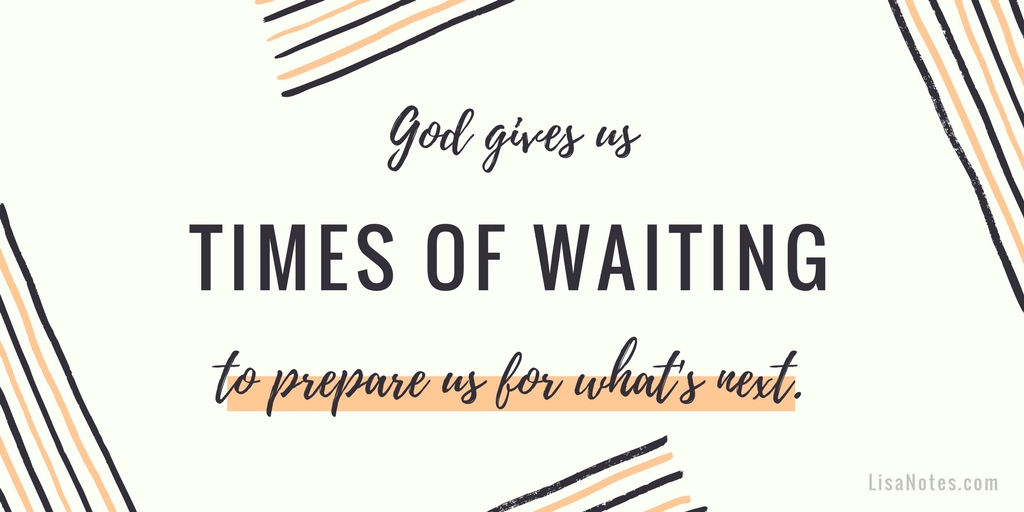
God gives us times of waiting to prepare us for what’s next.
And sometimes he gives us a deadline to push us into action.
The time has come to prepare for the future. Time to clean out Morgan’s old room, to empty her closets, to prepare a fresh space for when they come to visit, no longer just the two of them, but the three of them once the baby is here. I want to make room for our little granddaughter.
So we painted the walls. Rearranged the furniture. Cleaned out from under the bed.
But this space-making for a new person isn’t just physical. We want to make not just space in our house, but space in our schedules.
And most importantly, we want to make space in our hearts.
In the Waiting . . . The Present
Jeff and I will soon visit Maine for our anniversary, a new place we’ve never been. We’ll celebrate 25 years of marriage.
But while we’re there, we also want to honor this moment.
We want to mark the now—this transition point during the waiting. We’re leaving a season of “just us” and embarking on the next season with a 3rd generation in our family.
You should see the spare bedroom now. It has less furniture, but more space. It has less grownup things, but more children’s books and stuffed animals.
You can’t see the spare places in our heart. But they’ve expanded, too. Loving the grandbaby is a now thing, not just a future thing. I’ve seen her twice on ultrasound and will see her again there soon.
Changing Seasons
Whatever season of life you are in now, know you won’t stay there forever. Your season will change, too.
And when it’s possible, God will give you a waiting period. A time to transition.
May we use our waiting periods wisely. In them we can prepare to carry out new responsibilities. And clean out space to receive new blessings.
So what’s been saving my life this summer?
Preparing for the joy of what’s next.
* * *
What has saved your life this summer? Another answer for me: I’ve begun a practice saying out loud, “All done!” at the end of every afternoon so I’ll put down my project-of-the-day. I’d love to hear your answers in the comments.
Read the other three posts from sweet, sweet friends and grace-filled bloggers in Linda’s synchroblog, “What Saved My Life This Summer.”
1. Linda
~ * ~
2. Beth

~ * ~
3. June
~ * ~