
Sometimes It Takes a Little Longer to Connect
—Shifting to the Right Pace
The 50 Page Dilemma
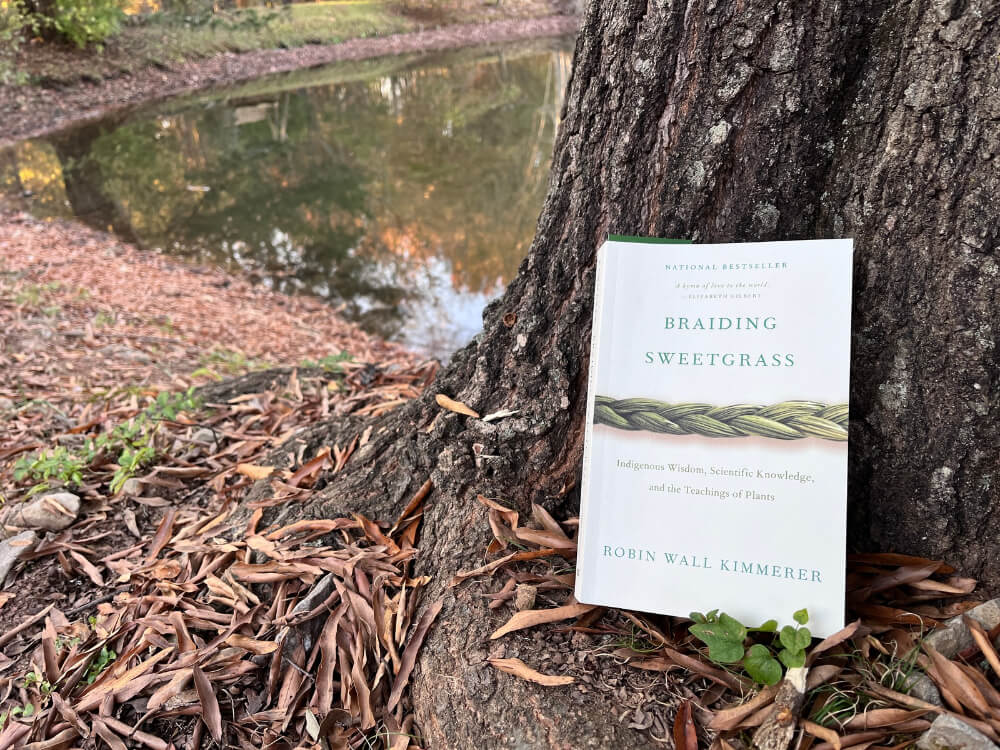
Should I stop reading Braiding Sweetgrass?
A few years back, I began following this general rule of reading:
If a book doesn’t grab your attention by page 50, you can DNF it (do not finish) with no guilt.
So when I get to page 50 of Braiding Sweetgrass, after it has been sitting untouched on my bedroom shelf for almost a year, I toy with the idea of giving up. It feels so slow. I’ve already begun skimming, the red flag that it’s losing me.
Yet it’s hard for me to give up on a book. What if the very next page will be the turning point?
It makes me sad that I don’t like it. I’ve been hearing good things about Braiding Sweetgrass for a few years now.
But maybe it just isn’t for me.
Life is short, and the number of books on my to-read list is very, very, very long.
Yet in honor of friends who rave about the book, I read a few more pages.
And then on page 53, while Robin Wall Kimmerer is going deep into her chapter on “Learning the Grammar of Animacy,” something happens.
Wait. Now I’m Interested.
She is telling that English is a noun-based language (how had I never heard or noticed this?). Verbs make up only around 30% of English words. But in her native Potawatomi language, verbs are about 70% of its words.
I am interested. I stop skimming. And I keep reading.
She keeps engaging me. She writes about how children animate the world, speaking of plants and animals as if they are people. They only stop when we adults step in to remind them, no, “the tree is not a who, but an it,” turning living things back into inanimate objects. As Kimmerer writes, “If a maple is an it, we can take up the chain saw. If a maple is a her, we think twice.”
I slow way down to keep reading, every word.
On page 82, in the chapter of “A Mother’s Work,” Kimmerer tells about cleaning out her pond so her children can swim in it. For whatever reason, I am entranced.
Halfway into the chapter, I find myself underlining her declaration that “Transformation is not accomplished by tentative wading at the edge” as she describes her new relationship with mud. Instead of trying to protect herself from mud, she has given in to it, noticing all the fascinating creatures that live in it.
Now I’m on page 110. And I’m completely hooked.
I finally have adapted to the cadence of the book.
It’s slower than I’m used to. I expected a quick read, a scanning for facts. But that style of reading is not a good fit for this book. Nor for me. We were missing each other. Until I slowed down.
I’ve matched our pace at last.
Now I settle in with each new chapter. Slowly and attentively, I remain curious to see what magic will unfold as I relax and absorb the essays instead of hurrying and scouring them for information.
Page after page I turn, until a chapter is concluded, and I am content.
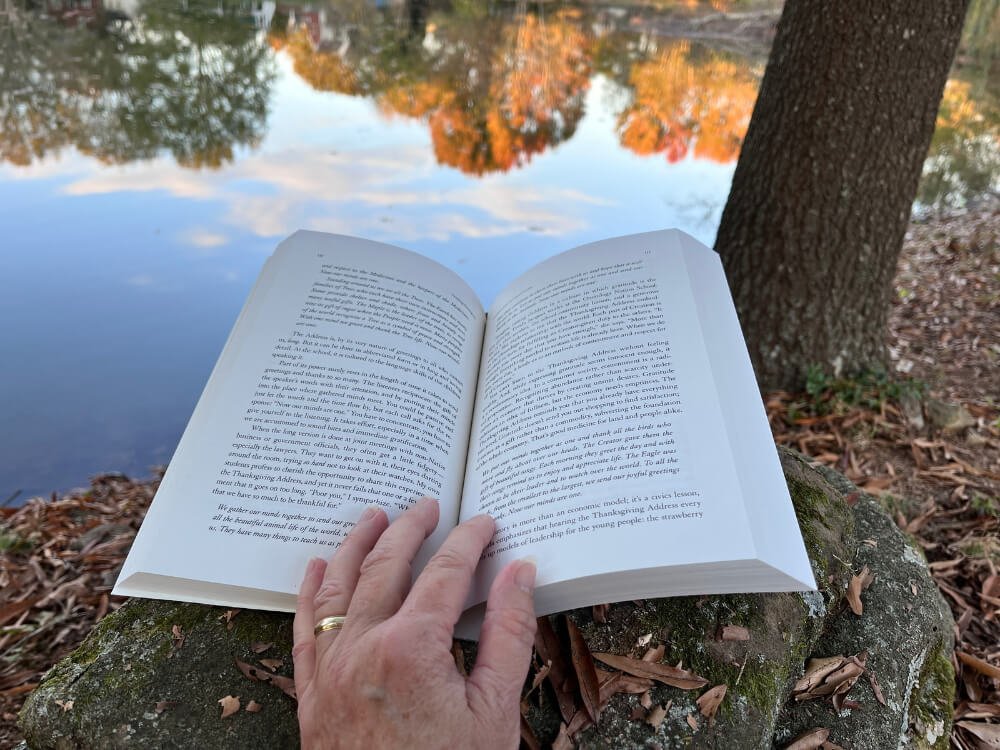
When We Find Each Other’s Pace
Not every book is meant to be read the same. At least not by every reader. Sometimes we match up perfectly from the beginning. Sometimes we never do at all. DNF.
The same is true of relationships. Not every person is meant to be engaged the same way.
Some people are quick and loud and in and out. But others require a slowing down, a leaning in, a patient waiting. When we don’t adjust our pace, we can miss each other entirely.
And like my reading of Braiding Sweetgrass, finding the right pace with a person may take a few more conversations than we’d like, to understand how someone else moves in the world, to see if we can match our strides, to uncover the beauty of a person that comes dearly recommended by another.
First impressions aren’t always the truest ones.
A connection may sometimes take a little longer than we’d planned. Maybe a few extra page turns. And maybe we’ll get there if we don’t give up just yet. Not yet.
It was in the not yet with Braiding Sweetgrass that I finally crossed over. I made the shift from boredom to delight.
And if we have time, space, and desire to explore, maybe, just maybe, we can delight in each other, too, enjoying a connection we may have given up too quickly otherwise.
I am thankful I still have 274 pages left to read of Kimmerer’s wise journey with plants in our natural world.
I wonder what else may be just around the corner if I continue hanging on for a few more pages.
And a few more after that.
How do you decide on a book that begins slowly? Do you give up quickly? Hang on too long?
Share your thoughts in the comments.

Shift is my One Word for 2026. I’ve discovered it in some of the oddest places. As with this book, sometimes the the problem isn’t in the pages—or in a person—but in the pace I’m bringing to the encounter. A small shift in my approach has sometimes made all the difference.
I’m glad you found your pace with “Braiding Sweetgrass”. I found many things in that book fascinating including the observation that English is a noun-based language.
Many books don’t grab me at the beginning, and knowing that I remind myself to be patient.
I usually am reluctant to give up on a book, especially if it’s been recommended by people whose taste I admire. There are a few I’ve ordered rather blindly that have been disappointments, and I agree that life is too short to push through a read that you don’t find interesting. Thanks for telling us about Braiding Sweetgrass, Lisa.