Double the Insight: Why It Works to Read Fiction and Nonfiction Together
{Nonfiction November Week 3}
If you’re a reader, you probably have a favorite: fiction or nonfiction. Some of us love escaping into stories; others seek facts and insights.
But what if real understanding happens when you don’t choose between them, but read both?
Reading fiction and nonfiction together can deepen your perspective of both worlds. One stirs emotion; the other sharpens perspective.
Below are a few reasons why this pairing works for me—and three book pairings from what I’ve read this year.
1. Fiction Opens Your Heart; Nonfiction Opens Your Mind
Okay, maybe it’s not quite that simple (fiction and nonfiction can both open hearts and minds). Still, books we read for stories often help us feel something, while books we read for information often help us think something.
Try these two together.
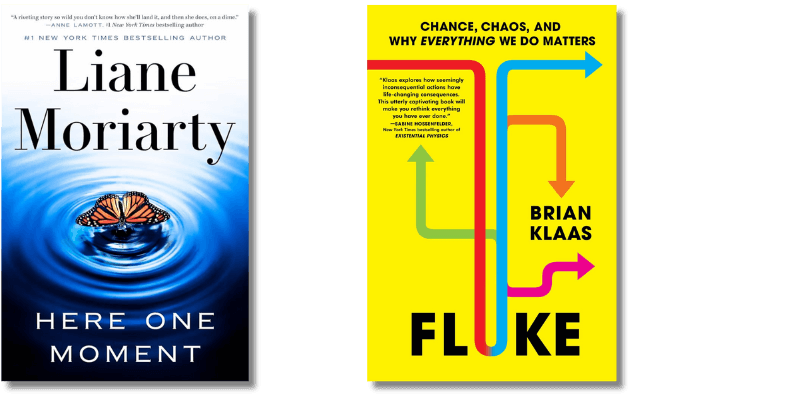
Fiction: Here One Moment by Liane Moriarty
The plot centers around a mysterious passenger aboard a flight who walks down the aisle predicting deaths. The story shows you the human side of how each person reacts to the news, and the ripple effect it creates in their lives.
Nonfiction: Fluke: Chance, Chaos, and Why Everything We Do Matters by Brian Klaas
This fascinating look at chaos theory and randomness shows how tiny moments can have huge consequences. It’s a real-life counterpart to Moriarty’s fictional story of ripple effects.
The fiction and nonfiction together help you feel the fragility of life as well as understand why even small choices matter.
2. Together, They Give You a More Complete Picture
Fiction fleshes out a concept without having to explain it. You see it for yourself as it unfolds in a story. With nonfiction you get a full explanation with details and facts and often even possible solutions.
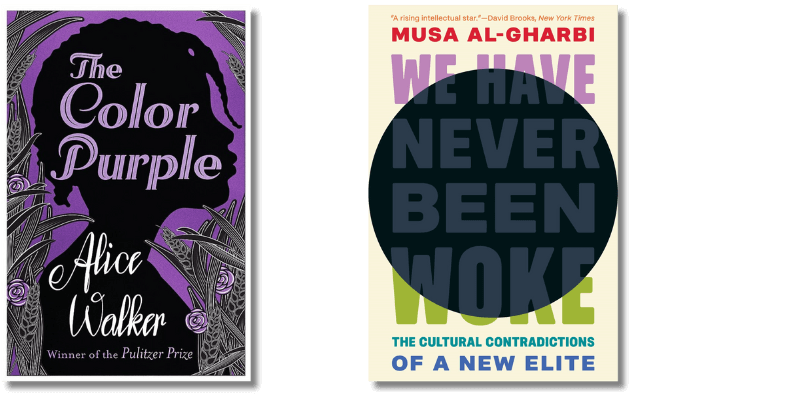
Fiction: The Color Purple by Alice Walker
Set in the early 1900s, this classic novel follows Celie, an African American woman, as she navigates trauma, resilience, and self-discovery in the American South.
Nonfiction: We Have Never Been Woke: The Cultural Contradictions of a New Elite by Musa al-Gharbi
This well-researched book is a thought-provoking look at how modern social justice movements intersect with class, culture, and power structures.
Read together, these two books offer a clearer picture of both historical and modern struggles over identity, race, and progress.
3. When Nonfiction Gets Heavy, Fiction Offers an Escape
Honestly, sometimes nonfiction can feel like homework, especially when the topics are intense or the science is dense. That’s where fiction provides a welcome release. Having both genres in your stack lets you match your reading mood.

Fiction: There Are Rivers in the Sky by Elif Shafak
This sweeping novel sucks you in over several centuries and continents, connecting four people linked by water, memory, and the ancient Epic of Gilgamesh.
Nonfiction: Returning Home to Our Bodies by Abigail Rose Clarke
This book invites self-reflection as you reconnect with their own body as part of nature—through somatics, social awareness, and imagination.
When you’re ready to go deep, pick up the nonfiction. But when you need to come up for air, reach for the novel.
The Best of Both Worlds
Pairing genres can keep your reading life fresh. Switching back and forth between fiction and nonfiction keeps your brain active and your heart engaged. It doesn’t have to be either/or.
When you need a change of pace, try adding some of both to your stack.
Share your thoughts in the comments.
More pairings here:
- The Power of Pairing Fiction and Nonfiction Books – 2024
- What Nonfiction and Fiction Books Go Well Together? – 2023
- Pair Your Nonfiction and Fiction Books – 2022
It’s Week 3 of Nonfiction November: Book Pairings. Find more pairings (and add your own) at Liz’s blog, Adventures in Reading, Running, and Working from Home.
A wonderful post, told with your usual helpful twist for your readers. My host post is here https://librofulltime.wordpress.com/2025/11/10/nonfiction-november-2025-week-3-pairings-2/ and I’m adding a link to this one now.
Thanks for adding my post to the linkup, Liz. This week of pairings is probably the most difficult one for me to do. So I love reading how others have made pairs and adding more titles to my tbr list!
I used to find it the most difficult one so when I started co-hosting, I made myself engage with it. My trick is to keep a draft through the year and also start it off with any intentions / additions I have mentioned in the last post – so I’ve carried Africa, Specifically Nigeria and Disability / Ableism over and will have a ready-made post by this time next year!
A great post Lisa. And I agree. I found with my reading of Virginia Woolf’s To the Lighthouse and Katharine Smyth’s All the Lives we Ever Lived that I learned more about both books than I would have if I had read them individually.
Yes, I love the double-dose of learning we get with a good pairing. I don’t often plan them intentionally but when they happen, I’m always thrilled with it!
I love what you’ve done here, Lisa, pairing fiction with relevant non-fiction. Very helpful and insightful. Blessings!
Thanks, Martha. It’s interesting to look back to see how books mesh together, sometimes happening intentionally and sometimes not. Have a great week!
A wonderful post, thanks for sharing.
Happy Nonfiction November
Thanks! Nonfiction November posts are my favorites to read so I appreciate everyone who links up this month.
Interesting idea! I’ve never considered doing this and will have to give it a try. Come see my week here. Happy reading!
I don’t always do it intentionally, but there is often some resemblance between books when I start looking that truly does double the impact of both books.
Fantastic way of presenting your pairings. Loved it!
I love your approach of pairing fiction and nonfiction. Fascinating!
I have always enjoyed reading fiction and non-fiction. Such reading does indeed provide varying perspectives and some have been, to me, life-changing. You do have interesting pairings. Sorry to say, I haven’t encountered any of those titles, but I’ve been a bit of a shut-in these past several years.
This is a really good post. I like that it briefly explains the books and why you paired them. Too many people take this topic and just stick up photos of book covers, which doesn’t help you understand what they are about or why they are paired.
It fascinates me that you put Fluke with Here One Moment. Yes, reading these two together would definitely bring in both mind and emotions.
Great post Lisa. Great way to share your pairings – to share why this is a perfect way to read F/NF together.
I love the notion you put forward there in #2 “…offer up a more complete picture…” as that is so true. I’ve not heard of the Musa al-Gharbi book, but it sounds really interesting. I’m going to have to look into that one.
I need to read more Elif Shafak books. The ones I’ve read were really good!
I have never done that because my book choices are often very random. I might go in the same direction with some books, but they are never deliberate pairings.
I never really paid attention to that, either, but I’ll be trying to keep an eye on it!
I love this idea so much of pairing fiction with nonfiction. I do find that fiction books often send me to Google so much– especially historical fiction when I’m trying to decide what is history and what is fiction.
I enjoyed this exercise so much. I will be adding your first pairing to my TBR list.